Art Nouveau
Art Nouveau


Paris metro station Abbesses, by Hector Guimard (1900); Lithograph by Alphonse Mucha (1897); Lamp by Louis Comfort Tiffany(1900–1910); Wall cabinet by Louis Majorelle; Interior of Hôtel Tassel by Victor Horta (1892-3)
Years active1890–1910CountryWestern World
Art Nouveau (/ˌɑːrt nuːˈvoʊ, ˌɑːr/; French: [aʁ nuvo]) is an international style of art, architecture and applied art, especially the decorative arts. It was most popular between 1890 and 1910.[1] It was a reaction to the academic art,eclecticism and historicism of 19th century architecture and decoration. It was inspired by natural forms and structures, particularly the curved lines of plants and flowers, and whiplash forms. Other defining characteristics of Art Nouveau were a sense of dynamism and movement, often given by asymmetry and by curving lines, and the use of modern materials, such as iron pillars, sculpted and curved in naturalistic designs.[2]
One major objective of Art Nouveau was to break down the traditional distinction between fine arts (especially painting and sculpture), and applied arts. It was most widely used in interior design, graphic arts, furniture, glass art, textiles, ceramics, jewelry and metal work. The style responded to leading nineteenth-century theoreticians, such as French architect Eugène-Emmanuel Viollet-le-Duc (1814–1879) and British art critic John Ruskin (1819–1900). In Britain, it was influenced by William Morris and the Arts and Crafts movement, which sought synthesis of art and craft. German architects and designers sought a spiritually uplifting Gesamtkunstwerk (“total work of art”) that would unify the architecture, furnishings, and art in the interior in a common style, to uplift and inspire the residents.[3]
The first Art Nouveau houses and interior decoration appeared in Brussels in 1890s, in the architecture and interior design of houses designed by Paul Hankar, Henry Van de Velde, and especially Victor Horta, whose Hôtel Tassel in Brussels was completed in 1893. [4][5][6][7] It moved quickly to Paris, where it was adapted by Hector Guimard, who saw Horta's work in Brussels and applied the style for the entrances of the new Paris Metro. It reached its peak at the1900 Paris International Exposition, which introduced the Art Nouveau work of artists such as Louis Tiffany. It appeared in graphic arts in the posters ofAlphonse Mucha, and the glassware of René Lalique and Émile Gallé.
From Belgium and France it spread to the rest of Europe, taking on different names and characteristics in each country. It often appeared not in capital cities, but in rapidly growing cities that wanted to establish artistic identities — Turin in Italy, Glasgow in Scotland; Munichand Darmstadt in Germany; Helsinki in Finland, then part of the Russian Empire; and Barcelona in Spain. In each country where it appeared, Art Nouveau took on its own distinctive characteristics, and, usually, its own name: it was calledModernisme in Barcelona, and Secession in Vienna, where it featured the work of architects including Otto Wagner, Joseph Maria Olbrich, and Josef Hoffmann. In the United States it was sometimes known as the Tiffany Style for the glass of Louis Tiffany.[8] [9]
Naming
The term art nouveau was first used first in the 1880s in the Belgian journal L’Art Moderne to describe the work of Les Vingt, twenty painters and sculptors seeking reform through art. The name was popularized by the Maison de l'Art Nouveau(House of the New Art), an art gallery opened in Paris in 1895 by the Franco-German art dealer Siegfried Bing. In France, Art Nouveau was also sometimes called by the British term "Modern Style", due to its roots in the Arts and Crafts movement,Style moderne, or Style 1900.[12] It was also sometimes called Style Jules Verne, Le Style Métro (after Hector Guimard's iron and glass subway entrances), Art Belle Époque, and Art fin de siècle.[13]
English uses the French name Art Nouveau (new art). The style is related to, but not identical with, styles that emerged in many countries in Europe at about the same time. Their local names were often used in their respective countries to describe the whole movement.
- In Belgium, where the architectural movement began, along with Art Nouveau it was sometimes termed ' or Style coup de fouet (whiplash style), or "noodle style" by its detractors.[13]
- In Britain, it was known as the Modern Style, or, because of works of Glasgow School, as the "Glasgow" style. It is known as Modern (Модерн) in Azerbaijan, Kazakhstan, Russia and Ukraine, Modernas in Lithuania after that,
- In Germany and Scandinavia, a related style was called Jugendstil, after the popular German art magazine of that name.[13]. It is now called Jugend in Finland and Sweden, Juugend in Estonia, Jūgendstils in Latvia. In Denmark it is also known as Skønvirke, in Germany - also as Reformstil,
- In Austria and the neighbouring countries then part of the Austro-Hungarian Empire, a similar style emerged, calledSecessionsstil in German after the artists of the Vienna Secession (Hungarian: szecesszió, Czech: secese, Slovak:secesia, Polish: secesja) or Wiener Jugendstil,
- In Italy, because of the popularity of designs from London's Liberty & Co department store (mostly designed by Archibald Knox), it was often called Stile Liberty ("Liberty style"), Stile floreale, or Arte nuova (New Art),
- In the United States, due to its association with Louis Comfort Tiffany, it was often called the "Tiffany style".[11][12]
- In the Netherlands it was called Nieuwe Kunst (new art)[11][12], in Portugal - Arte nova (both meaning new art).
- In Spain, the related style was known as Modernismo, Modernisme (in Catalan) and Arte joven ("young art").
Some names refer specifically to the organic forms that were popular with the Art Nouveau artists: Stile Floreal ("floral style") in France; Paling Stijl ("eel style") in Belgium,[14][15] Style Sapin (fir-tree style) in Switzerland and Wellenstil ("wave style") andLilienstil ("lily style") in Germany.[12]
Histor
Influences
-
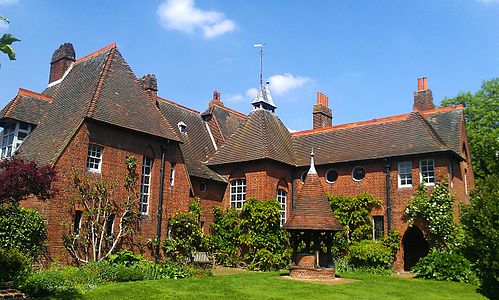
The Red House by William Morris and Philip Webb (1859)
-

Japanese woodblock print byUtagawa Kunisada (1850s)
-

The Peacock Room by James McNeil Whistler (1876–1877)
-

William Morris printed textile design (1883)
-
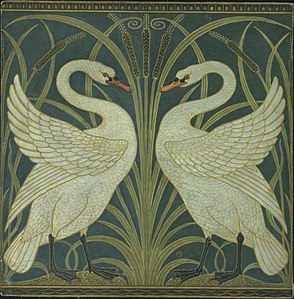
Swan, rush and iris wallpaper design by Walter Crane (1883)


The new art movement had its roots in Britain, in the floral designs of William Morris, and in the Arts and Crafts movementfounded by the pupils of Morris. Early prototypes of the style include the Red House of Morris (1859), and the lavishPeacock Room by James Abbott McNeill Whistler. The new movement was also strongly influenced by the Pre-Raphaelitepainters, including Dante Gabriel Rossetti and Edward Burne-Jones, and especially by British graphic artists of the 1880s, including Selwyn Image, Heywood Sumner, Walter Crane, Alfred Gilbert, and especially Aubrey Beardsley.[16]
In France, it was influenced by the architectural theorist and historian Eugène Viollet-le-Duc, a declared enemy of the historical Beaux-Arts architectural style. In his 1872 book Entretiens sur l'architecture, he wrote, "Use the means and knowledge given to us by our times, without the intervening traditions which are no longer viable today, and in that way we can inaugurate a new architecture. For each function its material; for each material its form and its ornament."[17] This book influenced a generation of architects, including Louis Sullivan, Victor Horta, Hector Guimard, and Antoni Gaudí.[18]
The French painters Maurice Denis, Pierre Bonnard and Édouard Vuillard played an important part in integrating fine arts painting with decoration. "I believe that before everything a painting must decorate", Denis wrote in 1891. "The choice of subjects or scenes is nothing. It is by the value of tones, the coloured surface and the harmony of lines that I can reach the spirit and wake up the emotions."[19] These painters all did both traditional painting and decorative painting on screens, in glass, and in other media.[20]
Another important influence on the new style was Japonism. This was a wave of enthusiasm for Japanese woodblock printing, particularly the works of Hiroshige, Hokusai, and Utagawa Kunisada, which were imported into Europe beginning in the 1870s. The enterprising Siegfried Bing founded a monthly journal, Le Japon artistique in 1888, and published thirty-six issues before it ended in 1891. It influenced both collectors and artists, including Gustav Klimt. The stylized features of Japanese prints appeared in Art Nouveau graphics, porcelain, jewellery, and furniture.
New technologies in printing and publishing allowed Art Nouveau to quickly reach a global audience. Art magazines, illustrated with photographs and colour lithographs, played an essential role in popularizing the new style. The Studio in England, Arts et idèes and Art et décoration in France, and Jugend in Germany allowed the style to spread rapidly to all corners of Europe. Aubrey Beardsley in England, and Eugène Grasset, Henri de Toulouse-Lautrec, and Félix Vallottonachieved international recognition as illustrators.[21] With the posters by Jules Cheret for dancer Loie Fuller in 1893, and byAlphonse Mucha for actress Sarah Bernhardt in 1895, the poster became not just advertising, but an art form. Sarah Bernhardt set aside large numbers of her posters for sale to collectors.[22]
Origins of Art Nouveau – Brussels (1893–1898)[edit]
-

Hankar House byPaul Hankar (1893)
-
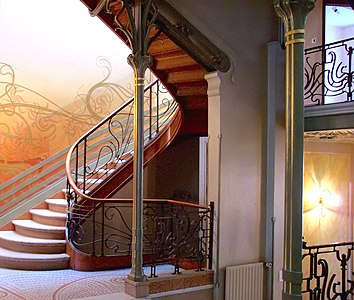
Stairway of Hôtel Tassel by Victor Horta (1892-1893)
-
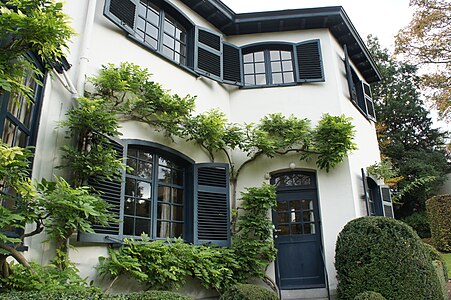
Bloemenwerf house in Brussels, by Henry Van de Velde(1895)
-

Bloemenwerf chair made by Henry Van de Velde for his residence (1895)
-

Poster for theInternational Exposition byHenri Privat-Livemont(1897)
_JPG01.jpg)
.JPG)


The first Art Nouveau houses, Hankar House by Paul Hankar (1893) and the Hôtel Tassel by Victor Horta (1892-1893),[23][24] appeared almost simultaneously in Brussels. Hankar was particularly inspired by the theories of the French architectEugène Viollet-le-Duc. With a goal to create a synthesis of fine arts and decorative arts, he brought Adolphe Crespin andAlbert Ciamberlani to decorate the interior and exterior with sgraffites, or murals. Hankar decorated stores, restaurants and galleries in what a local critic called "a veritable delirium of originality". He died in 1901 just as the movement was beginning to receive recognition.[25]
Victor Horta was among the most influential architects of the early Art Nouveau, and his Hôtel Tassel (1892-93) is one of the style's landmarks.[26] [27] Horta, an architect with classical training, designed the residence of a prominent Belgian chemist, Émile Tassel, on a very narrow and deep site. The central element of the house was the stairway, not enclosed by walls, decorated with a curling wrought-iron railing, and placed beneath a high skylight. The floors were supported by slender iron columns like the trunks of trees. The mosaic floors and walls were decorated with delicate arabesques in floral and vegetal forms, which became the most popular signature of Art Nouveau.[28] In a short period Horta built three more town houses in the new style; the Hôtel Solvay, Hôtel van Eetvelde, and Maison & Atelier Horta. All four are now UNESCO World Heritage Sites.
Henry Van de Velde, born in Antwerp, was another central figure in the birth of Art Nouveau. His architecture included his residence, Maison Bloemenwerf (1893-95) influenced by the Red House of work of William Morris. Van de Velde, like Horta, designed not just the house, but also the interior decoration. Trained as a painter, he became one of the first Art Nouveau designers, creating textiles, wallpaper, silverware, jewellery, and even clothing that matched the style of the residence. He was also an early theorist of the Art Nouveau style, demanding the use use of dynamic, often opposing lines. Van de Velde wrote: "A line is a force like all the other elementary forces. Several lines put together but opposed have a presence as strong as several forces". He found it difficult to compete with Victor Horta, and the two men disliked each other. Van de Velde moved to Germany, where he founded Grand-Ducal School of Arts and Crafts in Weimar and then played an important role in the German Werkbund.
The debut of Art Nouveau architecture in Brussels was accompanied by a wave of Decorative Art in the new style. Important artists included Gustave Strauven, who used wrought iron to achieve baroque effects on Brussels facades; the furniture designer Gustave Serrurier-Bovy, known for his highly original chairs and articulated metal furniture; and the jewellery designer Philippe Wolfers, who made jewellery in the form of dragonflies, butterflies, swans and serpents.[29]
The Brussels International Exposition held in 1897 brought international attention to the style; Horta, Hankar, Van de Velde, Serrurier-Bovy took part in the design of the fair, Henri Privat-Livemont created the poster for the exhibition.
The style was quickly noticed in neighbouring France. After visiting Horta's Hôtel Tassel, Hector Guimard built the Castel Béranger, among the first Paris buildings in the new style, between 1895 and 1898.[nb 1] Parisians had been complaining of the monotony of the architecture of the boulevards built under Napoleon III by Georges-Eugène Haussmann. They welcomed Guimard's colourful and picturesque style; the Castel Béranger was chosen as one of the best new façades in Paris, launching Guimard's career. Guimard was given the commission to design the entrances for the new Paris Métrosystem, which brought the style to the attention of the millions of visitors to the city's 1900 Exposition Universelle.[13]
Paris - Maison de l'Art Nouveau (1895)
-
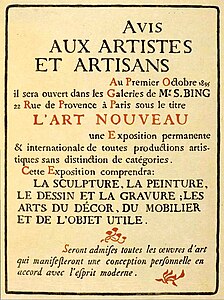
Siegfried Bing invited artists to show modern works in his new Maison de l'Art Nouveau (1895).
-

The Maison de l'Art Nouveau gallery of Siegfried Bing (1895)
-
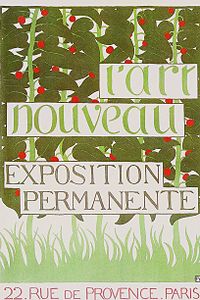
Poster by Félix Vallottonfor the new Maison de l'Art Nouveau (1896)
-

Gateway of the Castel Béranger byHector Guimard (1895–1898)


The Franco-German art dealer and publisher Siegfried Bing played a key role in publicizing the style. In 1891, he founded a magazine devoted to the art of Japan, which helped publicize Japonism in Europe. In 1892, he organized an exhibit of seven artists, among them Pierre Bonnard, Félix Vallotton, Édouard Vuillard, Toulouse-Lautrec and Eugène Grasset, which included both modern painting and decorative work. This exhibition was shown at the Société nationale des beaux-arts in 1895. In the same year, Bing opened a new gallery at 22 rue de Provence in Paris, the Maison de l'Art Nouveau, devoted to new works in both the fine and decorative arts. The interior and furniture of the gallery were designed by the Belgian architect Henry Van de Velde, one of the pioneers of Art Nouveau architecture. The Maison de l'Art Nouveau showed paintings by Georges Seurat, Paul Signac and Toulouse-Lautrec, glass from Louis Comfort Tiffany and Emile Gallé, jewellery by René Lalique, and posters by Aubrey Beardsley. The works shown there were not at all uniform in style. Bing wrote in 1902, "Art Nouveau, at the time of its creation, did not aspire in any way to have the honor of becoming a generic term. It was simply the name of a house opened as a rallying point for all the young and ardent artists impatient to show the modernity of their tendencies."[31]
Paris Exposition Universelle (1900)[edit]
-
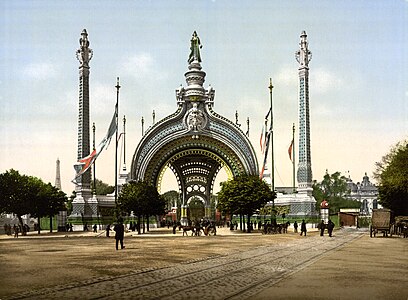
Main entrance to the Paris 1900 Exposition Universelle
-

The Bigot Pavilion, showcasing the work of ceramics artist Alexandre Bigot
-
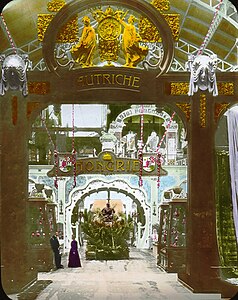
Entrance to the Austrian exhibit
-
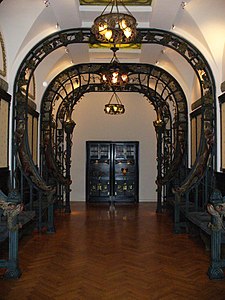
The German Pavilion byBruno Möhring
-

Paris metro station entrance at Abbessesdesigned by Hector Guimard for the 1900Exposition universelle


The Paris 1900 Exposition universelle marked the high point of Art Nouveau. Between April and November 1900, it attracted nearly fifty million visitors from around the world, and showcased the architecture, design, glassware, furniture and decorative objects of the style. The architecture of the Exposition was often a mixture of Art Nouveau and Beaux-Arts architecture: the main exhibit hall, the Grand Palais had a Beaux-Arts façade completely unrelated to the spectacular Art Nouveau stairway and exhibit hall in the interior.
French designers all made special works for the Exhibition: Lalique crystal and jewellery; jewellery by Henri Vever andGeorges Fouquet; Daum glass; the Manufacture nationale de Sèvres in porcelain; ceramics by Alexandre Bigot; sculpted glass lamps and vases by Emile Gallé; furniture by Édouard Colonna and Louis Majorelle; and many other prominent arts and crafts firms. At the 1900 Paris Exposition, Siegfried Bing presented a pavilion called Art Nouveau Bing, which featured six different interiors entirely decorated in the Style.[32][33]
The Exposition was the first international showcase for Art Nouveau designers and artists from across Europe and beyond. Prize winners and participants included Alphonse Mucha, who decorated the pavilion of Bosnia-Herzegovina; the decorators and designers Bruno Paul and Bruno Möhring from Berlin; Carlo Bugatti from Turin; Bernhardt Pankok from Bavaria; andLouis Comfort Tiffany and Company from the United States.[34] The Viennese architect Otto Wagner was a member of the jury, and presented a model of the Art Nouveau bathroom of his own town apartment in Vienna, featuring a glass bathtub.[35]
While the Paris Exposition was by far the largest, other expositions did much to popularize the style. The 1888 Barcelona Universal Exposition marked the beginning of the Modernisme style in Spain, with some buildings of Lluís Domènech i Montaner. The Esposizione internazionale d'arte decorativa moderna of 1902 in Turin, Italy, showcased designers from across Europe.
Local variations[edit]
Art Nouveau in France[edit]
-

Le Train bleu at the Gare de Lyon (1900)
-
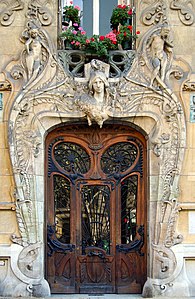
Doorway of theLavirotte Building byJules Lavirotte, 29 avenue Rapp, Paris (1901)
-

Cupola of the headquarters of Société générale at 29 boulevard Haussmann, byJacques Hermant(1905–11)
-

Poster by Theophile-Alexandre Steinlen for the cabaret Le Chat noir (1896)
-

The Villa Majorelle in Nancy by Henri Sauvage (1901–02)
-
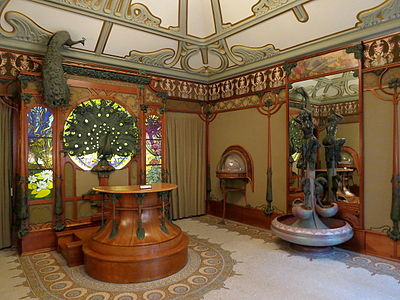
The jewellery shop of Georges Fouquet at 6 rue Royale, Paris, designed by Alphonse Mucha, now in the Carnavalet Museum(1901)


_-_Google_Art_Project.jpg)


Following the 1900 Exposition, the capital of Art Nouveau was Paris. The most extravagant residences in the style were built by Jules Lavirotte, who entirely covered the façades with ceramic sculptural decoration. The most flamboyant example is theLavirotte Building, at 29 avenue Rapp (1901). Office buildings and department stores featured high courtyards covered with stained glass cupolas and ceramic decoration. The style was particularly popular in restaurants and cafés, including Maxim'sat 3 rue Royale, and Le Train bleu at the Gare de Lyon (1900).[36]
The status of Paris attracted foreign artists to the city. The Swiss-born artist Eugène Grasset was one of the first creators of French Art Nouveau posters. He helped decorate the famous cabaret Le Chat noir in 1885, made his first posters for theFêtes de Paris and a celebrated poster of Sarah Bernhardt in 1890. In Paris, he taught at the Guérin school of art (École normale d'enseignement du dessin), where his students included Augusto Giacometti and Paul Berthon.[37][38] Swiss-bornTheophile-Alexandre Steinlen created the famous poster for the Paris cabaret Le Chat noir in 1896. The Czech artistAlphonse Mucha (1860–1939) arrived in Paris in 1888, and in 1895 made a poster for actress Sarah Bernhardt in the playGismonda by Victorien Sardou in Théâtre de la Renaissance. The success of this poster led to a contract to produce posters for six more plays by Bernhardt.
The city of Nancy in Lorraine became the other French capital of the new style. In 1901, the Alliance provinciale des industries d'art, also known as the École de Nancy, was founded, dedicated to upsetting the hierarchy that put painting and sculpture above the decorative arts. The major artists working there included the glass vase and lamp creators Emile Gallé, the Daum brothers in glass design, and the designer Louis Majorelle, who created furniture with graceful floral and vegetal forms. The architect Henri Sauvage brought the new architectural style to Nancy with his Villa Majorelle in 1902.
The French style was widely propagated by new magazines, including The Studio, Arts et Idées and Art et Décoration, whose photographs and colour lithographs made the style known to designers and wealthy clients around the world.
In France, the style reached its summit in 1900, and thereafter slipped rapidly out of fashion, virtually disappearing from France by 1905. Art Nouveau was a luxury style, which required expert and highly-paid craftsmen, and could not be easily or cheaply mass-produced. One of the few Art Nouveau products that could be mass produced was the perfume bottle, and these are still manufactured in the style today.
Art Nouveau in Belgium and the Netherlands
-

The house of architect Paul Cauchie (1905) featuring sgraffito, Etterbeek (Bruxelles)
-
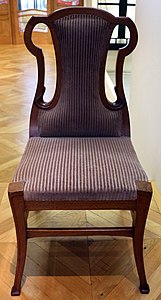
Chair by Henry Van De Velde (1896)
-

Bed and mirror by Gustave Serrurier-Bovy (1898–99), now in the Musée d'Orsay, Paris
-

Philippe Wolfers, Plume de Paon, (Collection King Baudouin Foundation, depot: KMKG-MRAH)
-


.jpg)
Belgium was an early centre of the Art Nouveau, thanks largely to the architecture of Victor Horta, who designed one of the first[nb 2] Art Nouveau houses, the Hôtel Tassel in 1894[7]. Horta met and had a strong influence on the work of the youngHector Guimard and Gustave Strauven who was Horta's disciple and started his own practice at 21. Important artists included another Art Nouveau pioneer architect Paul Hankar and Adolphe Crespin whose sgraffiti are at many Hankar's buildings; the architect and furniture designer Henry Van De Velde, the decorator Gustave Serrurier-Bovy, and the graphic artist Fernand Khnopff.[39][40][41] Belgian designers took advantage of an abundant supply of ivory imported from the Belgian Congo; mixed sculptures, combining stone, metal and ivory, by such artists as Philippe Wolfers, was popular.[42]
In the Netherlands, the style was known as the Nieuwe Kunst (the "New Art" in Dutch). Prominent building include American Hotel (1898-1900), Beurs van Berlage (1896-1903) by Hendrik Petrus Berlage, and Astoria (1904-1905) by Herman Hendrik Baanders and Gerrit van Arkel in Amsterdam; the railway station in Haarlem (1906-1908), the office building of the Holland America Lines (1917) in Rotterdam. Artists of the style included Carel Adolph Lion Cachet, Theo Nieuwenhuis and Gerrit Willem Dijsselhof, who designed in a more picturesque and decorative style. Furniture design was influenced by the importation of exotic woods from the Dutch East Indies (modern Indonesia), while textiles were influenced by the designs and techniques of batik.[42]
Modern Style and Glasgow School in Britain
-
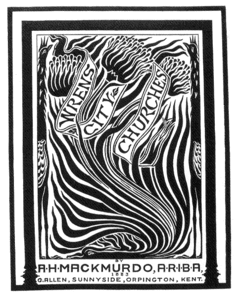
Cover design by Arthur Mackmurdo for a book onChristopher Wren (1883)
-

Willow Tearooms by Charles Rennie Mackintosh, in Kelvingrove, Glasgow (1903)
-
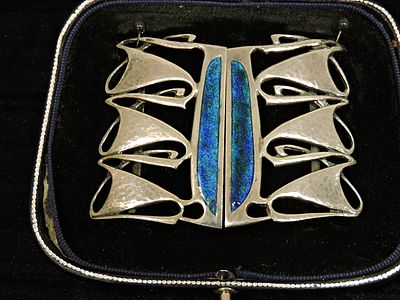
Belt buckle by Archibald Knox for Liberty Department Store
-

Embroidered panels by Margaret Macdonald Mackintosh (1902)


Art Nouveau had its roots in Britain, in the arts and crafts movement of the 1880s, which called for a closer union between the fine arts and decorative arts, and a break away from historical styles to designs inspired by function and nature. One notable early example is Arthur Mackmurdo's design for the cover of his essay on the city churches of Sir Christopher Wren, published in 1883.
Other important innovators in Britain included the graphic designers Aubrey Beardsley whose drawings featured the curved lines that became the most recognizable feature of the style. free-flowing wrought iron from the 1880s could also be adduced, or some flat floral textile designs, most of which owed some impetus to patterns of 19th century design. Other British graphic artists who had an important place in the style included Walter Crane and Charles Ashbee.[43]
The Liberty department store in London played an important role, through its colourful stylized floral designs for textiles, and the silver, pewter, and jewellery designs of Manxman (of Scottish descent) Archibald Knox. His jewellery designs in materials and forms broke away entirely from the historical traditions of jewellery design.
For Art Nouveau architecture and furniture design, the most important centre in Britain was Glasgow, with the creations ofCharles Rennie Mackintosh and the Glasgow School, whose work was inspired by the French Art Nouveau, Japanese art, symbolism and Gothic revival. Beginning in 1895, Mackintosh displayed his designs at international expositions in London, Vienna, and Turin; his designs particularly influenced the Secession Style in Vienna. His architectural creations included the Glasgow Herald Building (1894) and the library of the Glasgow School of Art (1897). He also established a major reputation as a furniture designer and decorator, working closely with his wife, Margaret Macdonald Mackintosh, a prominent painter and designer. Together they created striking designs that combined geometric straight lines with gently curving floral decoration, particularly a famous symbol of the style, the Glasgow Rose".[44]
Léon-Victor Solon, made an important contribution to Art Nouveau ceramics as art director at Mintons. He specialised in plaques and in tube-lined vases marketed as "secessionist ware" (usually described as named after the Viennese art movement).[45] Apart from ceramics, he designed textiles for the Leek silk industry[46] and doublures for a bookbinder (G.T.Bagguley of Newcastle under Lyme), who patented the Sutherland binding in 1895.
The Edward Everard building in Bristol, built during 1900–01 to house the printing works of Edward Everard, features an Art Nouveau façade. The figures depicted are of Johannes Gutenberg and William Morris, both eminent in the field of printing. A winged figure symbolises the "Spirit of Light", while a figure holding a lamp and mirror symbolises light and truth.
Jugendstil in Germany
-
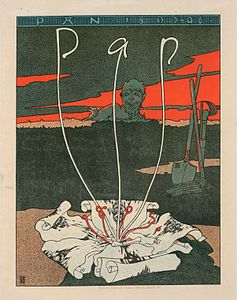
Cover of Pan magazine byJoseph Sattler (1895)
-

Cover of Jugend by Otto Eckmann (1896)
-

Tapestry The Five Swans byOtto Eckmann(1896–97)
-

Poster of theMunich Secession byFranz Stuck(1898-1900)
-
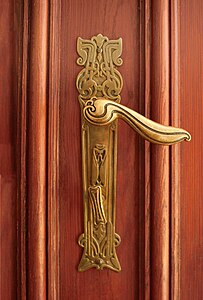
Jugendstil door handle in Berlin (circa 1900)
-

Chair by Richard Riemerschmid (1902)
-

Stoneware jug by Richard Riemerschmid (1902)


German Art Nouveau is commonly known by its German name, Jugendstil. The name is taken from the artistic journal, Die Jugend, which was published in Munich and espoused the new artistic movement. It was founded in 1896 by Georg Hirth(Hirth remained editor until his death in 1916, and the magazine survived until 1940). The magazine was instrumental in promoting the style in Germany. As a result, its name was adopted as the most common German-language term for the style: Jugendstil ("youth style"). Although, during the early 20th century, the word was applied to only two-dimensional examples of the graphic arts,[47] especially the forms of organic typography and graphic design found in and influenced by German magazines like Jugend, Pan, and Simplicissimus, it is now applied to more general manifestations of Art Nouveau visual arts in Germany, the Netherlands, the Baltic states, and Nordic countries.[11][48]
Earlier in 1892 Georg Hirth coined the word "secession" that the Association of Visual Artists of Munich used in their new name: Munich Secession. Along with better-known Vienna Secession, Berlin Secession group was also found in 1898.
Along with Jugend, two other journals, Simplicissimus, published in Munich, and Pan, published in Berlin, proved important proponents of the Jugendstil. The magazines were important for spreading the visual idiom of Jugendstil, especially the graphical qualities. Jugendstil art includes a variety of different methods, applied by the various individual artists and features the use of hard lines as well as sinuous curves. Methods range from classic to romantic. One feature of Jugendstil is the typography used, the letter and image combination of which is unmistakable. The combination was used for covers of novels, advertisements, and exhibition posters. Designers often used unique display typefaces that worked harmoniously with the image.
One of the most famous German artists associated with both Die Jugend and Pan was Otto Eckmann. His favourite animal was the swan, and such was his influence in the German movement that the swan came to serve as the leitmotif for the Jugendstil. Another prominent designer in the style was Richard Riemerschmid, who made furniture, pottery, and other decorative objects in a sober, geometric style that pointed forward toward Art Deco.[49]
The characterizing motif of whiplash (coup de fouet) curves was presented by Hermann Obrist in his embroidered wall hanging called "Cyclamen" in 1892.
-

Ernst Ludwig House by Joseph Maria Olbrich (1900) now hosting Darmstadt Colony Museum
-
Wedding tower in Darmstadt Artists’ Colony (1908)
-

Spa complex Sprudelhof in Bad Nauheim (1905-1911)
-

Mexikoplatz station in Berlin (1902-1904)
-

Hackesche Höfe inBerlin (1906)


_1.jpg)
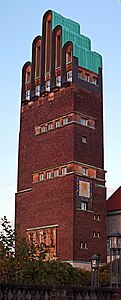
The Darmstadt Artists’ Colony was founded in 1899 by Ernest Ludwig, Grand Duke of Hesse. The architect who built Grand Duke's house, as well as the largest structure of the colony (Wedding tower), was Joseph Maria Olbrich, one of the Vienna Secession founders. Other notable artists of the colony were Peter Behrens and Hans Christiansen. Ernest Ludwig also commissioned to rebuild Bad Nauheim spa complex at the beginning of XX century. A completely new Sprudelhof complex was constructed in 1905-1911 under the inspection of Wilhelm Jost and attained one of the main objectives of Jugendstil: a synthesis of all the arts [50]. Another member of the reigning family who commissioned an Art Nouveau structure was Princess Elisabeth of Hesse and by Rhine. She founded Marfo-Mariinsky Convent in Moscow in 1908 and its katholikon is recognized as an Art Nouveau masterpiece.[51]
In Berlin Jugendstil was chosen for the construction of several railway stations. The most notable [52] is Bülowstraße byBruno Möhring (1900-1902), other examples are Mexikoplatz (1902-1904), Botanischer Garten (1908-1909), Frohnau(1908-1910), Wittenbergplatz (1911-1913) and Pankow (1912-1914) stations. Another notable structure of Berlin isHackesche Höfe (1906) distinctive by use of polychrome glazed brick for courtyard facade.
Vienna Secession in Austria
-

The Secession Hall in Vienna by Joseph Maria Olbrich (1897)
-

Vampire in Ver Sacrum #12 (1899) p.8 by Ernst Stöhr
-
Woman in a Yellow Dress by Max Kurzweil (1899)
-

Armchair by Koloman Moser
-

The Kiss by Gustav Klimt (1907–08)


_LACMA_M.2000.180.39_(2_of_2).jpg)

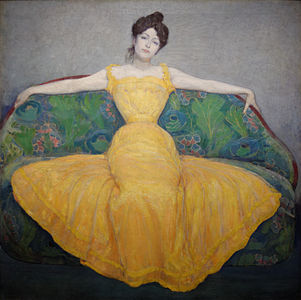
Vienna became the centre of a distinct variant of Art Nouveau, which became known as the Vienna Secession, an art movement that derived its name from Munich Secession established in 1892. Vienna Secession was founded in April 1897 by a group of artists that included Gustav Klimt, Koloman Moser, Josef Hoffmann, Joseph Maria Olbrich, Max Kurzweil, Ernst Stöhr, and others. The painter Klimt became the president of the group. They objected to the conservative orientation toward historicism expressed by Vienna Künstlerhaus, the official union of artists. The Secession founded a magazine, Ver Sacrum, to promote their works in all media. The Secession style was notably more feminine, less heavy and less nationalist than the Jugendstil in neighbouring Germany.[53] The architect Joseph Olbrich designed the domed Secession building in the new style, which became a showcase for the paintings of Gustav Klimt and other Secession artists.
Klimt became the best-known of the Secession painters, often erasing the border between fine art painting and decorative painting. Koloman Moser was an extremely versatile artist in the style; his work including magazine illustrations, architecture, silverware, ceramics, porcelain, textiles, stained glass windows, and furniture.
-
Detail of Majolica House by Otto Wagner (1898)
-

Karlsplatz Stadtbahn Station by Otto Wagner (1899)
-

Stained glass by Koloman Moser in Kirche am Steinhof(1904-1907)
-

The Palais Stoclet in Brussels by Josef Hoffmann (1905–1911)


.jpg)

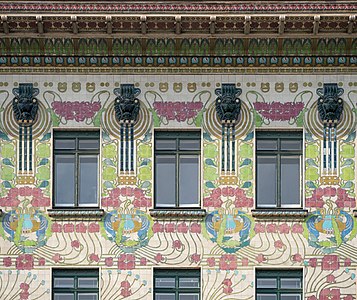
The most prominent architect of the Vienna Secession was Otto Wagner[54], he joined the movement soon after its inception to follow his students Hoffmann and Olbrich. His major projects included stations of the urban rail network (the Stadtbahn), the complex at Linke Wienzeile (consisting of Majolica House, the House of Medallions and the house at Köstlergasse), and the Steinhof Psychiatric Hospital, now called by his name. The stations now serve as exhibition halls of the Vienna Museum, and the largest structure of the Steinhof Psychiatric hospital is Kirche am Steinhof (1904-1907).
In 1899 Joseph Maria Olbrich moved to Darmstadt Artists' Colony, in 1903 Koloman Moser and Josef Hoffmann founded theWiener Werkstätte, a training school and workshop for designers and craftsmen of furniture, carpets, textiles and decorative objects.[55] Another notable collaboration of Vienna Secession founding members Gustav Klimt and Josef Hoffmann is theStoclet Palace in Brussels (1905-1911) that was designated as a World Heritage Site by UNESCO in June 2009.[56]
Szecesszió in the Kingdom of Hungar]
-

Museum of Applied Arts in Budapest by Ödön Lechner (1893-1896)
-

Subotica Synagogue, present-day Serbia by Marcell Komorand Dezső Jakab (1902)[57]
-

Reök Palace in Szeged by Ede Magyar (1907)
-

Australia house in Budapest Zoo by Károly Kós and Dezső Zrumeczky(1909-1912)
.jpg)


The pioneer and prophet of the Szecesszió (Secession in Hungarian), the architect Ödön Lechner created masterpieces that signified a transition from historicism to modernism for Hungarian architecture.[58] His idea for a Hungarian architectural style was the use of architectural ceramics and oriental motifs. In his works, he used pygorganite placed in production by 1886 by Zsolnay Porcelain Manufactory.[58] This material was used in the construction of notable Hungarian buildings of other styles, e.g. Hungarian Parliament Building and Matthias Church.
Works by Ödön Lechner[59] include the Museum of Applied Arts (1893-1896), other building with similar distinctive features are Geological Museum (1896-1899) and The Postal Savings Bank building (1899-1902), all in Budapest. However, due to the opposition of Hungarian architectural establishment to Lechner's success, he soon was unable to get new commissions comparable to his earlier buildings.[58] But Lechner was an inspiration and a master to the following generation of architects who played the main role in popularising the new style.[58] Within the process of Magyarization numerous buildings were commissioned to his disciples in outskirts of the kingdom: e.g. Marcell Komor and Dezső Jakab were commissioned to build the Synagogue (1901–1903) and Town Hall (1908-1910) in Szabadka (now Subotica, Serbia), County Prefecture (1905-1907) and Palace of Culture (1911-1913) in Marosvásárhely (now Târgu Mureș, Romania). Later Lechner himself built the Blue Church in Pozsony (present-day Bratislava, Slovakia) in 1909-1913.
Another important architect was Károly Kós who was a follower of John Ruskin and William Morris. Kós took the FinnishNational Romanticism movement as a model and the Transylvanian vernacular as the inspiration.[60] His most notable buildings include the Roman Catholic Church in Zebegény (1908-09), pavilions for the Budapest Municipal Zoo (1909-1912) and the Székely National Museum in Sepsiszentgyörgy (now Sfântu Gheorghe, Romania, 1911-12).
-

Paintings in the church in Zebegény (1908-09) by Aladár Körösfői-Kriesch
-

Stained glass bySándor Nagy
-

Mosaic by Miksa Róth at Török Bank building inBudapest (1906)
-

Relief at the facade of Gresham Palace byGéza Maróti in Budapest (1906)
-

Cabinet by Ödön Faragó, from Budapest (1901)


The movement that promoted Szecesszió in arts was Gödöllő Art Colony, founded by Aladár Körösfői-Kriesch, also a followerJohn Ruskin and William Morris and a professor at the Royal School of Applied Arts in Budapest in 1901.[61] Its artists took part in many projects: painted Franz Liszt Academy of Music, the Church in Zebegény (1908-09), created stained glass and mosaics for Palace of Culture (1911-1913) in Marosvásárhely (now Târgu Mureș, Romania).[62]
An associate to Gödöllő Art Colony,[63] Miksa Róth was also involved in several dozens of Szecesszió projects, including Budapest masterpieces like Gresham Palace (stained glass, 1907) and Török Bank (mosaics, 1906) and also created mosaics and stained glass for Palace of Culture (1911-1913) in Marosvásárhely.
A notable furniture designer is Ödön Faragó who combined traditional popular architecture, oriental architecture and international Art Nouveau in a highly picturesque style. Pál Horti, another Hungarian designer, had a much more sober and functional style, made of oak with delicate traceries of ebony and brass.
Secession in the Austrian Empire (Cisleithania)[edit]
-

-

Frescoes of Municipal House in Prague by Alphonse Mucha
-

Ceramic relief of Viola Theater inPrague by Ladislav Šaloun
-
.jpg)
_ceiling,_Prague_-_8906.jpg)


The most prolific Slovenian Art Nouveau architect was Ciril Metod Koch.[64] He studied at Otto Wagner's classes in Vienna and worked in the Laybach (now Ljubljana, Slovenia) City Council from 1894 to 1923. After the earthquake in Laybach in 1895, he designed many secular buildings in Secession style that he adopted from 1900 to 1910:[64] Pogačnik House (1901), Čuden Building (1901), The Farmers Loan Bank (1906–07), renovated Hauptmann Building in Secession style in 1904. The highlight of his career was the Loan Bank in Radmannsdorf (now Radovljica) in 1906.[64]
The most notable Secession buildings in Prague are examples of total art with distinctive architecture, sculpture and paintings.[65] The main railway station (1901-1909) was designed by Josef Fanta and features paintings of Václav Jansa and sculptures of Ladislav Šaloun and Stanislav Sucharda along with other artists. The Municipal House (1904-1912) was designed by Osvald Polívka and Antonín Balšánek, painted by famous Czech painter Alphonse Mucha and features sculptures of Josef Mařatka and Ladislav Šaloun. Polívka, Mařatka, and Šaloun simultaneously cooperated in the construction of New City Hall (1908-1911) along with Stanislav Sucharda, and Mucha later painted St. Vitus Cathedral's stained glass windows in his distinctive style.
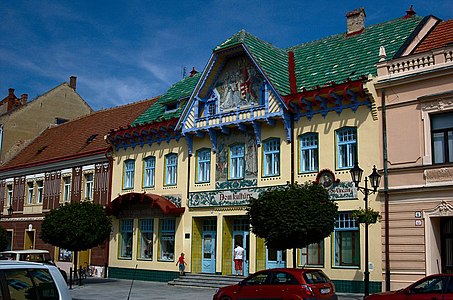
The style of combining Hungarian Szecesszió and national architectural elements was typical for a Slovak architect Dušan Jurkovič . His most original works are the Cultural House in Szakolca (now Skalica in Slovakia, 1905), buildings of spa inLuhačovice (now Czech Republic) in 1901–1903, and 35 war cemeteries near Nowy Żmigród in Galicia (now Poland), most of them heavily influenced by local Lemko (Rusyn) folk art and carpentry (1915–1917).
Stile Liberty in Italy[edit]
-

Floral vase byGalileo Chini(1896–98)
-

Carlo Bugatti, Cobra Chair and Desk (1902),Brooklyn Museum
-

Interior of Casa Fenoglio-Lafleur by Pietro Fenoglio in Turin (1902)
-

The portal of Casa Campanini by Alfredo Campanini in Milan(1903-1906)
-

Tea and coffee service with salver and stand, by Carlo Bugatti (1907)
-

Primaverapanel byGalileo Chini(1914)


Italy's Stile Liberty took its name from the London department store Liberty, the colourful textiles of which were particularly popular in Italy. Notable Italian designers included Galileo Chini, whose ceramics were inspired both by majolica patterns and by Art Nouveau. He was later known as a painter and a scenic designer; he designed the sets for two Puccini operas Gianni Schicchi and Turandot.
Examples of the Stile Liberty include the Teatro Massimo by Ernesto Basile in Palermo (1897), combining Art Nouveau and classical elements, Casa Fenoglio-Lafleur (1902) by Pietro Fenoglio in Turin; Palazzo Castiglioni (1901-3)[66] by Giuseppe Sommaruga, Casa Campanini (1903-1906) by Alfredo Campanini, and Casa Guazzoni (1904-6) by Giovanni Battista Bossi (all in Milan).
The most important figure in Italian Art Nouveau furniture design was Carlo Bugatti, the son of an architect and decorator, father of Rembrandt Bugatti, Liberty sculptor, and of Ettore Bugatti, famous automobile designer. He studied at the Milanese Academy of Brera, and later the Académie des Beaux-Arts in Paris. His work was distinguished by its exoticism and eccentricity, included silverware, textiles, ceramics, and musical instruments, but he is best remembered for his innovative furniture designs, shown first in the 1888 Milan Fine Arts Fair. His furniture often featured a keyhole design, and had unusual coverings, including parchment and silk, and inlays of bone and ivory. It also sometimes had surprising organic shapes, copied after snails and cobras.[67]
Modernisme in Catalonia[edit]
-

Sagrada Família basilica in Barcelona by Antoni Gaudí (1883–)
-

Trencadís facade of Casa Batlló by Antoni Gaudíand Josep Maria Jujol(1904–06)
-
-

Hospital de Sant Pauby Lluis Domenech i Montaner (1901–30)
-

Casa de les Punxes by Josep Puig i Cadafalch(1905)


_Pavell%C3%B3_de_Sant_Rafael-RalfR-DSCF0580.jpg)

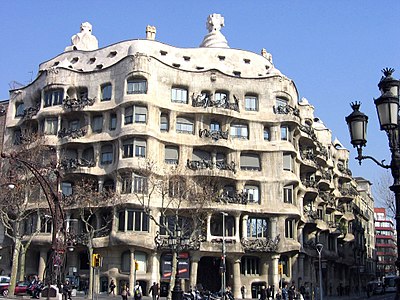
A highly original variant of the style appeared in Barcelona, Catalonia. It is called Modernisme in Catalan and Modernismo in Spanish. Its most famous creator was Antoni Gaudí, who used Art Nouveau's floral and organic forms in a very novel way inPalau Güell (1886-1890).[69][70][71] He considered every detail of his creations and integrated into his architecture such crafts as ceramics, stained glass, wrought ironwork forging and carpentry. His work on Güell Pavilions (1884-1887) and thenParc Güell (1900–1914) revealed a new technique in the treatment of materials called trencadís, which used waste ceramic pieces. His designs from about 1903, the Casa Batlló (1904–1906) and Casa Milà (1906–1912)[68], are most closely related to the stylistic elements of Art Nouveau.[72] However, famous structures such as the Sagrada Família characteristically contrast the modernising Art Nouveau tendencies with revivalist Neo-Gothic.[72] Casa Batlló, Casa Milà, Güell Pavilions, andParc Güell were results of his collaboration with Josep Maria Jujol, who himself created houses in Sant Joan Despí (1913–1926), several churches near Tarragona (1918 and 1926) and the sinuous Casa Planells (1924) in Barcelona.
Besides the dominating presence of Gaudí, Lluís Domènech i Montaner also used Art Nouveau in Barcelona in buildings such as the Castell dels Tres Dragons (1888), Casa Lleó Morera, Palau de la Música Catalana (1905) and Hospital de Sant Pau (1901-1930).[72] The two latter buildings have been listed by UNESCO as World Cultural Heritage.[73]
Another major modernista was Josep Puig i Cadafalch, who designed the Casa Martí and its Els Quatre Gats café, the Casimir Casaramona textile factory (now the CaixaFòrum art museum), Casa Macaya, Casa Amatller, the Palau del Baró de Quadras (housing Casa Àsia for 10 years until 2013) and the Casa de les Punxes ("House of Spikes").
-

Ramon Casas and Pere Romeu on a Tandem by Ramon Casas (1897)
-

Sculpture of polychrome terracota by Lambert Escaler
-

Lowboy by Antoni Gaudí(1889)
-

Stained glass ceiling of Palau de la Música Catalana by Antoni Rigalt (1905-1908)
-
Furniture by Gaspar Homar


The Modernisme movement left a wide art heritage including drawings, paintings, sculptures, glass and metal work, mosaics, ceramics, and furniture. A part of it can be found in Museu Nacional d'Art de Catalunya.
Inspired by a Paris café called Le Chat Noir, where he had previously worked, Pere Romeu i Borràs decided to open a café in Barcelona that was named Els Quatre Gats (Four Cats in Catalan).[74] The café became a central meeting point for Barcelona’s most prominent figures of Modernisme, such as Pablo Picasso and Ramon Casas i Carbó who helped to promote the movement by his posters and postcards. For the café he created a picture called Ramon Casas and Pere Romeu on a Tandem that was replaced with his another composition entitled Ramon Casas and Pere Romeu in an Automobile in 1901, symbolizing the new century.
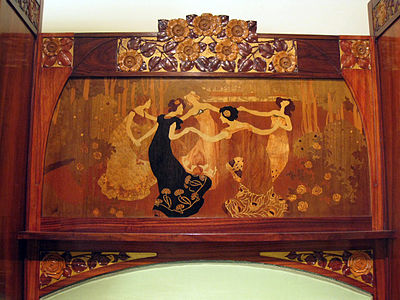
Antoni Gaudí himself designed furniture for many houses he built, e.g. Confidant from the Batlló House. He influenced another notable Catalan furniture designer Gaspar Homar (1870–1953) who often combined marquetry and mosaics with his furnishings.[75]
Arte Nova in Portugal[edit]
-

Facade of Major Pessoa Residence in Aveiro (1907-1909)
-

Atrium of Major Pessoa Residence
-

Tile of Cooperativa Agrícola inAveiro (1913)
-

Museum-Residence Dr. Anastácio Gonçalves inLisbon (1904-1905)
-

The Livraria Lellobookstore in Porto, Portugal (1906)


.jpg)

The concept defining Art Nouveau variation of Aveiro (Portugal) called Arte Nova was ostentation: the style was brought by a conservative bourgeoisie who wanted to express their might by decorative façades leaving interiors conservative.[76] Another distinctive feature of Arte Nova was using locally produced tiles with Art Nouveau motifs.[76]
The most influential artist of Arte Nova is Francisco Augusto da Silva Rocha.[76] He designed many building both in Aveiro and in other cities in Portugal,[77] while actually not being an architect (it was common for Aveiro that time).[76] One of them has both an exterior and interior of Art Nouveau and now hosts the Museum of Arte Nova - it is the Major Pessoa Residence. Another notable example is the Former Cooperativa Agrícola featuring hand-painted tiles. There are some Art Nouveau sculptures at the Central cemetery of Aveiro as well.[76]
There most notable examples of Arte Nova in other cities of Portugal[78][79] are the Museum-Residence Dr. Anastácio Gonçalves by Manuel Joaquim Norte Júnior(1904-1905) in Lisbon, Café Majestic by João Queiroz (1921) andLivraria Lello bookstore by Xavier Esteves(1906), both in Porto.
Jugendstil in the Nordic Countries[edit]
Finland[edit]
-

Main entrance of the Pohjola Insurance building (1899–1901), sculptures by Hilda Flodin
-

By the River of Tuonela (1903) by Akseli Gallen-Kallela
-

Tampere Cathedral (1902-1907) by Lars Sonck
-

Chair by Eliel Saarinen (1907–1908)
-

Statues at Helsinki Central railway station by Emil Wikström
.jpg)


Art Nouveau was popular in the Nordic countries, where it was usually known as Jugendstil, and was often combined with theNational Romantic Style of each country. The Nordic country with the largest number of Jugendstil buildings is the Grand Duchy of Finland, then a part of Russian Empire.[80] The Jugendstil period coincided with Golden Age of Finnish Art and national awakening. After Paris Exposition in 1900 the leading Finnish artist was Akseli Gallen-Kallela.[81] He is known for his illustrations of the Kalevala, the Finnish national epic, as well as for painting numerous Judendstil buildings in the Duchy.
The architects of the Finnish pavilion at the Exposition were Herman Gesellius, Armas Lindgren, and Eliel Saarinen. They worked together from 1896 to 1905 and created many notable buildings in Helsinki including Pohjola Insurance building(1899–1901) and National Museum of Finland (1905–1910)[82] as well as their joint residence Hvitträsk in Kirkkonummi(1902). Architects were inspired by Nordic legends and nature, rough granite façade thus became a symbol for belonging to the Finnish nation.[83] After the firm dissolved, Saarinen designed the Helsinki Railway Station (1905–1914) in clearer forms, influenced by American architecture.[83] The sculptor who worked with Saarinen in construction of National Museum of Finland and Helsinki Railway Station was Emil Wikström.
Another architect who created several masterpieces in Finland was Lars Sonck. His major Jugendstil works include Tampere Cathedral (1902-1907), Ainola, the home of Jean Sibelius (1903), Headquarters of the Helsinki Telephone Association (1903-1907) and Kallio Church in Helsinki (1908-1912).
Norway[edit]
-
Graphic design by Gerhard Munthe(1914)
-
Viking-Art Nouveau Chair by Norwegian designer Lars Kinsarvik (1900)
-
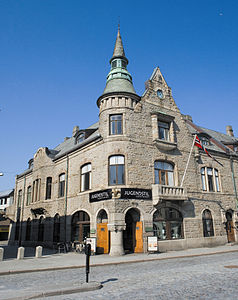
Art Nouveau Centre in Ålesund (1905-1907)
-
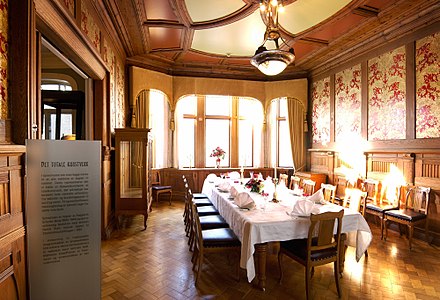
Interior of Art Nouveau Centre in Ålesund
-

Ornaments of a door in Art Nouveau Centre in Ålesund


.jpg)
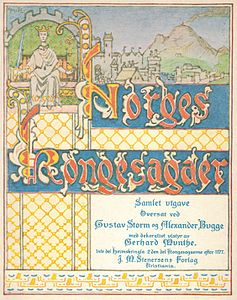
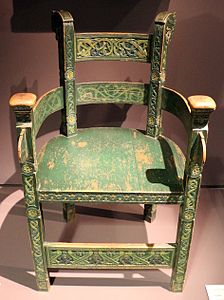
Norway also was aspiring independence (from Sweden) and local Art Nouveau was connected with a revival inspired byViking folk art and crafts. Notable designers included Lars Kisarvik, who designed chairs with traditional Viking and Celticpatterns, and Gerhard Munthe, who designed a chair with a stylized dragon-head emblem from ancient Viking ships, as well as a wide variety of posters, paintings and graphics.[84]
The Norwegian town of Ålesund is regarded as the main centre of Art Nouveau in Scandinavia because it was completely reconstructed after a fire of 23 January 1904.[85] 350 buildings were built between 1904 and 1907 under an urban plan designed by the engineer Frederik Næsser. The merger of unity and variety gave birth to a style known as Ål Stil. Buildings of the style have linear decor and echoes of both Jugendstil and vernacular elements, e.g. towers of stave churches or the crested roofs.[85] One of the buildings, Swan Pharmacy, now hosts the Art Nouveau Centre.
Sweden and Denmark[edit]
-

City Library of Aarhus by Hack Kampmann (1898-1901)
-

The Great Hall of City Library of Aarhus by Karl Hansen Reistrup
-

Altar ofEngelbrektskyrkan inStockholm (1914)
-

Sculptures at the façade of Royal Dramatic Theater in Stockholm (1901-1908)


.jpg)
Jugenstil masterpieces of other Nordic countries include Engelbrektskyrkan (1914) and Royal Dramatic Theater (1901-1908) in Stockholm, Sweden[86] and former City Library (now Danish National Business Archives) in Aarhus, Denmark (1898-1901).[87] The architect of the latter is Hack Kampmann, then a proponent of National Romantic Style who also createdCustom House, Theatre and Villa Kampen in Aarhus.
Modern in Russia[edit]
-

An Art NouveauFabergé eggmade as an Easter gift from Czar Nicholas II of Russia to his wife (1898))
-
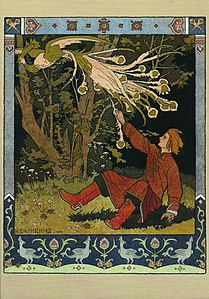
Illustration of the Firebirdby Ivan Bilibin (1899)
-

Set for Nikolai Rimsky-Korsakov's balletScheherazade by Leon Bakst (1910)
-

Program design for "Afternoon of a Faun" byLeon Bakst for Sergei Diaghilev's Ballets Russes, (1912)
-

Chairs by Sergey Malyutin, Talashkino Art Colony
-

Ceramic fireplace by Mikhail Vrubel(1908)


_02_by_L._Bakst_2.jpg)


A very colourful Russian variation of Art Nouveau appeared in Moscow and Saint Petersburg in 1898 with the publication of a new art journal, "Мир искусства" (transliteration: Mir Iskusstva) ("The World of Art"), by Russian artists Alexandre Benoisand Léon Bakst, and chief editor Sergei Diaghilev. The magazine organized exhibitions of leading Russian artists, includingMikhail Vrubel, Konstantin Somov, Isaac Levitan, and the book illustrator Ivan Bilibin. The World of Art style made less use of the vegetal and floral forms of French Art Nouveau; it drew heavily upon the bright colours and exotic designs of Russian folklore and fairy tales. The most influential contribution of the "World of Art" was the creation by Diaghilev of a new ballet company, the Ballets Russes, headed by Diaghilev, with costumes and sets designed by Bakst and Benois. The new ballet company premiered in Paris in 1909, and performed there every year through 1913. The exotic and colourful sets designed by Benois and Bakst had a major impact on French art and design. The costume and set designs were reproduced in the leading Paris magazines, L'Illustration, La Vie parisienne and Gazette du bon ton, and the Russian style became known in Paris as à la Bakst. The company was stranded in Paris first by the outbreak of World War I, and then by the Russian Revolution in 1917, and ironically never performed in Russia.[88]
Art Nouveau in Russia was promoted not only by single architects but also by art colonies who worked in the Russian Revival style that is sometimes considered as the Russian version of the National Romantic European movement. The two best-known colonies were situated in Abramtsevo, funded by Savva Mamontov, and Talashkino, Smolensk Governorate, funded by Princess Maria Tenisheva. They most notably feature interiors and ceramics.
-

Teremok House by Sergey Malyutin in Talashkino (1901-1902)
-

Yaroslavsky railway station by Franz (Fyodor) Schechtel inMoscow (1902-1904)
-
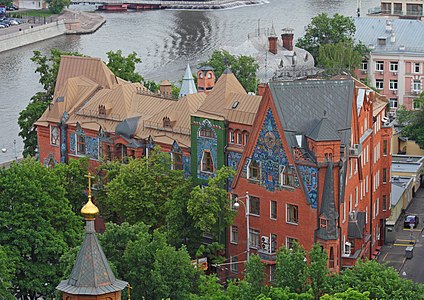
Pertsova House by Sergey Malyutin in Moscow (1905-1907)
-

Bas-reliefs at facade of Trinity Church Apartments (1908-1909)
_02.JPG)


.jpg)
Art Nouveau Architecture in Russia was highly influenced by contemporary movements[89] constituting Art Nouveau style (Glasgow School, Jugendstil of Germany, Vienna Secession, National Romantic style of Nordic countries (one of which,Grand Duchy of Finland, was a part of Russian Empire) and the Franco-Belgian Art Nouveau). However, there are examples of artistic expression that blended Art Nouveau with Russian Revival architecture, which drew from historic Russian architecture, mostly in wood, and referred to the Architecture of Kievan Rus'.
One of these examples is works of Sergey Malyutin: Teremok House in Talashkino (1901-1902) where he worked in the art colony and Pertsova House (also known as Pertsov House) in Moscow (1905-1907). He also was a member of Mir iskusstvamovement. Another blend of Russian Revival and Art Nouveau principles is Yaroslavsky railway station in Moscow by Franz (Fyodor) Schechtel (1902-1904). The Saint Petersburg architect Nikolai Vasilyev built in a range of styles before emigrating in 1923. By some researches[89] Trinity Church Apartments building (also known as House with Beasts, 1908-1909) is also characterized as Art Nouveau. This building is most notable for stone carvings made by Sergei Vashkov inspired by the carvings of Cathedral of Saint Demetrius in Vladimir and Saint George Cathedral in Yuryev-Polsky of XII and XIII centuries.
Jūgendstils (Art Nouveau in Riga)[edit]
-

Facade of house at Elizabetes ielā, 10b, by Mikhail Eisenstein (1903)
-

Stairway in Pēkšēns House by Konstantīns Pēkšēns (1903) now hosting Riga Jūgendstils museum
-

National Romantic decoration on a house built by Konstantīns Pēkšēns (1908)
-

Ministry of Education, built by Edgar Friesendorf (1911)

.jpg)
_2014-03-13.jpg)

Riga, the present-day capital of Latvia, was at the time one of the major cities of the Russian Empire. Art Nouveau architecture in Riga nevertheless developed according to its own dynamics, and the style became overwhelmingly popular in the city. Soon after the Latvian Ethnographic Exhibition in 1896 and the Industrial and Handicrafts Exhibition in 1901, Art Nouveau became the dominant style in the city.[90] Thus Art Nouveau architecture accounts for one-third of all the buildings in the centre of Riga, making it the city with the highest concentration of such buildings anywhere in the world. The quantity and quality of Art Nouveau architecture was among the criteria for including Riga in UNESCO World Cultural Heritage.[91]
There were different variations of Art Nouveau architecture in Riga:
- in Eclectic Art Nouveau, floral and other nature-inspired elements of decoration were most popular. Examples of that variation are works of Mikhail Eisenstein,
- in Perpendicular Art Nouveau, geometrical ornaments were integrated into the vertical compositions of the facades. Several department stores where built in this style, and it is sometimes also referred to as "department store style" orWarenhausstil in German,
- National Romantic Art Nouveau was inspired by local folk art, monumental volumes and the use of natural building materials.
Some later Neo-Classical buildings also contained Art Nouveau details.
Style Sapin in La Chaux-de-Fonds, Switzerland[edit]
-

Villa Fallet with fir-inspired decoration (1905)
-

Crematorium (1909), entrance
-

Crematorium (1909), interior
-

Crematorium (1909), detail
-

Crematorium (1909), detail
-

Art Nouveau Balconies in La Chaux-de-Fonds


The Swiss variation called Style Sapin was born in La Chaux-de-Fonds as a mix of French and Belgian Art Nouveau, German Jugendstil and Vienna Secession because of the town’s location.[92] The most prominent work is The La Chaux-de-Fonds Crematorium where Charles l’Eplattenier acted as a painter and sculptor and his pupils at the city's Ecole d'Art (Art School)[92] Robert Belli and Henri Robert acted as architects.[93]
A notable building with fir-inspired motifs is Villa Fallet whose architects were René Chapallaz and Charles-Édouard Jeanneret known later better known as Le Corbusier, also a pupil of Charles l’Eplattenier.[92][94]
Tiffany Style in the United States[edit]
-

Tiffany Chapel from the 1893 Word's Columbian Exposition, now in theCharles Hosmer Morse Museum of American Artin Winter Park, Florida.
-
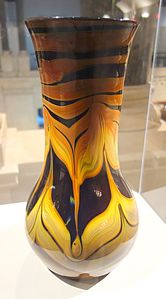
Glass vase byLouis Comfort Tiffany now in theCincinnati Art Museum (1893–96)
-

Lily lamp by Louis Comfort Tiffany (1900–1910)
-

Tiffany window in his house at Oyster Bay, New York
-
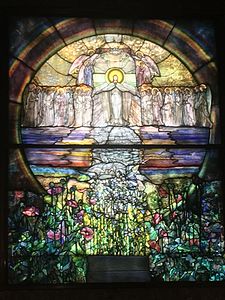
The Flight of SoulsWindow by Louis Comfort Tiffany won a gold medal at the 1900 Paris Exposition


In the United States, the firm of Louis Comfort Tiffany played a central role in American Art Nouveau. Born in 1848, he studied at the National Academy of Design in New York, began working with glass at the age of 24, entered the family business started by his father, and 1885 set up his own enterprise devoted to fine glass, and developed new techniques for its colouring. In 1893, he began making glass vases and bowls, again developing new techniques that allowed more original shapes and colouring, and began experimenting with decorative window glass. Layers of glass were printed, marbled and superimposed, giving an exceptional richness and variety of colour In 1895 his new works were featured in the Art Nouveau gallery of Siegfried Bing, giving him a new European clientele. After the death of his father in 1902, he took over the entire Tiffany enterprise, but still devoted much of his time to designing and manufacturing glass art objects. At the urging ofThomas Edison, he began to manufacture electric lamps with multicoloured glass shades in structures of bronze and iron, or decorated with mosaics, produced in numerous series and editions, each made with the care of a piece of jewellery. A team of designers and craftsmen worked on each product. The Tiffany lamp in particular became one of the icons of the Art Nouveau, but Tiffany's craftsmen (and craftswomen) designed and made extraordinary windows, vases, and other glass art. Tiffany's glass also had great success at the 1900 Exposition Universelle in Paris; his stained glass window called the Flight of Souls won a gold medal.[95]
Another important figure in American Art Nouveau was the architect Louis Sullivan,[96][97] best known as the architect of some of the first American iron-framed skyscrapers. At the 1893 World's Columbian Exposition in Chicago, most famous for the neoclassical architecture of its renowned White City, he designed a spectacular Art Nouveau entrance to the Transportation Building. The Columbian Exposition was also an important venue for Tiffany; a chapel he designed was shown at the Pavilion of Art and Industry. The Tiffany Chapel, along with one of the windows of Tiffany's home in New York, are now on display at the Charles Hosmer Morse Museum of American Art in Winter Park, Florida.
Art Nouveau in Argentina[edit]
-

Stained glass and sculptures by Ercole Pasina in Calise House in Buenos Aires (1911)
-

Interior of Galería Güemes, Buenos Aires by Francisco Gianotti(1913)
-

Palacio Barolo in Buenos Aires by Mario Palanti(1919-1923)
-
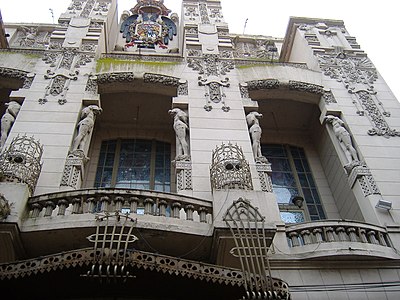
Metal work, ceramics and statues at the facade of Club Español building inRosario (1912)
-

Ceramic chimney of Confitería La Europea in Rosario (1916)


Flooded with immigrants, Argentina welcomed all artistic and architectural European styles, Art Nouveau was not an exclusion.[98] Cities with the most notable Art Nouveau heritage in Argentina are Buenos Aires, Rosario and Mar del Plata.[99]
Paris was a prototype for Buenos Aires with the construction of large boulevards and avenues in the 19th century.[98] The local style along with French influence was also following Italian Liberty as many architects (Virginio Colombo, Francisco Gianotti, Mario Palanti) were Italians. In works of Julián García Núñez Catalan influence can be noted as he completed his studies in Barcelona in 1900.[98] The influence of Vienna Secession can be found at Paso y Viamonte building.[98]
The introduction of Art Nouveau in Rosario is connected to Francisco Roca Simó who trained in Barcelona.[100] His Club Español building (1912) features one of the largest stained glass windows in Latin America produced (as well as tiling and ceramics) by the local firm Buxadera, Fornells y Cía. [101] The sculptor of the building is Diego Masana from Barcelona.[101]
Belgian influence on Argentinian Art Nouveau is represented by the Villa Ortiz Basualdo, now containing the Juan Carlos Castagnino Municipal Museum of Art in Mar del Plata where the furniture, interiors, and lighting are by Gustave Serrurier-Bovy.
Art Nouveau in the rest of the world[edit]
-
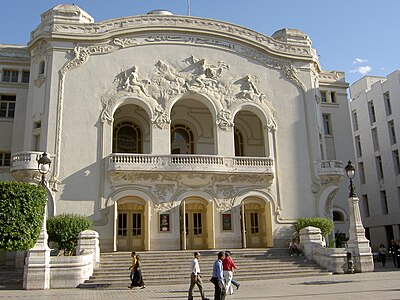
Théâtre municipal in Tunisia (1902)
-

-

-

Palacio Salvo in Montevideo,Uruguay (1926)
-


As in Argentina, Art Nouveau in other countries was mostly influenced by foreign architects:
- Catalans were behind Art Nouveau projects in Havana, Cuba, they were even not qualified enough to be called architects.[102]. Catalans were not directly involved in works in Ponce, Puerto Rico but were an inspiration and a subject of study for local architects in Ponce, Puerto Rico[103],
- French were behind Art Nouveau in Tunisia (that was a French protectorate then),
- Germans were behind Jugendstil heritage of Lüderitz, Namibia[104]; Qingdao, China,
- Italians were behind Art Nouveau in Valparaiso, Chile[105]; Montevideo, Uruguay; Rio de Janeiro, Brasil,[106]
- Russians were behind Art Nouveau heritage of Harbin, China,[107]
- Art Nouveau Heritage in Lima consists of work of Italians Masperi brothers, French architect Claude Sahut and British masters of stained glass[108]
- Palacio de Bellas Artes in Mexico City was a result of the cooperation of Italians (architect Adamo Boari and sculptorLeonardo Bistolfi), local architect Federico Mariscal, Hungarian artists Aladár Körösfői-Kriesch, Géza Maróti andMiksa Róth, Catalan sculptor Agustí Querol Subirats and French master Edgar Brandt.[109]
Characteristics[edit]
-

Coup de Fouet or "Whiplash" design by Hermann Obrist (1895)
-
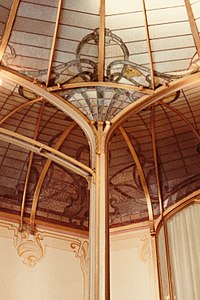
An abundance of light. Skylight in Hôtel van Eetvelde by Victor Horta (1895-1899)[110]
-

Stylized vegetal forms; Entrance of the Anvers Metro Station in Paris by Hector Guimard(1900)
-
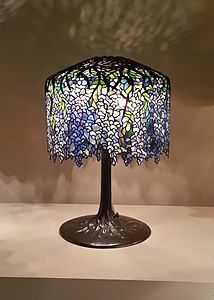
Floral patterns. Lamp with Wisteria design byLouis Comfort Tiffany(1899-1900)
-
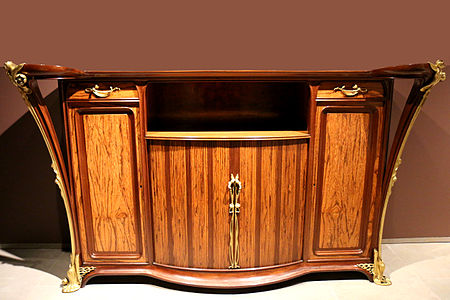
Exotic materials and decoration. Mahogany and amourette wood cabinet with water lily decoration of gilded bronze by Louis Majorelle (1905-08)
-

Strict geometry of Vienna Secession. theSanatorium Purkersdorf by Josef Hoffmann andKoloman Moser (1904)
-

Geometric lines theVienna Secession;Palais Stoclet by Josef Hoffmann (1905-1911)
-

Cubic form and geometric decoration of Villa Wagner II by Otto Wagner (1912-1913)


Early Art Nouveau, particularly in Belgium and France, was also characterized by undulating, curving forms inspired by lilies, vines, flower stems and other natural forms. used in particular in the interiors of the of Victor Horta and the decoration ofLouis Majorelle and Emile Gallé. [111] It also drew upon patterns based on butterflies and dragonflies, borrowed from Japanese art, which were popular in Europe at the time. [112]
Early Art Nouveau also often featured more stylized forms expressing movement, such as the coup de fouet or "whiplash" line, used by designer Hermann Obrist in 1894. A description published in Pan magazine of Hermann Obrist's wall hangingCyclamen (1894) described it as "sudden violent curves generated by the crack of a whip,"[113] The term "whiplash" is frequently applied to the characteristic curves employed by Art Nouveau artists.[113] Such decorative "whiplash" motifs, formed by dynamic, undulating, and flowing lines in a syncopated rhythm and asymmetrical shape, are found throughout the architecture, painting, sculpture, and other forms of Art Nouveau design.[113]
Floral forms were popular, inspired by lilies, wisteria and other flowers, particularly in the lamps of Louis Comfort Tiffany and the glass objects made by the artists of the School of Nancy and Émile Gallé. Stylized floral forms were particularly used byVictor Horta in carpets, balustrades, windows, and furniture. The were also used extensively by Hector Guimard for balustrades, and,most famously, for the lamps and railings at the entrances of the Paris Metro. Guimard explained: "That which must be avoided in everything that is continuous is the parallel and symmetry. Nature is the greatest builder and nature makes nothing that is parallel and nothing that is symmetrical."[114]
Earlier Art Nouveau furniture, such as that made by Louis Majorelle and Henry Van de Velde, was characterized by the use of exotic and expensive materials, including mahogany with inlays of precious woods and trim, and curving forms without right angles. It gave a sensation of lightness.
In the second phase of Art Nouveau, following 1900, the decoration became purer and the lines were more stylized. The curving lines and forms evolved into polygons and then into cubes and other geometric forms. These geometric forms were used with particular effect in the architecture and furniture of Joseph Maria Olbrich, Otto Wagner, Koloman Moser and Josef Hoffmann, especially the Palais Stoclet in Brussels, which announced the arrival of Art Deco and modernism.[115][116][117]
Another characteristic of Art Deco architecture was the use of light, by opening up of interior spaces, by the removal of walls, and the extensive use of skylights to bring a maximum amount of light into the interior. The residence-studio of architect and other houses built Victor Horta had extensive skylights, supported on curving iron frames. In the Hotel Tasselhe removed the traditional walls around the stairway, so that the stairs became a central element of the interior design.
Influences[edit]
The origins of Art Nouveau are sometimes attributed in the resistance of the artist William Morris to the cluttered compositions and the revival tendencies of the 19th century and his theories that helped initiate the Arts and crafts movement.[118] Arthur Mackmurdo's book-cover for Wren's City Churches (1883), with its rhythmic floral patterns, is also sometimes described as the first realisation of Art Nouveau.[118] About the same time, the flat perspective and strong colours of Japanese wood block prints, especially those of Katsushika Hokusai, had a strong effect on the formulation of Art Nouveau.[119] The Japonisme that was popular in Europe during the 1880s and 1890s was particularly influential on many artists with its organic forms and references to the natural world.[119] Besides being adopted by artists like Emile Gallé andJames Abbott McNeill Whistler, Japanese-inspired art and design was championed by the businessmen Siegfried Bing andArthur Lasenby Liberty at their stores, in Paris and London respectively.[120] [119]

Doorway at 24 place Etienne Pernet, (Paris 15e), 1905 Alfred Wagon, architect.
In architecture, hyperbolas and parabolas in windows, arches, and doors are common, and decorative mouldings 'grow' into plant-derived forms. Like most design styles, Art Nouveau sought to harmonise its forms. The text above the Paris Metro entrance uses the qualities of the rest of the iron work in the structure.[121]
Relationship with contemporary styles and movements[edit]

Portrait of Adele Bloch-Bauer I byGustav Klimt (1907)
As an art style, Art Nouveau has affinities with thePre-Raphaelites and the Symbolist styles, and artists like Aubrey Beardsley, Alphonse Mucha, Edward Burne-Jones, Gustav Klimt and Jan Toorop could be classed in more than one of these styles. Unlike Symbolist painting, however, Art Nouveau has a distinctive appearance; and, unlike the artisan-oriented Arts and Crafts Movement, Art Nouveau artists readily used new materials, machined surfaces, and abstraction in the service of pure design.
Art Nouveau did not eschew the use of machines, as the Arts and Crafts Movement did. For sculpture, the principal materials employed were glass and wrought iron, resulting in sculptural qualities even in architecture. Ceramics were also employed in creating editions of sculptures by artists such as Auguste Rodin.[122]
Art Nouveau architecture made use of many technological innovations of the late 19th century, especially the use of exposed iron and large, irregularly shaped pieces of glass for architecture.
Art Nouveau tendencies were also absorbed into local styles. In Denmark, for example, it was one aspect of Skønvirke("aesthetic work"), which itself more closely relates to the Arts and Crafts style.[123][124] Likewise, artists adopted many of the floral and organic motifs of Art Nouveau into the Młoda Polska ("Young Poland") style in Poland.[125] Młoda Polska, however, was also inclusive of other artistic styles and encompassed a broader approach to art, literature, and lifestyle.[126]
Art Deco
Art Deco
.jpg)


Top to bottom: Chrysler Building in New York City (1930); Poster for the Chicago World's Fairby Weimer Pursell (1933); and hood ornamentVictoire by René Lalique (1928)
Years active1910–1939CountryGlobal
Art Deco, sometimes referred to as Deco, is a style of visual arts, architecture and design that first appeared in France just before World War I.[1] Art Deco influenced the design of buildings, furniture, jewelry, fashion, cars, movie theatres, trains, ocean liners, and everyday objects such as radios and vacuum cleaners.[2] It took its name, short for Arts Décoratifs, from theExposition internationale des arts décoratifs et industriels modernes(International Exhibition of Modern Decorative and Industrial Arts) held in Paris in 1925.[3] It combined modern styles with fine craftsmanship and rich materials. During its heyday, Art Deco represented luxury, glamour, exuberance, and faith in social and technological progress.
Art Deco was a pastiche of many different styles, sometimes contradictory, united by a desire to be modern. From its outset, Art Deco was influenced by the bold geometric forms of Cubism; the bright colors of Fauvism and of theBallets Russes; the updated craftsmanship of the furniture of the eras of Louis Philippe I and Louis XVI; and the exotic styles of China and Japan, India,Persia, ancient Egypt and Maya art. It featured rare and expensive materials, such as ebony and ivory, and exquisite craftsmanship. The Chrysler Buildingand other skyscrapers of New York built during the 1920s and 1930s are monuments of the Art Deco style.
In the 1930s, during the Great Depression, the Art Deco style became more subdued. New materials arrived, including chrome plating, stainless steel, andplastic. A sleeker form of the style, called Streamline Moderne, appeared in the 1930s; it featured curving forms and smooth, polished surfaces.[4] Art Deco is one of the first truly international styles, but its dominance ended with the beginning of World War II and the rise of the strictly functional and unadorned styles of modern architecture and the International Style of architecture that followed.[5]
Contents
- 1Naming
- 2Origins
- 3Influences
- 4Style of luxury and modernity
- 5International Exhibition of Modern Decorative and Industrial Arts (1925)
- 6Skyscrapers
- 7Late Art Deco
- 8Painting
- 9Sculpture
- 10Graphic arts
- 11Architecture
- 12Decoration and motifs
- 13Furniture
- 14Design
- 15Textiles and fashion
- 16Jewelry
- 17Glass art
- 18Metal art
- 19Art Deco architecture around the world
- 20Preservation and Neo Art Deco
- 21Gallery
- 22See also
- 23References
- 24Bibliography
- 25External links
Naming
Art Deco took its name, short for Arts Décoratifs, from the Exposition Internationale des Arts Décoratifs et Industriels Modernes held in Paris in 1925,[3] though the diverse styles that characterize Art Deco had already appeared in Paris andBrussels before World War I.
The term arts décoratifs was first used in France in 1858; published in the Bulletin de la Société française de photographie.[6]
In 1868, Le Figaro newspaper used the term objets d'art décoratifs with respect to objects for stage scenery created for theThéâtre de l'Opéra.[7][8][9]
In 1875, furniture designers, textile, jewelry and glass designers, and other craftsmen were officially given the status of artists by the French government. In response to this, the École royale gratuite de dessin (Royal Free School of Design) founded in 1766 under King Louis XVI to train artists and artisans in crafts relating to the fine arts, was renamed the National School of Decorative Arts (l'École nationale des arts décoratifs). It took its present name of ENSAD (École nationale supérieure des arts décoratifs) in 1927.
During the 1925 Exposition the architect Le Corbusier wrote a series of articles about the exhibition for his magazine L'Esprit Nouveau under the title, "1925 EXPO. ARTS. DÉCO." which were combined into a book, "L'art décoratif d'aujourd'hui" (Decorative Art Today). The book was a spirited attack on the excesses of the colorful and lavish objects at the Exposition; and on the idea that practical objects such as furniture should have any decoration at all; his conclusion was that "Modern decoration has no decoration".[10]
The actual phrase "Art déco" did not appear in print until 1966, when it featured in the title of the first modern exhibit on the subject, called Les Années 25 : Art déco, Bauhaus, Stijl, Esprit nouveau, which covered the variety of major styles in the 1920s and 1930s. The term Art déco was then used in a 1966 newspaper article by Hillary Gelson in the Times (London, 12 November), describing the different styles at the exhibit.[11][12]
Art Deco gained currency as a broadly applied stylistic label in 1968 when historian Bevis Hillier published the first major academic book on the style: Art Deco of the 20s and 30s.[2] Hillier noted that the term was already being used by art dealers and cites The Times (2 November 1966) and an essay named "Les Arts Déco" in Elle magazine (November 1967) as examples of prior usage.[13] In 1971, Hillier organized an exhibition at the Minneapolis Institute of Arts, which he details in his book about it, The World of Art Deco.[14][15]
Origins
Society of Decorative Artists (1901–1913)

A fireplace screen by theSymbolist painter Odilon Redonnow in the Musée d'Orsay, Paris (1908)
The emergence of Art Deco was closely connected with the rise in status of decorative artists, who until late in the 19th century had been considered simply as artisans. The term "arts décoratifs" had been invented in 1875, giving the designers of furniture, textiles, and other decoration official status. The Société des artistes décorateurs (Society of decorative artists), or SAD, was founded in 1901, and decorative artists were given the same rights of authorship as painters and sculptors. A similar movement developed in Italy. The first international exhibition devoted entirely to the decorative arts, the Esposizione international d'Arte decorative moderna, was held in Turin in 1902. Several new magazines devoted to decorative arts were founded in Paris, including Arts et décoration and L'Art décoratif moderne. Decorative arts sections were introduced into the annual salons of the Sociéte des artistes français, and later in theSalon d'automne. French nationalism also played a part in the resurgence of decorative arts; French designers felt challenged by the increasing exports of less expensive German furnishings. In 1911, the SAD proposed the holding of a major new international exposition of decorative arts in 1912. No copies of old styles were to be permitted; only modern works. The exhibit was postponed until 1914, then, because of the war, postponed until 1925, when it gave its name to the whole family of styles known as Déco.[16]
Parisian department stores and fashion designers also played an important part in the rise of Art Déco. Established firms including the luggage maker Louis Vuitton, silverware firm Christofle, glass designer René Lalique, and the jewelers Louis Cartier and Boucheron, who all began designing products in more modern styles. Beginning in 1900, department stores had recruited decorative artists to work in their design studios. The decoration of the 1912 Salon d'Automne had been entrusted to the department store Printemps.[17] During the same year Printemps created its own workshop called "Primavera". By 1920 Primavera employed more than three hundred artists. The styles ranged from the updated versions of Louis XIV, Louis XVI and especially Louis Philippe furniture made by Louis Süe and the Primavera workshop to more modern forms from the workshop of the Au Louvre department store. Other designers, including Émile-Jacques Ruhlmann and Paul Foliot refused to use mass production, and insisted that each piece be made individually by hand. The early art deco style featured luxurious and exotic materials such as ebony, and ivory and silk, very bright colors and stylized motifs, particularly baskets and bouquets of flowers of all colors, giving a modernist look.[18]
Théâtre des Champs-Élysées (1910–1913)
-

Antoine Bourdelle, La Danse, facade of the Théâtre des Champs-Elysées, Paris (1912)
-

Théâtre des Champs-Élysées, by Auguste Perret, 15 avenue Montaigne, Paris, (1910–13). Reinforced concrete gave architects the ability to create new forms and bigger spaces.
-

Interior of the Théâtre des Champs-Élysées, with Bourdelle bas-reliefs over the stage
-

Dome of the Theater, with Art-Deco rose design by Maurice Denis
_(3713880263).jpg)


,_bas-relief,_Th%C3%A9%C3%A2tre_des_Champs_Elys%C3%A9es_DSC09313.jpg)
Antoine Bourdelle, 1910–12, Apollon et sa méditation entourée des 9 muses (The Meditation of Apollo and the Muses), bas-relief, Théâtre des Champs Elysées, Paris. This work represents one of the earliest examples of what became known as Art Deco sculpture
The Théâtre des Champs-Élysées (1910–1913), by Auguste Perret was the first landmark Art Deco building completed in Paris. Previously reinforced concrete had been used only for industrial and apartment buildings, Perret had built the first modern reinforced concrete apartment building in Paris on rue Benjamin Franklin in 1903–04. Henri Sauvage, another important future Art Deco architect, built another in 1904 at 7 rue Trétaigne (1904). From 1908 to 1910, the 21-year old Le Corbusier worked as a draftsman in Perret's office, learning the techniques of concrete construction. Perret's building had clean rectangular form, geometric decoration and straight lines, the future trademarks of Art Deco. The decor of the theater was also revolutionary; the facade was decorated with high reliefs by Antoine Bourdelle, a dome by Maurice Denis, paintings by Édouard Vuillard, and an Art Deco curtain Ker-Xavier Roussel. The theater became famous as the venue for many of the first performances of the Ballets Russes. Perret and Sauvage became the leading Art Deco architects in Paris in the 1920s.[19][20]
Salon d'Automne (1912–1913)
-
Set design for Sheherazade (1910) by Leon Bakst
-

Table and chairs by Maurice Dufrene and carpet by Paul Follot at the 1912 Salon des artistes décorateurs
-
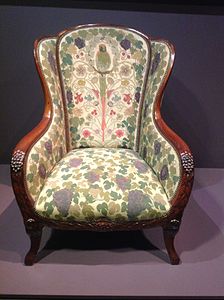
Art Deco armchair made for art collector Jacques Doucet (1912–13)
-
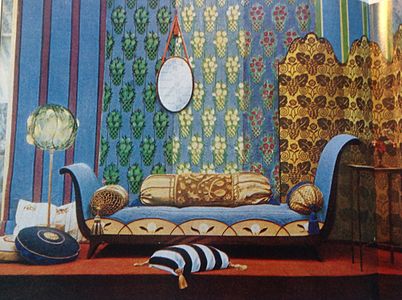
Display of early Art Deco furnishings by the Atelier Français at the 1913 Salon d'Automnefrom Art et décoration magazine (1914)


.jpg)
At its birth between 1910 and 1914, Art Deco was an explosion of colors, featuring bright and often clashing hues, frequently in floral designs, presented in furniture upholstery, carpets, screens, wallpaper and fabrics. Many colorful works, including chairs and a table by Maurice Dufrene and a bright Gobelin carpet by Paul Follot were presented at the 1912 Salon des artistes décorateurs. In 1912–1913 designer Adrien Karbowsky made a floral chair with a parrot design for the hunting lodge of art collector Jacques Doucet.[21] The furniture designers Louis Süe and André Mare made their first appearance at the 1912 exhibit, under the name of the Atelier Française, combining colorful fabrics with exotic and expensive materials, including ebony and ivory. After World War I they became one of the most prominent French interior design firms, producing the furniture for the first-class salons and cabins of the French transatlantic ocean liners.[22]
The vivid colors of Art Deco came from many sources, including the exotic set designs by Leon Bakst for the Ballets Russes, which caused a sensation in Paris just before World War I. Some of the colors were inspired by the earlier Fauvismmovement led by Henri Matisse; others by the Orphism of painters such as Sonia Delaunay; others by the movement known as the Nabis, and in the work of symbolist painter Odilon Redon, who designed fireplace screens and other decorative objects. Bright colors were a feature of the work of fashion designer Paul Poiret, whose work influenced both Art Deco fashion and interior design.[22]
Cubist influence
-

Design for the facade of La Maison Cubiste(Cubist House) by Raymond Duchamp-Villon(1912)
-

Raymond Duchamp-Villon, 1912, La Maison Cubiste (Cubist House) at the Salon d'Automne, 1912, detail of the entrance
-
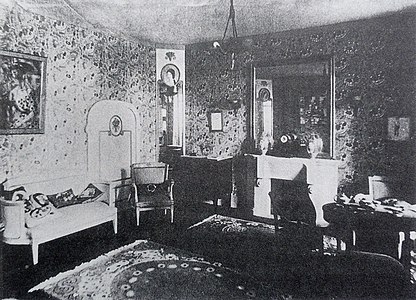
Le Salon Bourgeois, designed by André Mareinside La Maison Cubiste, in the decorative arts section of the Salon d'Automne, 1912, Paris. Metzinger's Femme à l'Éventail on the left wall
-
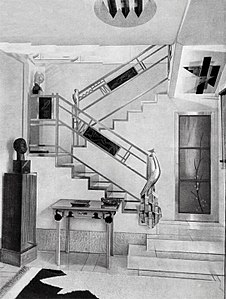
Stairway in the hôtel particulier of fashion designer-art collectorJacques Doucet (1927). Design by Joseph Csaky. The geometric forms of Cubism had an important influence on Art Deco
-

Jacques Doucet's hôtel particulier, 1927. Picasso's Les Demoiselles d'Avignoncan be seen hanging in the background

_at_the_Salon_d%27Automne,_1912,_detail_of_the_entrance._Photograph_by_Duchamp-Villon.jpg)


Joseph Csaky, 1912,Danseuse (Femme à l'éventail, Femme à la cruche), original plaster, exhibited at the 1912 Salon d'Automne and the 1914Salon des Indépendants, a Proto-Art Deco sculpture
The art style known as Cubism appeared in France between 1907 and 1912, influencing the development of Art Deco. The Cubists, themselves under the influence of Paul Cézanne, were interested in the simplification of forms to their geometric essentials: the cylinder, the sphere, the cone.[23]
In 1912, the artists of the Section d'Or exhibited works considerably more accessible to the general public than the analytical Cubism of Picasso and Braque. The Cubist vocabulary was poised to attract fashion, furniture and interior designers.[24][25]
In the 1912 writings of André Vera. Le Nouveau style, published in the journal L'Art décoratif, he expressed the rejection of Art Nouveau forms (asymmetric, polychrome and picturesque) and called for simplicité volontaire, symétrie manifeste, l'ordre et l'harmonie, themes that would eventually become common within Art Deco; though the Deco style was often extremely colorful and anything but simple.[26]
In the Art Décoratif section of the 1912 Salon d'Automne, an architectural installation was exhibited known as the La Maison Cubiste.[27][28] The facade was designed by Raymond Duchamp-Villon. The decor of the house was by André Mare.[29][30] La Maison Cubiste was a furnished installation with a facade, a staircase, wrought iron banisters, a bedroom, a living room—the Salon Bourgeois, where paintings by Albert Gleizes, Jean Metzinger, Marie Laurencin, Marcel Duchamp, Fernand Léger and Roger de La Fresnaye were hung.[31][32][33]Thousands of spectators at the salon passed through the full-scale model.[34]
The facade of the house, designed by Duchamp-Villon, was not very radical by modern standards; the lintels and pediments had prismatic shapes, but otherwise the facade resembled an ordinary house of the period. For the two rooms, Mare designed the wallpaper, which featured stylized roses and floral patterns, along with upholstery, furniture and carpets, all with flamboyant and colorful motifs. It was a distinct break from traditional decor. The critic Emile Sedeyn described Mare's work in the magazine Art et Décoration: "He does not embarrass himself with simplicity, for he multiplies flowers wherever they can be put. The effect he seeks is obviously one of picturesqueness and gaiety. He achieves it."[35]The Cubist element was provided by the paintings. The installation was attacked by some critics as extremely radical, which helped make for its success.[36] This architectural installation was subsequently exhibited at the 1913 Armory Show, New York, Chicago and Boston.[25][37][38][39][40] Thanks largely to the exhibition, the term "Cubist" began to be applied to anything modern, from women's haircuts to clothing to theater performances.[36]
The Cubist influence continued within Art Deco, even as Deco branched out in many other directions. In 1927, CubistsJoseph Csaky, Jacques Lipchitz, Louis Marcoussis, Henri Laurens, the sculptor Gustave Miklos, and others collaborated in the decoration of a Studio House, rue Saint-James, Neuilly-sur-Seine, designed by the architect Paul Ruaud and owned by the French fashion designer Jacques Doucet, also a collector of Post-Impressionist art by Henri Matisse and Cubistpaintings (including Les Demoiselles d'Avignon, which he bought directly from Picasso's studio). Laurens designed the fountain, Csaky designed Doucet's staircase,[41] Lipchitz made the fireplace mantel, and Marcoussis made a Cubist rug.[42][43][44]
Besides the Cubist artists, Doucet brought in other Deco interior designers to help in decorating the house, including Pierre Legrain, who was in charge of organizing the decoration, and Paul Iribe, Marcel Coard, André Groult, Eileen Gray and Rose Adler to provide furniture. The decor included massive pieces made of macassar ebony, inspired by African art, and furniture covered with Morocco leather, crocodile skin and snakeskin, and patterns taken from African designs.[45]
Influences
-

The exoticism of the Ballets Russes had a strong influence on early Deco. A drawing of the dancer Vaslav Nijinsky by Paris fashion artist Georges Barbier (1913)
-

Illustration by Georges Barbier of a gown by Paquin (1914). Stylized floral designs and bright colors were a feature of early Art Deco.
-

Lobby of 450 Sutter Street in San Francisco by Timothy Pflueger, (1929) inspired by ancient Maya art
-
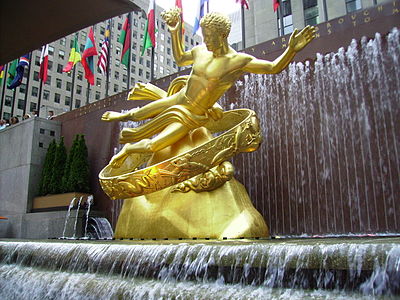
The gilded bronze Prometheus at Rockefeller Center by Paul Manship (1934), a stylized Art Deco update of classical sculpture (1936)
-

A ceramic vase inspired by motifs of traditional African carved wood sculpture, by Emile Lenoble (1937), Museum of Decorative Arts, Paris
,_Vaslav_Nijinsky_(1890-1950),_1913_1.jpg)


Art Deco was not a single style, but a collection of different and sometimes contradictory styles. In architecture, Art Deco was the successor to and reaction against Art Nouveau, a style which flourished in Europe between 1895 and 1900, and also gradually replaced the Beaux-Arts and neoclassical that were predominant in European and American architecture. In 1905Eugène Grasset wrote and published Méthode de Composition Ornementale, Éléments Rectilignes,[46] in which he systematically explored the decorative (ornamental) aspects of geometric elements, forms, motifs and their variations, in contrast with (and as a departure from) the undulating Art Nouveau style of Hector Guimard, so popular in Paris a few years earlier. Grasset stressed the principle that various simple geometric shapes like triangles and squares are the basis of all compositional arrangements. The reinforced concrete buildings of Auguste Perret and Henri Sauvage, and particularly theTheatre des Champs-Elysees, offered a new form of construction and decoration which was copied worldwide.[47]
In decoration, many different styles were borrowed and used by Art Deco. They included pre-modern art from around the world and observable at the Musée du Louvre, Musée de l'Homme and the Musée national des Arts d'Afrique et d'Océanie. There was also popular interest in archeology due to excavations at Pompeii, Troy, and the tomb of the 18th dynasty Pharaoh Tutankhamun. Artists and designers integrated motifs from ancient Egypt, Mesopotamia, Greece, Rome, Asia,Mesoamerica and Oceania with Machine Age elements.[48][49][50][51][52][53]
Other styles borrowed included Russian Constructivism and Italian Futurism, as well as Orphism, Functionalism, andModernism in general.[25][54][48][55] Art Deco also used the clashing colors and designs of Fauvism, notably in the work of Henri Matisse and André Derain, inspired the designs of art deco textiles, wallpaper, and painted ceramics.[25] It took ideas from the high fashion vocabulary of the period, which featured geometric designs, chevrons, zigzags, and stylized bouquets of flowers. It was influenced by discoveries in Egyptology, and growing interest in the Orient and in African art. From 1925 onwards, it was often inspired by a passion for new machines, such as airships, automobiles and ocean liners, and by 1930 this influence resulted in the style called Streamline Moderne.[56]
Style of luxury and modernity
-

The boudoir of fashion designer Jeanne Lanvin(1922–25) now in the Museum of Decorative Arts, Paris
-

Bath of Jeanne Lanvin, of Sienna marble, with decoration of carved stucco and bronze (1922–25)
-
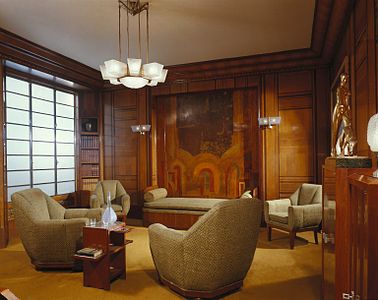
An Art Deco study by the Paris design firm of Alavoine, now in the Brooklyn Museum (1928–30)
-

Glass Salon (Le salon de verre) designed byPaul Ruaud with furniture by Eileen Gray, for Madame Mathieu-Levy (milliner of the boutique J. Suzanne Talbot), 9, rue de Lota, Paris, 1922 (published in L'Illustration, 27 May 1933)


,_Paris,_1922.jpg)
Art Deco was associated with both luxury and modernity; it combined very expensive materials and exquisite craftsmanship put into modernistic forms. Nothing was cheap about Art Deco: pieces of furniture included ivory and silver inlays, and pieces of Art Deco jewelry combined diamonds with platinum, jade, and other precious materials. The style was used to decorate the first-class salons of ocean liners, deluxe trains, and skyscrapers. It was used around the world to decorate the great movie palaces of the late 1920s and 1930s. Later, after the Great Depression, the style changed and became more sober.
A good example of the luxury style of Art Deco is the boudoir of the fashion designer Jeanne Lanvin, designed by Armand-Albert Rateau (1882–1938) made between 1922–25. It was located in her house at 16 rue Barbet de Jouy, in Paris, which was demolished in 1965. The room was reconstructed in the Museum of Decorative Arts in Paris. The walls are covered with molded lambris below sculpted bas-reliefs in stucco. The alcove is framed with columns of marble on with bases and a plinth of sculpted wood. The floor is of white and black marble, and in the cabinets decorative objects are displayed against a background of blue silk. Her bathroom had a tub and washstand made of sienna marble, with a wall of carved stucco and bronze fittings.[57]
By 1928 the style had become more comfortable, with deep leather club chairs. The study designed by the Paris firm of Alavoine for an American businessman in 1928–30, now in the Brooklyn Museum, had a unique American feature. Since it was constructed during Prohibition, when serving alcohol was prohibited, it included a secret bar hidden behind the panels.[58][failed verification]
By the 1930s, the style had been somewhat simplified, but it was still extravagant. In 1932 the decorator Paul Ruoud made the Glass Salon for Suzanne Talbot. It featured a serpentine armchair and two tubular armchairs by Eileen Gray, a floor of mat silvered glass slabs, a panel of abstract patterns in silver and black lacquer, and an assortment of animal skins.[59]
International Exhibition of Modern Decorative and Industrial Arts (1925)
-
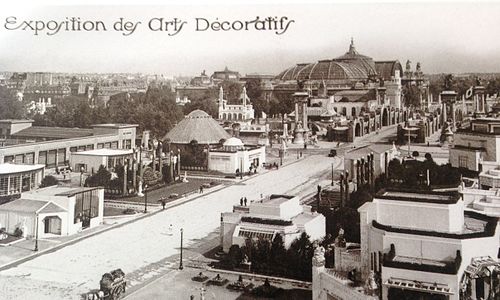
Postcard of the International Exhibition of Modern Decorative and Industrial Arts in Paris (1925)
-

Entrance to the 1925 Exposition from Place de la Concordeby Pierre Patout
-
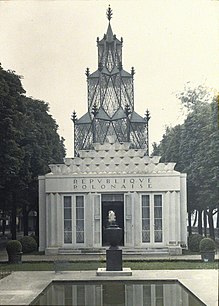
Polish pavilion (1925)
-

Pavilion of the Galeries Lafayette Department Store at the 1925 Exposition
-
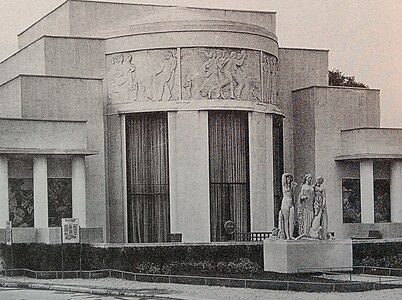
The Hotel du Collectionneur, pavilion of the furniture manufacturer Émile-Jacques Ruhlmann, designed by Pierre Patout.
-
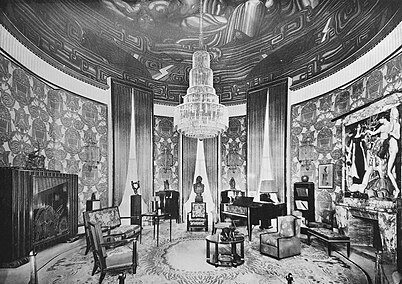
Salon of the Hôtel du Collectionneur from the 1925 International Exposition of Decorative Arts, furnished by Émile-Jacques Ruhlmann, painting by Jean Dupas, design by Pierre Patout


.jpg)
.jpg)
The event that marked the zenith of the style and gave it its name was the International Exhibition of Modern Decorative and Industrial Arts which took place in Paris from April to October in 1925. This was officially sponsored by the French government, and covered a site in Paris of 55 acres, running from the Grand Palais on the right bank to Les Invalides on the left bank, and along the banks of the Seine. The Grand Palais, the largest hall in the city, was filled with exhibits of decorative arts from the participating countries. There were 15,000 exhibitors from twenty different countries, including England, Italy, Spain, Poland, Czechoslovakia, Belgium, Japan, and the new Soviet Union, though Germany was not invited because of tensions after the war and the United States, misunderstanding the purpose of the exhibit, declined to participate. It was visited by sixteen million people during its seven-month run. The rules of the exhibition required that all work be modern; no historical styles were allowed. The main purpose of the Exhibit was to promote the French manufacturers of luxury furniture, porcelain, glass, metal work, textiles and other decorative products. To further promote the products, all the major Paris department stores and major designers had their own pavilions. The Exposition had a secondary purpose in promoting products from French colonies in Africa and Asia, including ivory and exotic woods.
The Hôtel du Collectionneur was a popular attraction at the Exposition; it displayed the new furniture designs of Emile-Jacques Ruhlmann, as well as Art Deco fabrics, carpets, and a painting by Jean Dupas. The interior design followed the same principles of symmetry and geometric forms which set it apart from Art Nouveau, and bright colors, fine craftsmanship rare and expensive materials which set it apart from the strict functionality of the Modernist style. While most of the pavilions were lavishly decorated and filled with hand-made luxury furniture, two pavilions, those of the Soviet Union and Pavilion du Nouveau Esprit, built by the magazine of that name run by Le Corbusier, were built in an austere style with plain white walls and no decoration; they were among the earliest examples of modernist architecture.[60]
Skyscrapers
-

The American Radiator Building in New York City byRaymond Hood (1924)
-

Chrysler Building inNew York City, byWilliam Van Alen(1928–30)
-

New York City skyline (1931-1933)
-
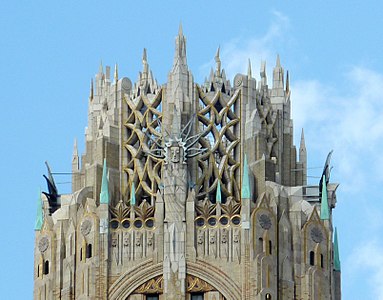
Crown of the General Electric Building(also known as 570 Lexington Avenue) byCross & Cross (1933)
-

30 Rockefeller Center, now theComcast Building, byRaymond Hood(1933)

.jpg)
_in_flight_over_Manhattan,_circa_1931-1933.jpg)


American skyscrapers marked the summit of the Art Deco style; they became the tallest and most recognizable modern buildings in the world. They were designed to show the prestige of their builders through their height, their shape, their color, and their dramatic illumination at night.[61] The American Radiator Building by Raymond Hood (1924) combined Gothic and Deco modern elements in the design of the building. Black brick on the frontage of the building (symbolizing coal) was selected to give an idea of solidity and to give the building a solid mass. Other parts of the facade were covered in gold bricks (symbolizing fire), and the entry was decorated with marble and black mirrors. Another early Art Deco skyscraper was Detroit's Guardian Building, which opened in 1929. Designed by modernist Wirt C. Rowland, the building was the first to employ stainless steel as a decorative element, and the extensive use of colored designs in place of traditional ornaments.
The New York skyline was radically changed by the Chrysler Building in Manhattan (completed in 1930), designed by William Van Alen. It was a giant seventy-seven floor tall advertisement for Chrysler automobiles. The top was crowned by a stainless steel spire, and was ornamented by deco "gargoyles" in the form of stainless steel radiator cap decorations. The base of the tower, thirty-three stories above the street, was decorated with colorful art deco friezes, and the lobby was decorated with art deco symbols and images expressing modernity.[62]
The Chrysler Building was followed by the Empire State Building by William F. Lamb (1931) and the RCA Building (now theComcast Building) in Rockefeller Center, by Raymond Hood (1933) which together completely changed the skyline of New York. The tops of the buildings were decorated with Art Deco crowns and spires covered with stainless steel, and, in the case of the Chrysler building, with Art Deco gargoyles modeled after radiator ornaments, while the entrances and lobbies were lavishly decorated with Art Deco sculpture, ceramics, and design. Similar buildings, though not quite as tall, soon appeared in Chicago and other large American cities. The Chrysler Building was soon surpassed in height by the Empire State Building, in a slightly less lavish Deco style. Rockefeller Center added a new design element: several tall building grouped around an open plaza, with a fountain in the center.[63]
Late Art Deco
-

Lincoln Theater in Miami Beach, Florida by Thomas W. Lamb (1936)
-
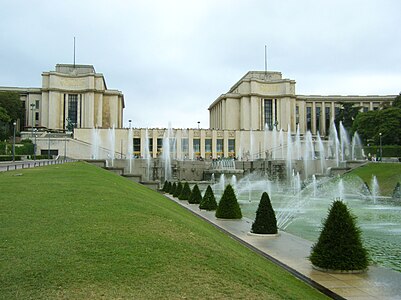
The Palais de Chaillot by Louis-Hippolyte Boileau,Jacques Carlu and Léon Azéma from the 1937 Paris International Exposition
-
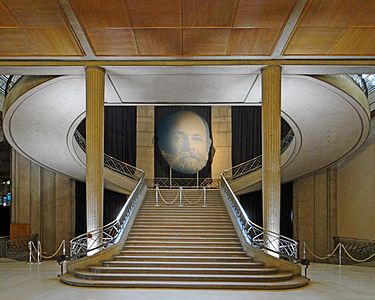
Stairway of the Economic and Social Council in Paris, originally the Museum of Public Works, built for the 1937 Paris International Expositionby Auguste Perret (1937)
-

High School in King City, California, built by Robert Stanton for the Works Progress Administration(1939)


_(11872278295).jpg)

In 1925 two different competing schools coexisted within Art Deco: the traditionalists, who had founded the Society of Decorative Artists; included the furniture designer Emile-Jacques Ruhlmann, Jean Dunard, the sculptor Antoine Bourdelle, and designer Paul Poiret; they combined modern forms with traditional craftsmanship and expensive materials. On the other side were the modernists, who increasingly rejected the past and wanted a style based upon advances in new technologies, simplicity, a lack of decoration, inexpensive materials, and mass production. The modernists founded their own organization,The French Union of Modern Artists, in 1929. Its members included architects Pierre Chareau, Francis Jourdain, Robert Mallet-Stevens, Corbusier, and, in the Soviet Union, Konstantin Melnikov; the Irish designer Eileen Gray, and French designer Sonia Delaunay, the jewelers Jean Fouquet and Jean Puiforcat. They fiercely attacked the traditional art deco style, which they said was created only for the wealthy, and insisted that well-constructed buildings should be available to everyone, and that form should follow function. The beauty of an object or building resided in whether it was perfectly fit to fulfill its function. Modern industrial methods meant that furniture and buildings could be mass-produced, not made by hand.[64][65]
The Art Deco interior designer Paul Follot defended Art Deco in this way: "We know that man is never content with the indispensable and that the superfluous is always needed...If not, we would have to get rid of music, flowers, and perfumes..!"[66] However, Le Corbusier was a brilliant publicist for modernist architecture; he stated that a house was simply "a machine to live in", and tirelessly promoted the idea that Art Deco was the past and modernism was the future. Le Corbusier's ideas were gradually adopted by architecture schools, and the aesthetics of Art Deco were abandoned. The same features that made Art Deco popular in the beginning, its craftsmanship, rich materials and ornament, led to its decline. The Great Depression that began in the United States in 1929, and reached Europe shortly afterwards, greatly reduced the number of wealthy clients who could pay for the furnishings and art objects. In the Depression economic climate, few companies were ready to build new skyscrapers.[25] Even the Ruhlmann firm resorted to producing pieces of furniture in series, rather than individual hand-made items. The last buildings built in Paris in the new style were the Museum of Public Works by Auguste Perret (now the French Economic, Social and Environmental Council) and the Palais de Chaillotby Louis-Hippolyte Boileau, Jacques Carlu and Léon Azéma, and the Palais de Tokyo of the 1937 Paris International Exposition; they looked out at the grandiose pavilion of Nazi Germany, designed by Albert Speer, which faced the equally grandiose socialist-realist pavilion of Stalin's Soviet Union.
After World War II the dominant architectural style became the International Style pioneered by Le Corbusier, and Mies Van der Rohe. A handful of Art Deco hotels were built in Miami Beach after World War II, but elsewhere the style largely vanished, except in industrial design, where it continued to be used in automobile styling and products such as jukeboxes. In the 1960s, it experienced a modest academic revival, thanks in part to the writings of architectural historians such as Bevis Hillier. In the 1970s efforts were made in the United States and Europe to preserve the best examples of Art Deco architecture, and many buildings were restored and repurposed. Postmodern architecture, which first appeared in the 1980s, like Art Deco, often includes purely decorative features.[25][48][67][68] Deco continues to inspire designers, and is often used in contemporary fashion, jewelry, and toiletries.[69]
Painting
-

Detail of Time, 1941, ceiling mural in lobby ofRockefeller Center by the Spanish painter Josep Maria Sert
-

Reginald Marsh, 1936, Workers sorting the mail, a mural in the U.S. Customs House in New York
-
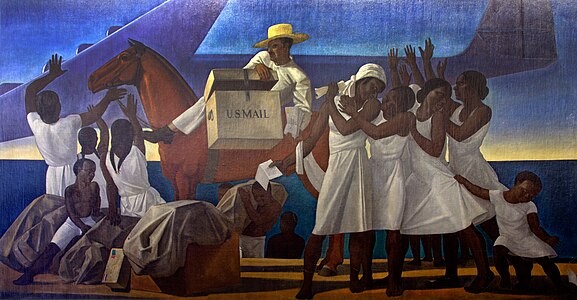
Rockwell Kent, 1938, Art in the Tropics, mural in the William Jefferson Clinton Federal Building


There was no section set aside for painting at the 1925 Exposition. Art deco painting was by definition decorative, designed to decorate a room or work of architecture, so few painters worked exclusively in the style, but two painters are closely associated with Art Deco. Jean Dupas painted Art Deco murals for the Bordeaux Pavilion at the 1925 Decorative Arts Exposition in Paris, and also painted the picture over the fireplace in the Maison de la Collectioneur exhibit at the 1925 Exposition, which featured furniture by Ruhlmann and other prominent Art Deco designers. His murals were also prominent in the decor of the French ocean liner SS Normandie. His work was purely decorative, designed as a background or accompaniment to other elements of the decor.[70]
The other painter closely associated with the style is Tamara de Lempicka. Born in Poland, she emigrated to Paris after theRussian Revolution. She studied under Maurice Denis and André Lhote, and borrowed many elements from their styles. She painted portraits in a realistic, dynamic and colorful Art Deco style.[71]
In the 1930s a dramatic new form of Art Deco painting appeared in the United States. During the Great Depression, theFederal Art Project of the Works Progress Administration was created to give work to unemployed artists. Many were given the task of decorating government buildings, hospitals and schools. There was no specific art deco style used in the murals; artists engaged to paint murals in government buildings came from many different schools, from American regionalism tosocial realism; they included Reginald Marsh, Rockwell Kent and the Mexican painter Diego Rivera. The murals were Art Deco because they were all decorative and related to the activities in the building or city where they were painted: Reginald Marsh and Rockwell Kent both decorated U.S. postal buildings, and showed postal employees at work while Diego Rivera depicted automobile factory workers for the Detroit Institute of Arts. Diego Rivera's mural Man at the Crossroads (1933) for Rockefeller Center featured an unauthorized portrait of Lenin.[72][73] When Rivera refused to remove Lenin, the painting was destroyed and a new mural was painted by the Spanish artist Josep Maria Sert.[74][75][76]
Sculpture
Monumental and public sculpture
Sculpture was a very common and integral feature of Art Deco architecture. In France, allegorical bas-reliefs representing dance and music by Antoine Bourdelle decorated the earliest Art Deco landmark in Paris, the Théâtre des Champs-Élyséesin Paris, in 1912. The 1925 had major sculptural works placed around the site, pavilions were decorated with sculptural friezes, and several pavilions devoted to smaller studio sculpture. In the 1930s, a large group of prominent sculptors made works for the 1937 Exposition Internationale des Arts et Techniques dans la Vie Moderne at Chaillot. Alfred Janniot made the relief sculptures on the facade of the Palais de Tokyo. The Musée d'Art Moderne de la Ville de Paris, and the esplanade in front of the Palais de Chaillot, facing the Eiffel Tower, was crowded with new statuary by Charles Malfray, Henry Arnold, and many others.[77]
Public art deco sculpture was almost always representational, usually of heroic or allegorical figures related to the purpose of the building or room. The themes were usually selected by the patrons, not the artist. Abstract sculpture for decoration was extremely rare.[78][79]
In the United States, the most prominent Art Deco sculptor for public art was Paul Manship, who updated classical and mythological subjects and themes in an Art Deco style. His most famous work was the statue of Prometheus at Rockefeller Center in New York, a 20th-century adaptation of a classical subject. Other important works for Rockefeller Center were made by Lee Lawrie, including the sculptural facade and the Atlas statue.
During the Great Depression in the United States, many sculptors were commissioned to make works for the decoration of federal government buildings, with funds provided by the WPA, or Works Progress Administration. They included sculptor Sidney Biehler Waugh, who created stylized and idealized images of workers and their tasks for federal government office buildings.[80] In San Francisco, Ralph Stackpole provided sculpture for the facade of the new San Francisco Stock Exchangebuilding. In Washington DC, Michael Lantz made works for the Federal Trade Commission building.
In Britain, Deco public statuary was made by Eric Gill for the BBC Broadcasting House, while Ronald Atkinson decorated the lobby of the former Daily Express Building in London (1932).
One of the best known and certainly the largest public Art Deco sculpture is the Christ the Redeemer by the French sculptorPaul Landowski, completed between 1922 and 1931, located on a mountain top overlooking Rio de Janeiro, Brazil.
-

Aluminum statue of Ceres by John Storrsatop the Chicago Board of Trade Building (1930)
-
The gilded bronze Prometheus at Rockefeller Center by Paul Manship (1934), a stylized Art Deco update of classical sculpture (1936)
-
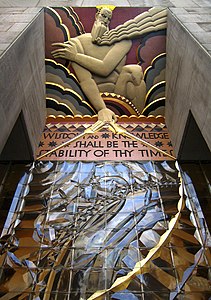
Portal decorationWisdom by Lee Lawrie,Rockefeller Center, New York (1933)
-

Lee Lawrie, 1936–37,Atlas statue, in front of the Rockefeller Center in New York (installed 1937)
-

Man Controlling Trade by Michael Lantz at the Federal Trade Commission building, Washington, D.C. (1942)
-
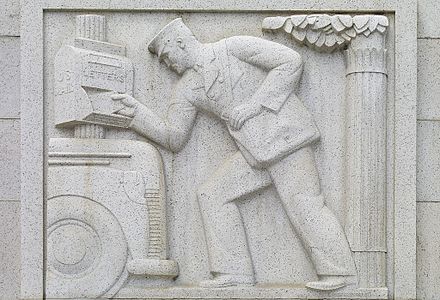
Mail Delivery East, by Edmond Amateis, one of four bas-relief sculptures on the Robert N. C. Nix, Sr., Federal Building inPhiladelphia, 1937
-

Ralph Stackpole's sculpture group over the door of the San Francisco Stock Exchange (1930)
-

'Aerial between Wisdom and Gaiety' by Eric Gill, Facade of BBC Broadcasting House, London (1932)
-

Christ the Redeemer by Paul Landowski, (1931), soapstone, Corcovado Mountain, Rio de Janeiro


Studio sculpture
Many early Art Deco sculptures were small, designed to decorate salons. One genre of this sculpture was called theChryselephantine statuette, named for a style of ancient Greek temple statues made of gold and ivory. They were sometimes made of bronze, or sometimes with much more lavish materials, such as ivory. onyx alabaster, and gold leaf.
One of the best-known Art Deco salon sculptors was the Romanian-born Demétre Chiparus, who produced colorful small sculptures of dancers. Other notable salon sculptors included Ferdinand Preiss, Josef Lorenzl, Alexander Kelety, Dorothea Charol and Gustav Schmidtcassel.[81] Another important American sculptor in the studio format was Harriet Whitney Frishmuth, who had studied with Auguste Rodin in Paris.
Pierre Le Paguays was a prominent Art Dco studio sculptor, whose work was shown at the 1925 Exposition. he worked with bronze, marble, ivory, onyx, gold, alabaster and other precious materials.[82]
-

Joseph Csaky, Tête (front and side view), limestone, Kröller-Müller Museum, Otterlo (c. 1920)
-

"The Hunter" by Pierre Le Faguays (1920s)
-
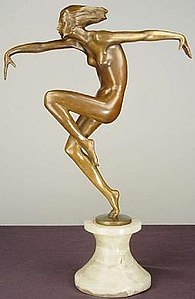
Bronze nude of a dancer on an onyx plinth byJosef Lorenzl, c. 1925
-

Speed, a design for a radiator ornament by the American sculptor Harriet Whitney Frishmuth (1925)
-

The Flight of Europa by Paul Manship, bronze with gold leaf, Whitney Museum (1925)
-
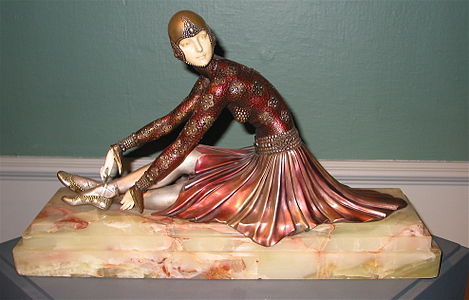
Demétre Chiparus, Tanara, bronze, ivory and onyx (c. 1925)
-
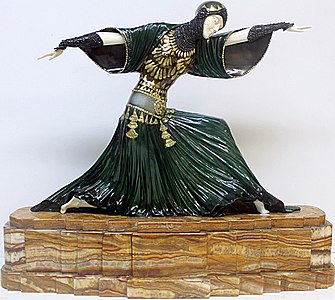
Demétre Chiparus, Dancer, bronze, ivory (c. 1925)


François Pompon was a pioneer of modern stylized animalier sculpture. He was not fully recognized for his artistic accomplishments until the age of 67 at the Salon d'Automne of 1922 with the work Ours blanc, also known as The White Bear, now in the Musée d'Orsay in Paris.[83]
Parallel with these Art Deco sculptors, more avant-garde and abstract modernist sculptors were at work in Paris and New York. The most prominent were Constantin Brâncuși, Joseph Csaky, Alexander Archipenko, Henri Laurens, Jacques Lipchitz,Gustave Miklos, Jean Lambert-Rucki, Jan et Joël Martel, Chana Orloff and Pablo Gargallo.[84]
Graphic arts
-
Program for the Ballets Russes by Leon Bakst(1912)
-

Peter Behrens,Deutscher Werkbundexhibition poster (1914)
-

A Vanity Fair cover by Georges Lepape (1919)
-
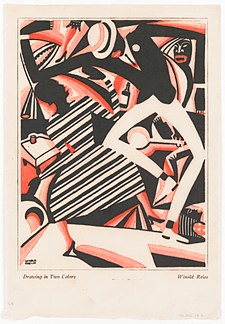
Interpretation of Harlem Jazz I by Winold Reiss(c.1920)
-

Cover of Harper's Bazaar by Erté (1922)
-

London Underground poster by Horace Taylor (1924)
-

Moulin Rouge poster by Charles Gesmar (1925)
-

Poster for Chicago World's Fair by Weimer Pursell (1933)


The Art Deco style appeared early in the graphic arts, in the years just before World War I. It appeared in Paris in the posters and the costume designs of Leon Bakst for the Ballets Russes, and in the catalogs of the fashion designers Paul Poiret.[85] The illustrations of Georges Barbier, and Georges Lepape and the images in the fashion magazine La Gazette du bon ton perfectly captured the elegance and sensuality of the style. In the 1920s, the look changed; the fashions stressed were more casual, sportive and daring, with the woman models usually smoking cigarettes. American fashion magazines such as Vogue, Vanity Fair and Harper's Bazaar quickly picked up the new style and popularized it in the United States. It also influenced the work of American book illustrators such as Rockwell Kent. In Germany, the most famous poster artist of the period was Ludwig Hohlwein, who created colorful and dramatic posters for music festivals, beers, and, late in his career, for the Nazi Party.[86]
During the Art Nouveau period, posters usually advertised theatrical products or cabarets. In the 1920s, travel posters, made for steamship lines and airlines, became extremely popular. The style changed notably in the 1920s, to focus attention on the product being advertised. The images became simpler, precise, more linear, more dynamic, and were often placed against a single color background. In France popular Art Deco designers included, Charles Loupot and Paul Colin, who became famous for his posters of American singer and dancer Josephine Baker. Jean Carlu designed posters for Charlie Chaplin movies, soaps, and theaters; in the late 1930s he emigrated to the United States, where, during the World War, he designed posters to encourage war production. The designer Charles Gesmar became famous making posters for the singer Mistinguett and for Air France. Among the best known French Art Deco poster designers was Cassandre, who made the celebrated poster of the ocean liner SS Normandie in 1935.[86]
In the 1930s a new genre of posters appeared in the United States during the Great Depression. The Federal Art Project hired American artists to create posters to promote tourism and cultural events.
Architecture
-
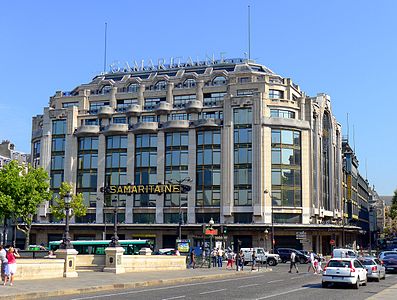
La Samaritaine department store, by Henri Sauvage, Paris, (1925–28)
-

Los Angeles City Hall by John Parkinson, John C. Austin, andAlbert C. Martin, Sr. (1928)
-
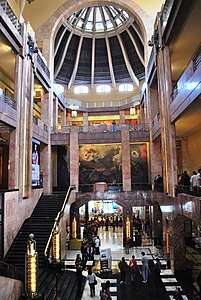
Interior of the Palacio de Bellas Artes (Palace of Fine Arts) inMexico City (1934)
-

National Diet Building in Tokyo, Japan (1936)
-

Mayakovskaya Metro Station in Moscow (1936)

_edit1.jpg)


The architectural style of art deco made its debut in Paris in 1903–04, with the construction of two apartment buildings in Paris, one by Auguste Perret on rue Trétaigne and the other on rue Benjamin Franklin by Henri Sauvage. The two young architects used reinforced concrete for the first time in Paris residential buildings; the new buildings had clean lines, rectangular forms, and no decoration on the facades; they marked a clean break with the art nouveau style.[87] Between 1910 and 1913, Perret used his experience in concrete apartment buildings to construct the Théâtre des Champs-Élysées, 15 avenue Montaigne. Between 1925 and 1928 he constructed the new art deco facade of the La Samaritaine department store in Paris.[88]
After the First World War, art deco buildings of steel and reinforced concrete began to appear in large cities across Europe and the United States. In the United States the style was most commonly used for office buildings, government buildings, movie theaters, and railroad stations. It sometimes was combined with other styles; Los Angeles City Hall combined Art Deco with a roof based on the ancient Greek Mausoleum at Halicarnassus, while the Los Angeles railroad station combined Deco with Spanish mission architecture. Art Deco elements also appeared in engineering projects, including the towers of theGolden Gate Bridge and the intake towers of Hoover Dam. In the 1920s and 1930s it became a truly international style, with examples including the Palacio de Bellas Artes (Palace of Fine Arts) in Mexico City by Federico Mariscal, theMayakovskaya Metro Station in Moscow and the National Diet Building in Tokyo by Watanabe Fukuzo.[citation needed]
The Art Deco style was not limited to buildings on land; the ocean liner SS Normandie, whose first voyage was in 1935, featured Art Deco design, including a dining room whose ceiling and decoration were made of glass by Lalique.[89]
"Cathedrals of Commerce"
-
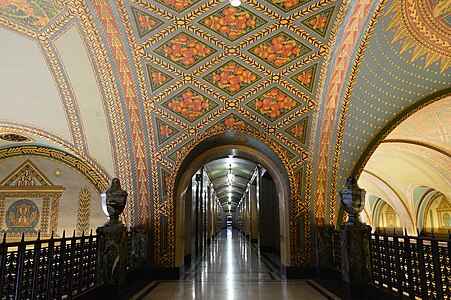
The Fisher Building in Detroit by Joseph Nathaniel French (1928)
-

Lower lobby of the Guardian Building in Detroit by Wirt Rowland(1929)
-
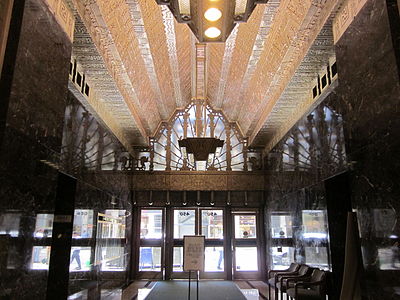
Lobby of 450 Sutter Street in San Francisco byTimothy Pflueger (1929)
-
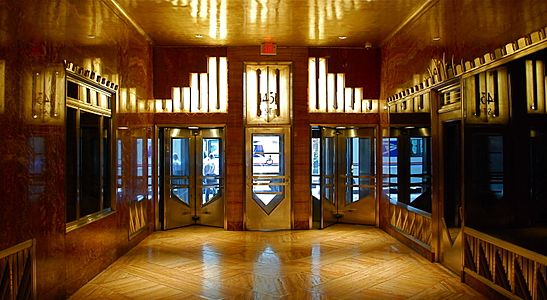
Lobby of the Chrysler Building by William Van Alen in New York City (1930)
-

Elevator of the Chrysler Building (1930)

.jpg)


The grand showcases of Art deco interior design were the lobbies of government buildings, theaters, and particularly office buildings. Interiors were extremely colorful and dynamic, combining sculpture, murals, and ornate geometric design in marble, glass, ceramics and stainless steel. An early example was the Fisher Building in Detroit, by Joseph Nathaniel French; the lobby was highly decorated with sculpture and ceramics. The Guardian Building (originally the Union Trust Building) in Detroit, by Wirt Rowland (1929), decorated with red and black marble and brightly colored ceramics, highlighted by highly polished steel elevator doors and counters. The sculptural decoration installed in the walls illustrated the virtues of industry and saving; the building was immediately termed the "Cathedral of Commerce". The Medical and Dental Building called 450 Sutter Street in San Francisco by Timothy Pflueger was inspired by Mayan architecture, in a highly stylized form; it used pyramid shapes, and the interior walls were covered highly stylized rows of hieroglyphs.[90]
In France, the best example of an Art Deco interior during period was the Palais de la Porte Dorée (1931) by Albert Laprade, Léon Jaussely and Léon Bazin. The building (now the National Museum of Immigration, with an aquarium in the basement) was built for the Paris Colonial Exposition of 1931, to celebrate the people and products of French colonies. The exterior facade was entirely covered with sculpture, and the lobby created an Art Deco harmony with a wood parquet floor in a geometric pattern, a mural depicting the people of French colonies; and a harmonious composition of vertical doors and horizontal balconies.[90]
Movie palaces
-

Grauman's Egyptian Theater in Hollywood (1922)
-

Grand Rex movie theater in Paris (1932)
-
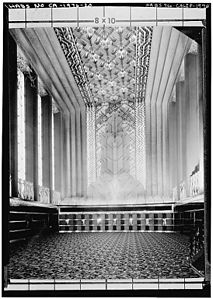
Four-story high grand lobby of the Paramount Theater, Oakland (1932)
-

Auditorium and stage of Radio City Music Hall, New York City (1932)
-
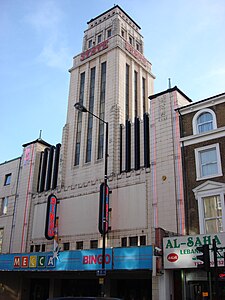
Gaumont State Cinemain London (1937)
-
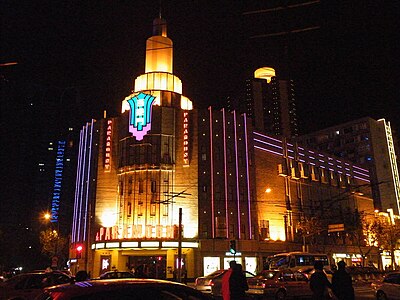


Many of the best surviving examples of Art Deco are movie theaters built in the 1920s and 1930s. The Art Deco period coincided with the conversion of silent films to sound, and movie companies built enormous theaters in major cities to capture the huge audience that came to see movies. Movie palaces in the 1920s often combined exotic themes with art deco style; Grauman's Egyptian Theater in Hollywood (1922) was inspired by ancient Egyptian tombs and pyramids, while the Fox Theater in Bakersfield, California attached a tower in California Mission style to an Art Deco hall. The largest of all is Radio City Music Hall in New York City, which opened in 1932. Originally designed as a stage theater, it quickly transformed into a movie theater, which could seat 6,015 persons The interior design by Donald Deskey used glass, aluminum, chrome, and leather to create a colorful escape from reality The Paramount Theater in Oakland, California, by Timothy Pflueger, had a colorful ceramic facade a lobby four stories high, and separate Art Deco smoking rooms for gentlemen and ladies. Similar grand palaces appeared in Europe. The Grand Rex in Paris (1932), with its imposing tower, was the largest movie theater in Europe. The Gaumont State Cinema in London (1937) had a tower modeled after the Empire State building, covered with cream-colored ceramic tiles and an interior in an Art Deco-Italian Renaissance style. The Paramount Theater in Shanghai, China (1933) was originally built as a dance hall called The gate of 100 pleasures; it was converted to a movie theater after the Communist Revolution in 1949, and now is a ballroom and disco. In the 1930s Italian architects built a small movie palace, the Cinema Impero, in Asmara in what is now Eritrea. Today, many of the movie theaters have been subdivided into multiplexes, but others have been restored and are used as cultural centers in their communities.[91]
Streamline Moderne
-

Paris Building in the Paquebot or ocean liner style, 3 boulevard Victor (1935), by Pierre Patout
-

Pan-Pacific Auditorium in Los Angeles (1936)
-
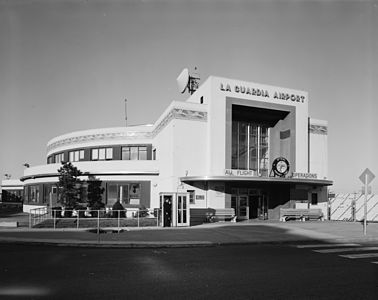
The Marine Air Terminal at La Guardia Airport (1937) was the New York terminal for the flights of Pan Am Clipper flying boats to Europe
-

The Hoover Building canteen in Perivale in the London suburbs, by Wallis, Gilbert and Partners (1938)
-

The Ford Pavilion at the 1939 New York World's Fair
-
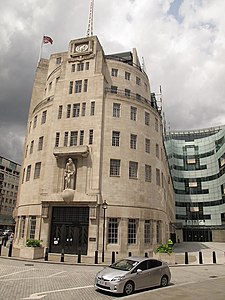
The nautical-style rounded corner of BBC Broadcasting House(1931)
-

Streamline Moderne church, First Church of Deliverance, Chicago, IL (1939), by Walter T. Bailey. Towers added 1948.


In the late 1930s, a new variety of Art Deco architecture became common; it was called Streamline Moderne or simply Streamline, or, in France, the Style Paqueboat, or Ocean Liner style. Buildings in the style were had rounded corners, long horizontal lines; they were built of reinforced concrete, and were almost always white; and sometimes had nautical features, such as railings that resembled those on a ship. The rounded corner was not entirely new; it had appeared in Berlin in 1923 in the Mossehaus by Erich Mendelsohn, and later in the Hoover Building, an industrial complex in the London suburb ofPerivale. In the United States, it became most closely associated with transport; Streamline moderne was rare in office buildings, but was often used for bus stations and airport terminals, such as terminal at La Guardia airport in New York City that handled the first transatlantic flights, via the PanAm clipper flying boats; and in roadside architecture, such as gas stations and diners. In the late 1930s a series of diners, modeled after streamlined railroad cars, were produced and installed in towns in New England; at least two examples still remain and are now registered historic buildings.[92]
Decoration and motifs
-

Iron fireplace screen, Rose Iron Works, Cleveland (1930)
-
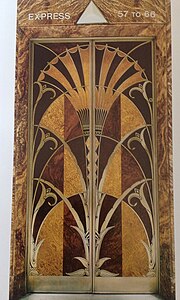
Elevator doors of the Chrysler Building, by William Van Alen (1927–30)
-
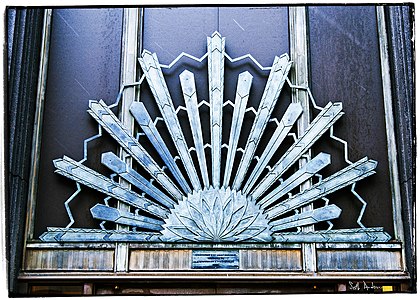
Sunrise motif from the Wisconsin Gas Building(1930)
-

Detail of mosaic facade of Paramount Theater (Oakland, California)(1931)

.jpg)


Decoration in the Art Deco period went through several distinct phases. Between 1910 and 1920, as Art Nouveau was exhausted, design styles saw a return to tradition, particularly in the work of Paul Iribe. In 1912 André Vera published an essay in the magazine L'Art Décoratif calling for a return to the craftsmanship and materials of earlier centuries, and using a new repertoire of forms taken from nature, particularly baskets and garlands of fruit and flowers. A second tendency of Art Deco, also from 1910 to 1920, was inspired by the bright colors of the artistic movement known as the Fauves and by the colorful costumes and sets of the Ballets Russes. This style was often expressed with exotic materials such as sharkskin, mother of pearl, ivory, tinted leather, lacquered and painted wood, and decorative inlays on furniture that emphasized its geometry. This period of the style reached its high point in the 1925 Paris Exposition of Decorative Arts. In the late 1920s and the 1930s, the decorative style changed, inspired by new materials and technologies. It became sleeker and less ornamental. Furniture, like architecture, began to have rounded edges and to take on a polished, streamlined look, taken from the streamline modern style. New materials, such as chrome-plated steel, aluminum and bakelite, an early form of plastic, began to appear in furniture and decoration.[93]
Throughout the Art Deco period, and particularly in the 1930s, the motifs of the decor expressed the function of the building. Theaters were decorated with sculpture which illustrated music, dance, and excitement; power companies showed sunrises, the Chrysler building showed stylized hood ornaments; The friezes of Palais de la Porte Dorée at the 1931 Paris Colonial Exposition showed the faces of the different nationalities of French colonies. The Streamline style made it appear that the building itself was in motion. The WPA murals of the 1930s featured ordinary people; factory workers, postal workers, families and farmers, in place of classical heroes.[94]
Furniture
-
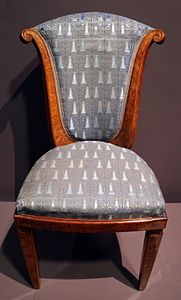
Chair by Paul Follot(1912–14)
-

Armchair by Louis Süe (1912) and painted screen by André Mare(1920)
-
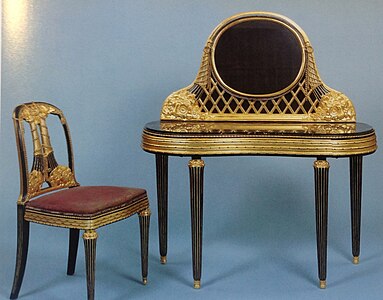
Dressing table and chair of marble and encrusted, lacquered, and gilded wood byPaul Follot (1919-1920
-
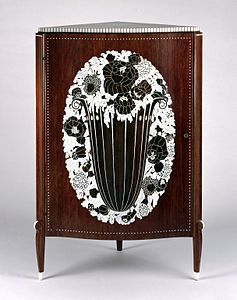
Corner cabinet of Mahogany with rose basket design of inlaid ivory by Émile-Jacques Ruhlmann (1923)
-

Cabinet by Émile-Jacques Ruhlmann (1926)
-

Cabinet design by Émile-Jacques Ruhlmann
-

Cabinet covered withshagreen or sharkskin, by André Groult (1925)
-
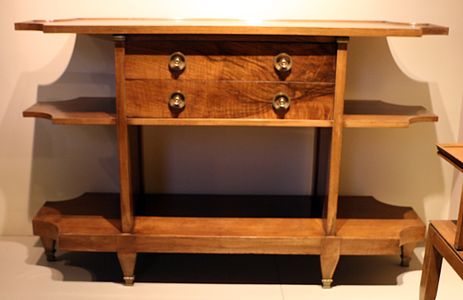
Furniture by Gio Ponti (1927)
-

Desk of an administrator, by Michel Roux-Spitz for the 1930 Salon of Decorative Artists
-
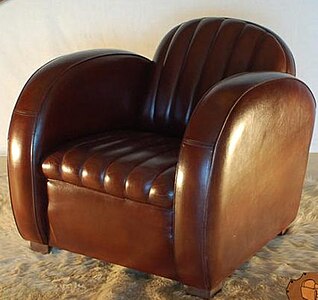
An Art Deco club chair (1930s)
-

Late Art Deco furniture and rug by Jules Leleu (1930s)
-
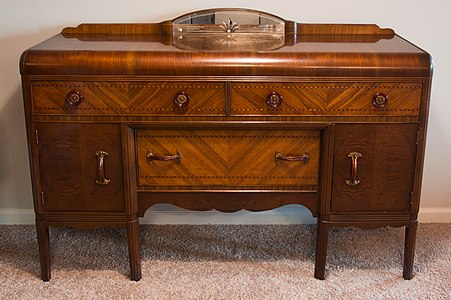
A Waterfall style buffet table

.jpg)
.jpg)
._Corner_Cabinet,_ca._1923..jpg)
_(2132077838).jpg)
_(5469658728).jpg)


_(2132078468).jpg)

French furniture from 1910 until the early 1920s was largely an updating of French traditional furniture styles, and the art nouveau designs of Louis Majorelle, Charles Plumet and other manufacturers. French furniture manufacturers felt threatened by the growing popularity of German manufacturers and styles, particularly the Biedermeier style, which was simple and clean-lined. The French designer Frantz Jourdain, the President of the Paris Salon d'Automne, invited designers from Munich to participate in the 1910 Salon. French designers saw the new German style, and decided to meet the German challenge. The French designers decided to present new French styles in the Salon of 1912. The rules of the Salon indicated that only modern styles would be permitted. All of the major French furniture designers took part in Salon: Paul Follot, Paul Iribe, Maurice Dufrene, André Groult, André Mare and Louis Suë took part, presenting new works that updated the traditional French styles of Louis XVI and Louis Philippe with more angular corners inspired by Cubism and brighter colors inspired by Fauvism and the Nabis.[95]
The painter André Mare and furniture designer Louis Suë both participated the 1912 Salon. After the war the two men joined together to form their own company, formally called the Compagnie des Arts Française, but usually known simply as Suë and Mare. Unlike the prominent art nouveau designers like Louis Majorelle, who personally designed every piece, they assembled a team of skilled craftsmen and produced complete interior designs, including furniture, glassware, carpets, ceramics, wallpaper and lighting. Their work featured bright colors and furniture and fine woods, such ebony encrusted with mother of pearl, abalone and silvered metal to create bouquets of flowers. They designed everything from the interiors of ocean liners to perfume bottles for the label of Jean Patou.The firm prospered in the early 1920s, but the two men were better craftsmen than businessmen. The firm was sold in 1928, and both men left.[96]
The most prominent furniture designer at the 1925 Decorative Arts Exposition was Émile-Jacques Ruhlmann, from Alsace. He first exhibited his works at the 1913 Autumn Salon, then had his own pavilion, the "House of the Rich Collector", at the 1925 Exposition. He used only most rare and expensive materials, including ebony, mahogany, rosewood, ambon and other exotic woods, decorated with inlays of ivory, tortoise shell, mother of pearl, Little pompoms of silk decorated the handles of drawers of the cabinets.[97] His furniture was based upon 18th-century models, but simplified and reshaped. In all of his work, the interior structure of the furniture was completely concealed. The framework usually of oak, was completely covered with an overlay of thin strips of wood, then covered by a second layer of strips of rare and expensive woods. This was then covered with a veneer and polished, so that the piece looked as if it had been cut out of a single block of wood. Contrast to the dark wood was provided by inlays of ivory, and ivory key plates and handles. According to Ruhlmann, armchairs had to be designed differently according to the functions of the rooms where they appeared; living room armchairs were designed to be welcoming, office chairs comfortable, and salon chairs voluptuous. Only a small number of pieces of each design of furniture was made, and the average price of one of his beds or cabinets was greater than the price of an average house.[98]
Jules Leleu was a traditional furniture designer who moved smoothly into Art Deco in the 1920s; he designed the furniture for the dining room of the Élysée Palace, and for the first-class cabins of the steamship Normandie. his style was characterized by the use of ebony, Macassar wood, walnut, with decoration of plaques of ivory and mother of pearl. He introduced the style of lacquered art deco furniture at the end of in the late 1920s, and in the late 1930s introduced furniture made of metal with panels of smoked glass.[99] In Italy, the designer Gio Ponti was famous for his streamlined designs.
The costly and exotic furniture of Ruhlmann and other traditionalists infuriated modernists, including the architect Le Corbusier, causing him to write a famous series of articles denouncing the arts décoratif style. He attacked furniture made only for the rich, and called upon designers to create furniture made with inexpensive materials and modern style, which ordinary people could afford. He designed his own chairs, created to be inexpensive and mass-produced.[100]
In the 1930s, furniture designs adapted to the form, with smoother surfaces and curved forms. The masters of the late style included Donald Deskey was one of the most influential designers; he created the interior of the Radio City Music Hall. He used a mixture of traditional and very modern materials, including aluminum, chrome, and bakelite, an early form of plastic.[101] The Waterfall style was popular the 1930s and 1940s, the most prevalent Art Deco form of furniture at the time. Pieces were typically of plywood finished with blond veneer and with rounded edges, resembling a waterfall.[102]
Design
-

Philips Art Deco radio set (1931)
-

Chrysler Airflow sedan, designed by Carl Breer (1934)
-

Grand dining room of the ocean liner SSNormandie (1935), by Pierre Patout; bas-reliefs byRaymond Delamarre
-
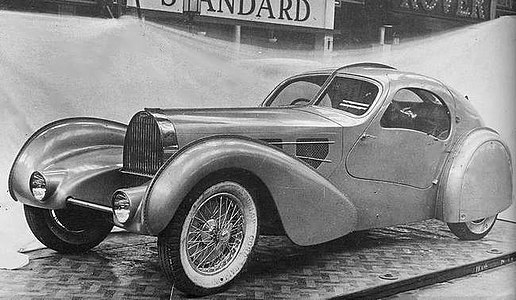
Bugatti Aérolithe (1936)
-
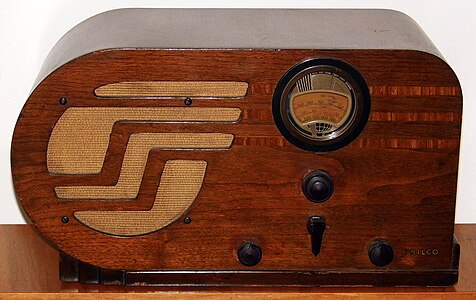
Philco Table Radio (c. 1937)
-

Electrolux Vacuum cleaner (1937)
-

Streamlined railroad locomotive (1939)


_interior.jpg)

_Table_Radio,_Model_37-610T,_Broadcast_%26_Short_Wave_Bands,_Art_Deco_Design,_5_Vacuum_Tubes,_Walnut_Veneer_Cabinet,_Circa_1937_(15351304051).jpg)


Streamline was a variety of Art Deco which emerged during the mid-1930s. It was influenced by modern aerodynamicprinciples developed for aviation and ballistics to reduce aerodynamic drag at high velocities. The bullet shapes were applied by designers to cars, trains, ships, and even objects not intended to move, such as refrigerators, gas pumps, and buildings.[50] One of the first production vehicles in this style was the Chrysler Airflow of 1933. It was unsuccessful commercially, but the beauty and functionality of its design set a precedent; meant modernity. It continued to be used in car design well after World War II.[103][104][105][106]
New industrial materials began to influence design of cars and household objects. These included aluminum, chrome, andbakelite, an early form of plastic. Bakelite could be easily molded into different forms, and soon was used in telephones, radios and other appliances.
Ocean liners also adopted a style of Art Deco, known in French as the Style Paquebot, or "Ocean Liner Style". The most famous example was the SS Normandie, which made its first transatlantic trip in 1935. It was designed particularly to bring wealthy Americans to Paris to shop. The cabins and salons featured the latest Art Deco furnishings and decoration. The Grand Salon of the ship, which was the restaurant for first-class passengers, was bigger than the Hall of Mirrors of thePalace of Versailles. It was illuminated by electric lights within twelve pillars of Lalique crystal; thirty-six matching pillars lined the walls. This was one of the earliest examples of illumination being directly integrated into architecture. The style of ships was soon adapted to buildings. A notable example is found on the San Francisco waterfront, where the Maritime Museum building, built as a public bath in 1937, resembles a ferryboat, with ship railings and rounded corners. The Star Ferry Terminal in Hong Kong also used a variation of the style.[25]
Textiles and fashion
-

Textile design Abundance by André Mare, (1911),Metropolitan Museum of Art
-
Rose Pattern Textiles designed by André Mare (c. 1919), Metropolitan Museum of Art
-

Rose Mousse pattern for upholstery, cotton and silk (1920), Metropolitan Museum of Art
-
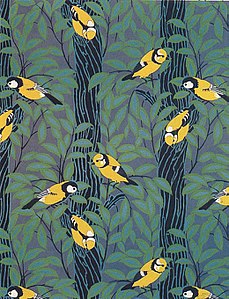
Design of birds from Les Ateliers de Martine byPaul Iribe (1918)


Textiles were an important part of the Art Deco style, in the form of colorful wallpaper, upholstery and carpets, In the 1920s, designers were inspired by the stage sets of the Ballets Russes, fabric designs and costumes from Léon Bakst and creations by the Wiener Werkstätte. The early interior designs of André Mare featured brightly colored and highly stylized garlands of roses and flowers, which decorated the walls, floors, and furniture. Stylized Floral motifs also dominated the work of Raoul Dufy and Paul Poiret, and in the furniture designs of J.E. Ruhlmann. The floral carpet was reinvented in Deco style by Paul Poiret.[107]
The use of the style was greatly enhanced by the introduction of the pochoir stencil-based printing system, which allowed designers to achieve crispness of lines and very vivid colors. Art Deco forms appeared in the clothing of Paul Poiret, Charles Worth and Jean Patou. After World War I, exports of clothing and fabrics became one of the most important currency earners of France.[108]
Late Art Deco wallpaper and textiles sometimes featured stylized industrial scenes, cityscapes, locomotives and other modern themes, as well as stylized female figures, metallic colors and geometric designs.[108]
Fashion changed dramatically during the Art Deco period, thanks in particular to designers Paul Poiret and later Coco Chanel. Poiret introduced an important innovation to fashion design, the concept of draping, a departure from the tailoring and pattern-making of the past.[109] He designed clothing cut along straight lines and constructed of rectangular motifs.[109]His styles offered structural simplicity[109] The corseted look and formal styles of the previous period were abandoned, and fashion became more practical, and streamlined. with the use of new materials, brighter colors and printed designs.[109] The designer Coco Chanel continued the transition, popularizing the style of sporty, casual chic.[110]
-

Evening coat by Paul Poiret, c. 1912, silk and metal, Metropolitan Museum of Art
-

Diving Venus Annette Kellerman in Los Angeles, California, c. 1920
-
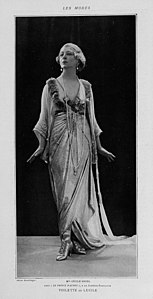
Cécile Sorel, at theComédie-Française, 1920
-

Desiree Lubovska in a dress by Jean Patou, c. 1921
-

Natacha Rambova in a dress designed by Paul Poiret, 1926
-
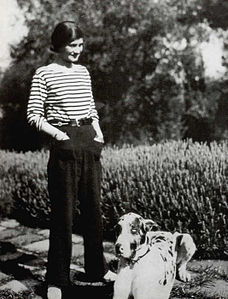
Coco Chanel in a sailor's blouse and trousers (1928)


Jewelry
-

Art Deco bracelet of gold, coral and jade (1925) (Musée des Arts Décoratifs, Paris)
-

René Lalique (1925–30), molded glass pendants on silk cords
-

Boucheron (1925), a gold buckle set with diamonds and carved onyx, lapis lazuli, jade, and coral
-
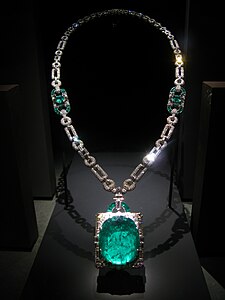
Cartier, (1930), Mackay Emerald Necklace, emerald, diamond and platinum, Smithsonian National Museum of Natural History, USA
_Museum_of_Decorative_Arts.jpg)

.jpg)

In the 1920s and 1930s, designers including René Lalique and Cartier tried to reduce the traditional dominance of diamondsby introducing more colorful gemstones, such as small emeralds, rubies and sapphires. They also placed greater emphasis on very elaborate and elegant settings, featuring less-expensive materials such as enamel, glass, horn and ivory. Diamonds themselves were cut in less traditional forms; the 1925 Exposition saw a large number of diamonds cut in the form of tiny rods or matchsticks. The settings for diamonds also changed; More and more often jewelers used platinum instead of gold, since it was strong and flexible, and could set clusters of stones. Jewelers also began to use more dark materials, such as enamels and black onyx, which provided a higher contrast with diamonds.[111]
Jewelry became much more colorful and varied in style. Cartier and the firm of Boucheron combined diamonds with colorful other gemstones cut into the form of leaves, fruit or flowers, to make brooches, rings, earrings, clips and pendants. Far Eastern themes also became popular; plaques of jade and coral were combined with platinum and diamonds, and vanity cases, cigarette cases and powder boxes were decorated with Japanese and Chinese landscapes made with mother of pearl, enamel and lacquer.[111]
Rapidly changing fashions in clothing brought new styles of jewelry. Sleeveless dresses of the 1920s meant that arms needed decoration, and designers quickly created bracelets of gold, silver and platinum encrusted with lapis-lazuli, onyx, coral, and other colorful stones; Other bracelets were intended for the upper arms, and several bracelets were often worn at the same time. The short haircuts of women in the twenties called for elaborate deco earring designs. As women began to smoke in public, designers created very ornate cigarette cases and ivory cigarette holders. The invention of the wrist-watch before World War I inspired jewelers to create extraordinary decorated watches, encrusted with diamonds and plated with enamel, gold and silver. Pendant watches, hanging from a ribbon, also became fashionable.[112]
The established jewelry houses of Paris in the period, Cartier, Chaumet, Georges Fouquet, Mauboussin, and Van Cleef & Arpels all created jewelry and objects in the new fashion. The firm of Chaumet made highly geometric cigarette boxes, cigarette lighters, pillboxes and notebooks, made of hard stones decorated with jade, lapis lazuli, diamonds and sapphires. They were joined by many young new designers, each with his own idea of deco. Raymond Templier designed pieces with highly intricate geometric patterns, including silver earrings that looked like skyscrapers. Gerard Sandoz was only 18 when he started to design jewelry in 1921; he designed many celebrated pieces based on the smooth and polished look of modern machinery. The glass designer René Lalique also entered the field, creating pendants of fruit, flowers, frogs, fairies or mermaids made of sculpted glass in bright colors, hanging on cords of silk with tassels.[112] The jeweler Paul Brandtcontrasted rectangular and triangular patterns, and embedded pearls in lines on onyx plaques. Jean Despres made necklaces of contrasting colors by bringing together silver and black lacquer, or gold with lapis lazuli. Many of his designs looked like highly polished pieces of machines. Jean Dunand was also inspired by modern machinery, combined with bright reds and blacks contrasting with polished metal.[112]
Glass art
-

The Firebird by René Lalique (1922)
-

Parrot vase by René Lalique (1922)
-

Hood ornament Victoire by René Lalique (1928)
-

A Daum vase with sculpted grapes (1925)
-

Window for a steel mill office by Louis Majorelle (1928)
-
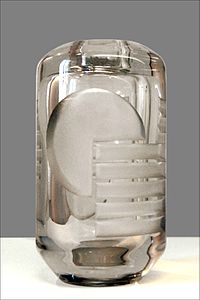
Daum vase (1930–35)

_by_Ren%C3%A9_Jules_Lalique,_1922,_blown_four_mold_glass_-_Cincinnati_Art_Museum_-_DSC04355.JPG)


_(4782889920).jpg)
Like the Art Nouveau period before it, Art Deco was an exceptional period for fine glass and other decorative objects, designed to fit their architectural surroundings. The most famous producer of glass objects was René Lalique, whose works, from vases to hood ornaments for automobiles, became symbols of the period. He had made ventures into glass before World War I, designing bottles for the perfumes of François Coty, but he did not begin serious production of art glass until after World War I. In 1918, at the age of 58, he bought a large glass works in Combs-la-Ville and began to manufacture both artistic and practical glass objects. He treated glass as a form of sculpture, and created statuettes, vases, bowls, lamps and ornaments. He used demi-crystal rather than lead crystal, which was softer and easier to form, though not as lustrous. He sometimes used colored glass, but more often used opalescent glass, where part or the whole of the outer surface was stained with a wash. Lalique provided the decorative glass panels, lights and illuminated glass ceilings for the ocean linersSS Ile de France in 1927 and the SS Normandie in 1935, and for some of the first-class sleeping cars of the French railroads. At the 1925 Exposition of Decorative Arts, he had his own pavilion, designed a dining room with a table settling and matching glass ceiling for the Sèvres Pavilion, and designed a glass fountain for the courtyard of the Cours des Métier, a slender glass column which spouted water from the sides and was illuminated at night.[113]
Other notable Art Deco glass manufacturers included Marius-Ernest Sabino, who specialized in figurines, vases, bowls, and glass sculptures of fish, nudes, and animals. For these he often used an opalescent glass which could change from white to blue to amber, depending upon the light. His vases and bowls featured molded friezes of animals, nudes or busts of women with fruit or flowers. His work was less subtle but more colorful than that of Lalique.[113]
Other notable Deco glass designers included Edmond Etling, who also used bright opalescent colors, often with geometric patterns and sculpted nudes; Albert Simonet, and Aristide Colotte and Maurice Marinot, who was known for his deeply etched sculptural bottles and vases. The firm of Daum from the city of Nancy, which had been famous for its Art Nouveau glass, produced a line of Deco vases and glass sculpture, solid, geometric and chunky in form. More delicate multicolored works were made by Gabriel Argy-Rousseau, who produced delicately colored vases with sculpted butterflies and nymphs, and Francois Decorchemont, whose vases were streaked and marbled.[113]
The Great Depression ruined a large part of the decorative glass industry, which depended upon wealthy clients. Some artists turned to designing stained glass windows for churches. In 1937, the Steuben glass company began the practice of commissioning famous artists to produce glassware.[113] Louis Majorelle, famous for his Art Nouveau furniture, designed a remarkable Art Deco stained glass window portraying steel workers for the offices of the Aciéries de Longwy, a steel mill inLongwy, France.
Metal art
-

A grill with two wings called The Pheasants, made by Paul Kiss and displayed at the 1925 Exposition of Decorative and Industrial Arts
-
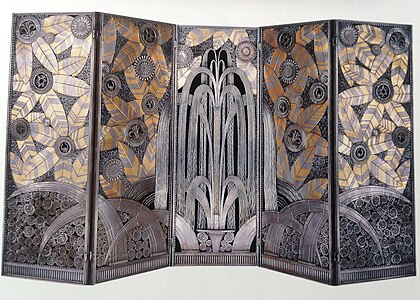
Iron and copper grill called Oasis by Edgar Brandt, displayed at the 1925 Paris Exposition
-

Cocktail set of chrome-plated steel by Norman Bel Geddes (1937)


Art Deco artists produced a wide variety of practical objects in the Art Deco style, made of industrial materials from traditional wrought iron to chrome-plated steel. The American artist Norman Bel Geddes designed a cocktail set resembling a skyscraper made of chrome-plated steel. Raymond Subes designed an elegant metal grille for the entrance of the Palais de la Porte Dorée, the centerpiece of the 1931 Paris Colonial Exposition. The French sculptor Jean Dunand produced magnificent doors on the theme "The Hunt", covered with gold leaf and paint on plaster (1935).[114]
Animation
Art Deco visuals and imagery was used in animated films including Batman, Night Hood, All's Fair at the Fair, Merry Mannequins, Page Miss Glory, Fantasia and Sleeping Beauty.[115]
Art Deco architecture around the world
Art Deco architecture began in Europe, but by 1939 there were examples in large cities on every continent and in almost every country. This is a selection of prominent buildings on each continent. (For a comprehensive of existing buildings by country, see List of Art Deco architecture.)
Africa
-

Fiat Tagliero Building in Asmara, Eritrea by Giuseppe Pettazzi(1938)[116]
-

St. Peter's Cathedral in Rabat, Morocco (1938)


Most Art Deco buildings in Africa were built during European colonial rule, and often designed by Italian and French architects.
Asia
-

New India Assurance Building in Mumbai, India (1936)
-

Broadway Mansions in Shanghai, China (1934)
-
National Diet Building in Tokyo, Japan (1936)
-

Kologdam Building in Bandung, Indonesia (1920)
-

Ankara railway station in Ankara, Turkey (1937)
-

Dare House in Chennai, India (1940)


A large number of the Art Deco buildings in Asia were designed by European architects, but in the Philippines local architectJuan Nakpil was preeminent. Many Art Deco landmarks in Asia were demolished during the great economic expansion of Asia the late 20th century, but some notable enclaves of the architecture still remain, particularly in Shanghai and Mumbai.
Australia and New Zealand
-

Manchester Unity Building inMelbourne (1932)
-

Sound Shell (1931) in Napier, New Zealand at night
-

ANZAC War Memorial inSydney (1934)


Melbourne and Sydney Australia have several notable Art Deco buildings, including the Manchester Unity Building and the former Russell Street Police Headquarters in Melbourne, the Castlemaine Art Museum in Castlemaine, central Victoria and the Grace Building, AWA Tower and ANZAC War Memorial in Sydney.
Several towns in New Zealand, including Napier and Hastings were rebuilt in Art Deco style after the 1931 Hawke's Bay earthquake, and many of the buildings have been protected and restored. Napier has been nominated for UNESCO World Heritage Site status, the first cultural site in New Zealand to be nominated.[117][118] Wellington has retained a sizeable number of Art Deco buildings.[119]
Canada, Mexico, and the United States
-

The Price Building inQuebec City, Canada (1930)
-
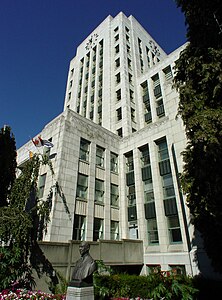
Vancouver City Hall inVancouver, British Columbia, Canada (1935)
-

La Nacional Buildings in Mexico City, México
-
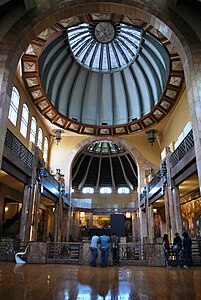
Interior of the Palacio de Bellas Artes in Mexico City, Mexico (1934)
-
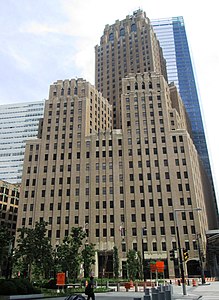
The Verizon Building inNew York City, US (1923–27)
-

Buffalo City Hall inBuffalo, US (1931)
-

Bullocks Wilshire inLos Angeles, US (1929)
-

Louisiana State Capitolin Baton Rouge, US (1930–32)
-
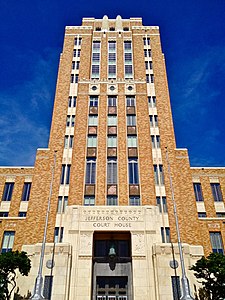
Jefferson County Courthouse inBeaumont, US (1931)


In Canada, surviving Art Deco structures are mainly in the major cities; Montreal, Toronto, Hamilton, Ontario, and Vancouver. They range from public buildings like Vancouver City Hall to commercial buildings (College Park) to public works (R. C. Harris Water Treatment Plant). File:Edificios La Nacional I y II.JPG | La Nacional Buildings Mexico City, Mexico (1932) In Mexico, the most imposing Art Deco example is interior of the Palacio de Bellas Artes (Palace of Fine Arts), finished in 1934 with its elaborate decor and murals. Examples of Art Deco residential architecture can be found in the Condesa neighborhood, many designed by Francisco J. Serrano.
In the United States, Art Deco buildings are found from coast to coast, in all the major cities. It was most widely used for office buildings, train stations, airport terminals, and movie theaters; residential buildings are rare. In the 1930s, the more austere streamline style became popular. Many buildings were demolished between 1945 and the late 1960s, but then efforts began to protect the best examples. The City of Miami Beach established the Miami Beach Architectural District to preserve the colorful collection of Art Deco buildings found there.
Central America and the Caribbean
-
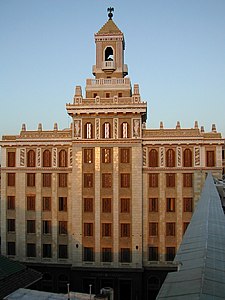
The Bacardi Building inHavana, Cuba (1930)
-

The Hotel Nacional de Cuba in Havana, Cuba (1930)
-

Havana art deco building
-

The Plaza del Mercado de Ponce in Ponce, Puerto Rico (1941)


.jpg)


Typical floor plan, the Lopez Serrano Building
Art Deco buildings can be found throughout Central America. A particularly rich
collection is found in Cuba, built largely for the large number of tourists who came to the island from the United States. One such building is the López Serrano built between 1929 and 1932 in the Vedado section of Havana.
Europe
-
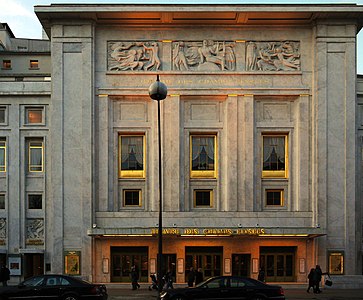
Théâtre des Champs-Élysées in Paris, France (1910–13)
-
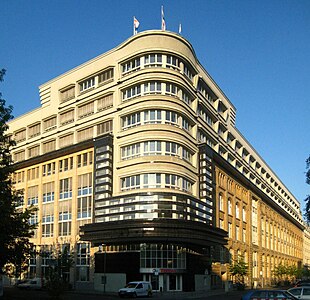
The Mossehaus with Art Deco elements by Erich Mendelsohn in Berlin, Germany (c.1923)
-

Basilica of the Sacred Heart inBrussels, Belgium (1925)
-

Éden Theater in Lisbon, Portugal (1931)
-

Palais de Tokyo, Musée d'Art Moderne de la Ville de Paris, France (1937)
-
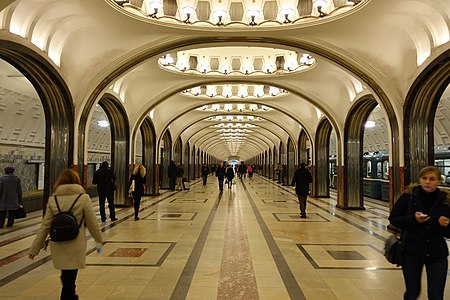
Mayakovskaya Station in Moscow, Russia (1938)
-

Rivoli Theater in Porto, Portugal (1937)
-

Daily Express Building in Manchester, UK (1939)


.jpg)


The architectural style first appeared in Paris with the Théâtre des Champs-Élysées (1910–13) by Auguste Perret but then spread rapidly around Europe, until examples could be found in nearly every large city, from London to Moscow. In Germany two variations of Art Deco flourished in the 1920s and 30s: The Neue Sachlichkeit style and Expressionist architecture. Notable examples include Erich Mendelsohn's Mossehaus and Schaubühne theater in Berlin, Fritz Höger's Chilehaus inHamburg and his Kirche am Hohenzollernplatz in Berlin, the Anzeiger Tower in Hannover and the Borsig Tower in Berlin.[120]
One of the largest Art Deco buildings in Western Europe is the Basilica of the Sacred Heart in Koekelberg, Brussels. In 1925, architect Albert van Huffel won the Grand Prize for Architecture with his scale model of the basilica at the Exposition Internationale des Arts Décoratifs et Industriels Modernes in Paris.[121]
Spain and Portugal have some striking examples of Art Deco buildings, particularly movie theaters. Examples in Portugal are the Capitólio Theater (1931) and the Éden Cine-Theater (1937) in Lisbon, the Rivoli Theater (1937) and the Coliseu (1941) in Porto and the Rosa Damasceno Theater (1937) in Santarém. An example in Spain is the Cine Rialto in Valencia (1939).
During the 1930s, Art Deco had a noticeable effect on house design in the United Kingdom,[48] as well as the design of various public buildings.[67] Straight, white-rendered house frontages rising to flat roofs, sharply geometric door surrounds and tall windows, as well as convex-curved metal corner windows, were all characteristic of that period.[68][122][123]
The London Underground is famous for many examples of Art Deco architecture,[124] and there are a number of buildings in the style situated along the Golden Mile in Brentford. Also in West London is the Hoover Building, which was originally built for The Hoover Company and was converted into a superstore in the early 1990s.
India
The Indian Institute of Architects, founded in Bombay in 1929, played a prominent role in propagating the Art Deco movement. In November 1937, this institute organized the ‘Ideal Home Exhibition’ held in the Town Hall in Bombay which spanned over 12 days and attracted about one hundred thousand visitors. As a result, it was declared a success by the 'Journal of the Indian Institute of Architects'. The exhibits displayed the ‘ideal’, or better described as the most ‘modern’ arrangements for various parts of the house, paying close detail to avoid architectural blunders and present the most efficient and well-thought-out models. The exhibition focused on various elements of a home ranging from furniture, elements of interior decoration as well as radios and refrigerators using new and scientifically relevant materials and methods.[125] Guided by their desire to emulate the west, the Indian architects were fascinated by the industrial modernity that Art Deco offered.[125] The western elites were the first to experiment with the technologically advanced facets of Art Deco, and architects began the process of transformation by the early 1930s.[125]
Bombay's expanding port commerce in the 1930s resulted in the growth of educated middle class population. It also saw an increase of people migrating to Bombay in search of job opportunities. This led to the pressing need for new developments through Land Reclamation Schemes and construction of new public and residential buildings.[126] Parallelly, the changing political climate in the country and the aspirational quality of the Art Deco aesthetics led to a whole-hearted acceptance of the building style in the city's development. Most of the buildings from this period can be seen spread throughout the city neighbourhoods in areas such as Churchgate, Colaba, Fort, Mohammed Ali Road, Cumbala Hill, Dadar, Matunga, Bandra and Chembur.[127][128]
South America
-

Lacerda Elevator in Salvador, Bahia, Brazil (1930)
-

Altino Arantes Building, inSão Paulo, Brazil (1947)
-

Viaduto do Chá, São Paulo, Brazil (1938)
-
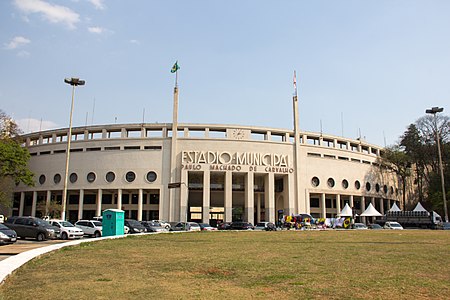
Pacaembu Stadium, São Paulo (1940)
-

Central do Brasil Station in Rio de Janeiro, Brazil (1943)
-

Kavanagh building in Buenos Aires, Argentina (1934)
-
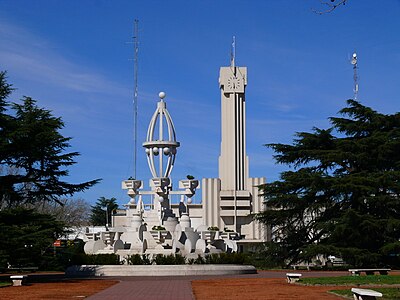
Palacio Municipal and fountain, Laprida, Buenos Aires, Argentina
-

The Abasto Market in Buenos Aires, circa 1945


.jpg)


.jpg)
The Art Deco in South America is present especially at the countries that received a great wave of immigration on the first half of the 20th century, with notable works at their richest cities, like São Paulo and Rio de Janeiro in Brazil and Buenos Aires in Argentina.The Kavanagh building in Buenos Aires (1934), by Sánchez, Lagos and de la Torre, was the tallest reinforced concrete structure when it was completed, and a notable example of late Art Deco style.
Preservation and Neo Art Deco
-

The Miami Beach Architectural Districtprotects historic Art Deco buildings
-

The U-Drop Inn, a roadside gas station and diner on U.S. Highway 66 in Shamrock, Texas (1936), now a historic monument
-

-

Smith Center for the Performing Arts in Las Vegas,Nevada, a Neo-Art Deco building (2012))


.jpg)

In many cities, efforts have been made to protect the remaining Art Deco buildings. In many U.S. cities, historic art deco movie theaters have been preserved and turned into cultural centers. Even more modest art deco buildings have been preserved as part of America's architectural heritage; an art deco cafe and gas station along Route 66 in Shamrock, Texas is an historic monument. The Miami Beach Architectural District protects several hundred old buildings, and requires that new buildings comply with the style. In Havana, Cuba, a large number of Art Deco buildings have badly deteriorated. Efforts are underway to bring the buildings back to their original color and appearance.
In the 21st century, modern variants of Art Deco, called Neo Art Deco (or Neo-Art Deco), have appeared in some American cities, inspired by the classic Art Deco buildings of the 1920s and 1930s.[129] Examples include the NBC Tower in Chicago, inspired by 30 Rockefeller Plaza in New York City; and Smith Center for the Performing Arts in Las Vegas, Nevada, which includes art deco features from Hoover Dam, fifty miles away.[129][130][131][132]
Gallery
-

"Skyscraper Lamp" designed byArnaldo dell'Ira, 1929
-
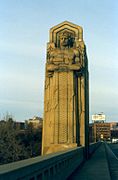
Guardians of Traffic pylon on Hope Memorial Bridge in Cleveland (1932)
-

Municipal Auditorium of Kansas City, Missouri: Hoit Price & Barnes, and Gentry, Voskamp & Neville, 1935
-

U.S. Works Progress Administration poster, John Wagner, artist, ca. 1940
-
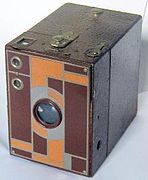
"Beau Brownie" camera, Walter Dorwin Teague 1930 design forEastman Kodak
-
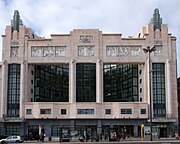
Former Teatro Eden, now Aparthotel Vip Eden in Lisbon,Portugal: Cassiano Branco and Carlo Florencio Dias, 1931
-
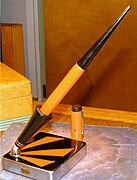
-
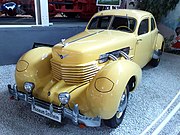
1937 Cord automobile model 812, designed in 1935 by Gordon M. Buehrig and staff
-
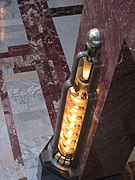
Palacio de Bellas Artes, Mexico City, Federico Mariscal, completed 1934
-
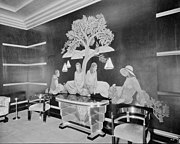
Women's Smoking Room at theParamount Theatre, Oakland.Timothy L. Pflueger, architect, 1931
-
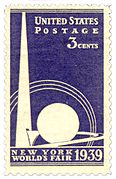
U.S. postage stamp commemorating the 1939 New York World's Fair, 1939
-

Henryk Kuna, Rytm ("Rhythm"), in Skaryszewski Park, Warsaw, Poland, 1925
-
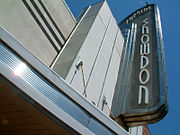
Disused Snowdon Theatre,Montreal, Quebec, Canada. Opened 1937, closed 1984. Daniel J. Crighton, architect
-

Union Terminal in Cincinnati, Ohio;Paul Philippe Cret, Alfred T. Fellheimer, Steward Wagner,Roland Wank, 1933
-

Lobby, Empire State Building, New York City. William F. Lamb, opened 1931
-

Federal Art Project poster promoting milk drinking in Cleveland, 1940
-

Interior drawing, Eaton's College Street department store, Toronto, Ontario, Canada
-

Niagara Mohawk Building,Syracuse, New York. Melvin L. King and Bley & Lyman, architects, completed 1930
,_lampada_a_grattacielo,_1929.jpg)


.jpg)


.jpg)
ART DECO AND MODERNE

Key West, FL. Smooth, veritical lines provide the art deco emphasis on this commercial building.
PERIOD OF POPULARITY: 1920’s – 1940
Identifying Art Deco: Smooth wall surface, often stucco; smooth-faced stone and metal; polychromy, often with vivid colors; forms simplified and streamlined; geometric designs including zigzags, chevrons; towers and other vertical projections, presenting a vertical emphasis; machined and often metalic construction materials for decorative features.
Identifying Art Moderne: Smooth, rounded wall surfaces, often stucco; flat roof with small ledge at roofline; horizontal grooves or lines in walls (sometimes fluted or pressed metal); asymmetrical façade; casement, corner, or ribbon windows arranged horizontally; metal balustrades; glass-block windows, often curved and built into the curved wall. Unlike Art Deco, an emphasis on the horizontal.
BACKGROUND AND INSPIRATION: Art Deco was the first widely popular style in U.S. to break with revivalist tradition represented by Beaux-Arts and period houses. Art Deco uses a style of decoration that was applied to jewelry, clothing, furniture, handicrafts, and – in this case – buildings. Industrial designers used art deco motifs to decorate streamlined cars, trains, kitchen appliances, and many other machine-age innovations. Art Deco takes its name from the Exposition Internationale des Arts Decoratifs and Industriels Modernes, held in Paris 1925. This event was billed as a showcase for works of “new inspiration and real originality”. The style strove for a modern and artistic expression to complement the machine age. An emphasis on the future rather than the past was the style’s principal characteristic. Both Art Deco and its cousin, Art Moderne, were rarely used for houses; they were more common for commercial buildings and skyscrapers, and occasional institutional buildings. The styles were most popular in New York City and other large metropolitan areas that continued to grow during the 1930s and 40s. Though relatively rare compared to other more popular styles, both Art Deco and Art Moderne spread widely throughout the country into large city and small town alike.
More Photos of Art Deco and Moderne on Flickr

Los Angeles, CA. The old Roxie Theatre on Broadway St. Art deco facades were popular for the modern-age picture theatres of the 1920s and 30s.

Boston, MA. An art deco office tower, lower floors pictured here. The vertical sleekness of the style was especially suitable for the second generation of America's skyscrapers after the 1920s.
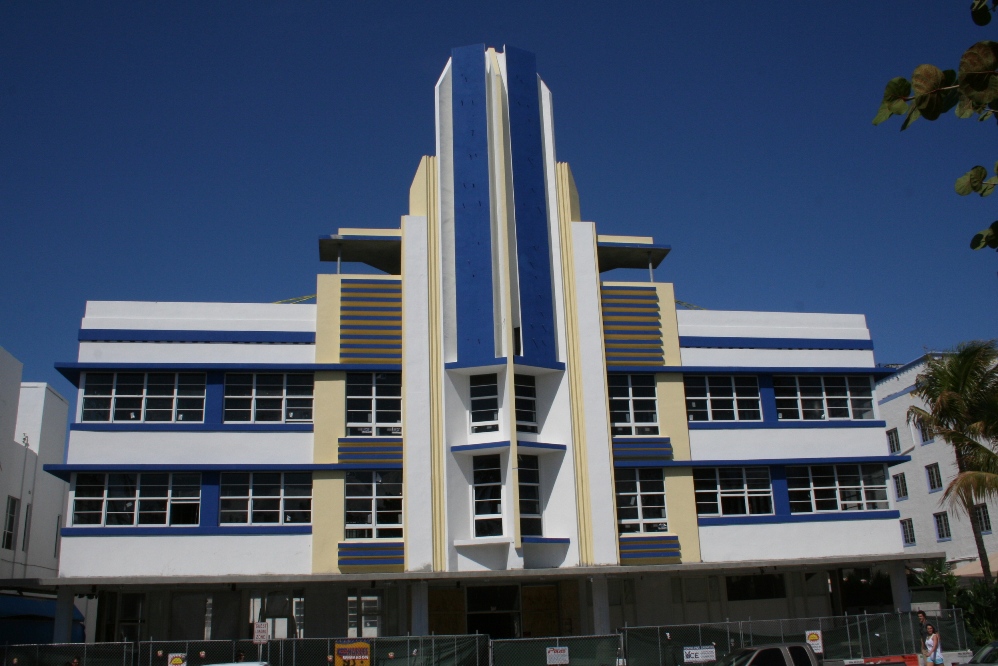
Miami Beach, FL. An impressive art deco central tower of vertical design.

Miami Beach, FL. Primarily art deco with "port hole" windows over the entry and corner windows on upper floors.

Miami Beach, FL. A combination of art deco and moderne styling provides for both veritcal and horizontal emphases.

Miami Beach, FL. Art moderne with streamlined, horizontal lines and curved ribbon windows.

Venice Beach, CA. An art moderne home with metal balustrade, curved facade, and prolific use of glass brick.

Key West, FL. A smooth, horizontal emphasis with ribbon windows and curved corner all indicate art moderne style.
ADVERTISING