Fallingwater

Fallingwater path from house to guest home
Fallingwater is a house designed by architect Frank Lloyd Wright in 1935 in rural southwestern Pennsylvania, 43 miles (69 km) southeast of Pittsburgh.[4]The house was built partly over a waterfall on Bear Run in the Mill Run section of Stewart Township, Fayette County, Pennsylvania, located in the Laurel Highlands of the Allegheny Mountains. The house was designed as a weekend home for the family of Liliane Kaufmann and her husband, Edgar J. Kaufmann Sr., owner of Kaufmann's Department Store.
After its completion, Time called Fallingwater Wright's "most beautiful job,"[5] and it is listed among Smithsonian's "Life List of 28 places to visit before you die."[6]The house was designated a National Historic Landmark in 1966.[2] In 1991, members of the American Institute of Architects named Fallingwater the "best all-time work of American architecture" and in 2007, it was ranked 29th on thelist of America's Favorite Architecture according to the AIA.[7] It and several other properties by Wright were inscribed on the World Heritage List under the title "The 20th-Century Architecture of Frank Lloyd Wright" in July 2019.[8]
History

Fallingwater, as seen from Bear Run
At age 67, Frank Lloyd Wright was given the opportunity to design and construct three buildings. With his three works of the late 1930s—Fallingwater; the Johnson Wax Building in Racine, Wisconsin; and the Herbert Jacobs housein Madison, Wisconsin—Wright regained his prominence in the architectural community.[9]
The Kaufmann
Edgar J. Kaufmann Sr. was a Pittsburgh businessman and president ofKaufmann's Department Store. Liliane Kaufmann, like her husband, was an avid outdoorsman; she enjoyed both hiking and horseback riding. In addition, both Liliane and Edgar were devoted to the public. It was important to the couple that their new home would reflect these two things.[10]
Edgar and Liliane's only child, Edgar Kaufmann Jr., eventually became the catalyst for his father’s relationship with Frank Lloyd Wright.[10] In the summer of 1934, Edgar Jr. read Frank Lloyd Wright’s An Autobiography (1932), and traveled to meet Wright at his home in Wisconsin in late September. Within three weeks, Edgar Jr. began an apprenticeship at the Taliesin Fellowship, a communal architecture program established in 1932 by Wright and his wife, Olgivanna. It was during a visit with Edgar Jr. at Taliesin in November 1934 that Edgar and Liliane Kaufmann first met Frank Lloyd Wright.[10]
The Kaufmanns lived in "La Tourelle", a French Norman estate in Fox Chapeldesigned in 1923 for Edgar J. Kaufmann by Pittsburgh architect Benno Janssen. However, the family also owned a remote property outside Pittsburgh — a small cabin near a waterfall — which was used as a summer retreat. When these cabins deteriorated, Mr. Kaufmann contacted Wright.
On December 18, 1934, Wright visited Bear Run and asked for a survey of the area around the waterfall.[11] One was prepared by Fayette Engineering Company ofUniontown, Pennsylvania, including all the site's boulders, trees, and topography, and forwarded to Wright in March 1935.[12]
Construction
As reported by Frank Lloyd Wright's apprentices at Taliesin, Edgar Kaufmann Sr. was in Milwaukee on September 22, nine months after their initial meeting, and called Wright at home early Sunday morning to surprise him with the news that he would be visiting Wright that day. Kaufmann could not wait to see Wright's plans. Wright had told Kaufmann in earlier communication that he had been working on the plans, but had not actually drawn anything. After breakfast that morning, amid a group of very nervous apprentices, Wright calmly drew the plans in the two hours in which it took Kaufmann to drive to Taliesin.[13] Witness Edgar Taffel, a current apprentice had stated that when Wright was designing the plans he spoke of how the spaces would be used, directly linking form to function.[14]
Wright designed the home above the waterfall, rather than below to afford a view of the cascades as Kaufmann had expected.[15][16] It has been said that Kaufmann was initially very upset that Wright had designed the house to sit atop the falls. Kaufmann had wanted the house located on the southern bank of Bear Run, directly facing the falls. He told Wright that they were his favorite aspect of the property.[11]
The Kaufmanns planned to entertain large groups of people, so the house needed to be larger than the original plot allowed. Also, Mr. and Mrs. Kaufmann requested separate bedrooms, as well as a bedroom for their adult son, and an additional guest room, for a total of four bedrooms.[11]
A cantilevered structure was used to address these requests.[11] The structural design for Fallingwater was undertaken by Wright in association with staff engineers Mendel Glickman and William Wesley Peters, who had been responsible for the columns featured in Wright’s revolutionary design for the Johnson Wax Headquarters.
Preliminary plans were issued to Kaufmann for approval on October 15, 1935,[17] after which Wright made an additional visit to the site and provided a cost estimate for the job. In December 1935, an old rock quarry was reopened to the west of the site to provide the stones needed for the house’s walls. Wright visited only periodically during construction, assigning his apprentice Robert Mosher as his permanent on-site representative.[17] The final working drawings were issued by Wright in March 1936, with work beginning on the bridge and main house in April.

The strong horizontal and vertical lines are a distinctive feature of Fallingwater
The construction was plagued by conflicts between Wright, Kaufmann, and the construction contractor. Uncomfortable with what he saw as Wright's insufficient experience using reinforced concrete, Kaufmann had the architect's daring cantilever design reviewed by a firm of consulting engineers. Upon receiving their report, Wright took offense, immediately requesting that Kaufmann return his drawings and indicating that he was withdrawing from the project. Kaufmann relented to Wright's gambit, and the engineer’s report was subsequently buried within a stone wall of the house.[17]
For the cantilevered floors, Wright and his team used upside-down T-shaped beams integrated into a monolithic concrete slab which formed both the ceiling of the space below and provided resistance against compression. The contractor, Walter Hall, also an engineer, produced independent computations and argued for increasing the reinforcing steelin the first floor’s slab. Wright refused the suggestion. While some sources state that the contractor quietly doubled the amount of reinforcement,[18]others say that Kaufmann's consulting engineers – at Kaufmann's request – redrew Wright's reinforcing drawings and doubled the amount of steel specified by Wright.[17]
In addition, the contractor did not build in a slight upward incline in theformwork for the cantilever to compensate for the settling and deflection of the cantilever. Once the concrete formwork was removed, the cantilever developed a noticeable sag. Upon learning of the unapproved steel addition, Wright recalled Mosher.[19]
With Kaufmann’s approval, the consulting engineers arranged for the contractor to install a supporting wall under the main supporting beam for the west terrace. When Wright discovered it on a site visit, he had Mosher discreetly remove the top course of stones. When Kaufmann later confessed to what had been done, Wright showed him what Mosher had done and pointed out that the cantilever had held up for the past month under test loads without the wall’s support.[20]
The main house was completed in 1938, and the guest house was completed the following year.[21]
Cost
The original estimated cost for building Fallingwater was $35,000. The final cost for the home and guest house was $155,000,[22][23][24] which included $75,000 for the house; $22,000 for finishings and furnishings; $50,000 for the guest house, garage and servants' quarters; and an $8,000 architect's fee. From 1938 through 1941, more than $22,000 was spent on additional details and for changes in the hardware and lighting.[25]
The total cost of $155,000, adjusted for inflation, is equivalent to about $2.8 million in 2018. The cost of the house's restoration in 2001 was estimated to be $11.5 million (approximately $16.3 million in 2018).[26]
Usage
Fallingwater was the family's weekend home from 1937 until 1963, when Edgar Kaufmann Jr. donated the property to theWestern Pennsylvania Conservancy.[23] The family retreated at Fallingwater on weekends to escape the heat and smoke of industrial Pittsburgh. Liliane enjoyed swimming in the nude and collecting modern art, especially the works of Diego Rivera, who was a guest at the country house.[27]
Kaufmann Jr. said, "[Wright] understood that people were creatures of nature, hence an architecture which conformed to nature would conform to what was basic in people. For example, although all of Falling Water [sic] is opened by broad bands of windows, people inside are sheltered as in a deep cave, secure in the sense of the hill behind them."[28]
Design

The interior of Fallingwater, showing a sitting area with furnishings designed by Wright
Fallingwater stands as one of Wright's greatest masterpieces both for its dynamism and for its integration with its striking natural surroundings. Fallingwater has been described as an architectural tour de force of Wright's organic architecture.[29] Wright's passion for Japanese architecture was strongly reflected in the design of Fallingwater, particularly in the importance of interpenetrating exterior and interior spaces and the strong emphasis placed on harmony between man and nature. Contemporary Japanese architect Tadao Ando has said of the house:
I think Wright learned the most important aspect of architecture, the treatment of space, from Japanese architecture. When I visited Fallingwater in Pennsylvania, I found that same sensibility of space. But there was the additional sounds of nature that appealed to me.[30]
The organically designed private residence was intended to be a nature retreat for its owners. The house is well-known for its connection to the site. It is built on top of an active waterfall that flows beneath the house.
The fireplace hearth in the living room integrates boulders found on the site and upon which the house was built — ledge rock which protrudes up to a foot through the living room floor was left in place to demonstrably link the outside with the inside. Wright had initially intended that the ledge be cut flush with the floor, but this had been one of the Kaufmann family's favorite sunning spots, so Mr. Kaufmann suggested that it be left as it was.[citation needed] The stone floors are waxed, while the hearth is left plain, giving the impression of dry rocks protruding from a stream.
Integration with the setting extends even to small details. For example, where glass meets stone walls no metal frame is used; rather, the glass and its horizontal dividers were run into a caulked recess in the stonework so that the stone walls appear uninterrupted by glazing. From the cantilevered living room, a stairway leads directly down to the stream below, and in a connecting space which connects the main house with the guest and servant level, a natural spring drips water inside, which is then channeled back out. Bedrooms are small, some with low ceilings to encourage people outward toward the open social areas, decks, and outdoors.

Driveway leading to the entrance of Fallingwater
Bear Run and the sound of its water permeate the house, especially during the spring when the snow is melting, and locally quarried stone walls and cantilevered terraces resembling the nearby rock formations are meant to be in harmony. The design incorporates broad expanses of windows and balconies which reach out into their surroundings. In conformance with Wright's views, the main entry door is away from the falls.
On the hillside above the main house stands a four-bay carport, servants' quarters, and a guest house. These attached outbuildings were built two years later using the same quality of materials and attention to detail as the main house. The guest quarters feature a spring-fed swimming pool which overflows and drains to the river below.
Wright had initially planned to have the house blend into its natural settings in rural Pennsylvania.[31] In doing so, he limited his color choices to two colors, light ochre for the concrete and his signature Cherokee red for the steel.[32]
After Fallingwater was deeded to the public, three carport bays were enclosed at the direction of Kaufmann Jr. to be used by museum visitors to view a presentation at the end of their guided tours on the Western Pennsylvania Conservancy (to which the home was entrusted). Kaufmann Jr. designed its interior himself, to specifications found in other Fallingwater interiors by Wright.
A model of the house was featured at the Museum of Modern Art in 2009.[33]
Western Pennsylvania Conservancy]
The cantilevers at Fallingwater
After his father’s death in 1955, Edgar Kaufmann Jr. inherited Fallingwater, continuing to use it as a weekend retreat until the early 1960s. Increasingly concerned with ensuring Fallingwater’s preservation, and following his father’s wishes, he entrusted Fallingwater and approximately 1,500 acres of land to the Western Pennsylvania Conservancy as tribute to his parents.[34] Edgar Jr. guided the organization’s thinking about Fallingwater’s administration, care and educational programming and was a frequent visitor even as guided public tours began in 1964. Kaufmann’s partner, the architect and designer Paul Mayén, also contributed to the legacy of Fallingwater with a design for the site’s visitor center, completed in 1981.[35] The house attracts more than 160,000 visitors from around the world each year.[21][36]
Preservation at Fallingwater[
Fallingwater has shown signs of deterioration over the past 80 years, due in large part to its exposure to humidity and sunlight. The severe freeze-thaw conditions of southwest Pennsylvania and water infiltration also affect the structural materials.[37] Because of these conditions, a thorough cleaning of the exterior stone walls is performed periodically. Various areas of the house are repainted as needed as part of the ongoing care of the masonry.
Fallingwater’s six bathrooms are lined with cork tiles. When used as a flooring material, the cork tiles were hand waxed, giving them a shiny finish that supplemented their natural ability to repel water. Over time, the cork has begun to show water damage in locations where water leaks persist. The Conservancy continues to restore these surfaces by removing the damaged cork and restoring the concrete underneath from any water damage before applying new cork tiles.[38]
In addition, Fallingwater's structural system includes a series of very bold reinforced concrete cantilevered balconies. Pronounced deflection of the concrete cantilevers was noticed as soon as formwork was removed at the construction stage. This deflection continued to increase over time, and eventually reached 7 inches (180 mm) over a 15 foot (4.6 m) span.

Miniature replica of the Fallingwater building atMRRV, Carnegie Science Center in Pittsburgh
In 1995, the Western Pennsylvania Conservancy commissioned a study of Fallingwater’s structural integrity. Structural engineers analyzed the movement of the cantilevers over time and conducted radar studies of the cantilevers to locate and quantify the reinforcement. These showed that the contractor had indeed added reinforcement over Wright's plan; nevertheless, the cantilevers were still insufficiently reinforced. An architecture firm was hired to fix the problem.[39] Both the concrete and its steel reinforcement were close to their failure limits. As a result, in 1997, temporary girders were installed beneath the cantilevers to carry their weight.[37][40]
In 2002, the structure was repaired permanently using post-tensioning. The living room flagstone floor blocks were individually tagged and removed. Blocks were joined to the concrete cantilever beams and floor joists, high-strength steel cables were fed through the blocks and exterior concrete walls and tightened using jacks. The floors and walls were then restored, leaving Fallingwater’s interior and exterior appearance unchanged. Today, the cantilevers have sufficient support, and the deflection stopped.[41] The Conservancy continues to monitor movement in the cantilevers.
Depictions in popular culture
- Fallingwater inspired the fictional Vandamm residence at Mount Rushmore in the 1959 Alfred Hitchcock film North by Northwest.[42]
- Composer Michael Daugherty's 2013 concerto for violin and string orchestra, "Fallingwater", was inspired by the house.[43]
- The cover of Autechre's EP Envane traces and stylizes parts of the building.
- The LEGO Architecture Set, Fallingwater (Set Number 21005) is a model of this House, released in 2009.
- Peter Blume's painting, The Rock, also commissioned by Liliane and Edgar Kaufmann, and now in the collection of theArt Institute of Chicago depicts a construction scene reminiscent of the construction of Fallingwater.[44]
- Rose Lalonde's house in the webcomic Homestuck is based on Fallingwater.
- Two characters in Neal Shusterman's Arc of a Scythe book series live at Fallingwater.[45]
Organic Architecture
You may be familiar with the term 'organic' from the produce aisle of your grocery store. When it comes to architecture, however, 'organic' means something very different.
Organic architecture refers to designing and building structures and spaces that are balanced with their natural surroundings and tailored to the function they serve for their inhabitants. Organically designed structures seem to meld with the landscape or rise from it as if the surrounding spaces gave birth to them.
Bachman House by Bruce Goff
Frank Lloyd Wright
As early as 1908, architect Frank Lloyd Wright, while not the first to use the term 'organic architecture,' began expounding his philosophy of organic architecture. His vision was for architects and designers to abandon the style traditions they learned and embrace designs shaped by the nature of the component materials, in harmony with the surrounding landscape.
He wanted them to envision form and function as a single, interconnected element. Among the many famous structures Wright designed, two of the most celebrated are:
- Fallingwater - Wright's most famous work, it uses natural stone and an existing mountain stream to blend habitation and nature.
- Unity Temple - Wright used straight lines and right angles to represent the city landscape while leaving the concrete surface uncovered.
Fallingwater by Frank Lloyd Wright
Wright's Principles of Organic Architecture
Wright's principles of organic architecture are as follows:
Shelter: Buildings must serve to protect their inhabitants' safety and privacy.
Space: The interior of a building is as much a part of its decor and aesthetic as the furnishings. Spaces should flow naturally from one area to the next without formidable separation, yet no room or space should be completely visible from any angle. The use of alcoves and other elements will create a constant sense of discovery as one moves through the space.
Nature: Inspiration should be drawn from the natural surroundings, not in imitation of them, but as guides to selecting materials, textures, and colors.
Peacefulness: The design should avoid jarring contrasts with the landscape while providing inhabitants with a sense of openness free of clutter and offering a sense of tranquility.
Language: Wright saw the patterns and forms of a building's designs as elements of grammar in the building's language. When put together the design speaks, but each construction much have its own unique voice.
Ornamentation: If ornamentation is to be used on a building, it must not appear as if it was a decorative afterthought. Rather, it must be an integral part of the structure, seamlessly joining with the overall form.
Simplicity: Designs must be clear with a uniform scheme.
Mechanical components and furniture: Whenever possible, furniture should be a built-in part of the space in order to integrate the unity of design. Mechanical components, like light fixtures, appliances, furnaces, and plumbing should be considered as part of the space itself, not overly obvious, but not a disjointed or hidden aspect.
Bruce Goff
Considered a creative genius for his architectural designs, piano compositions, and paintings,Bruce Goff stands out as a leader in the organic architecture movement for both his designs and his mentorship of new architects at the University of Oklahoma.
Originally a Kansas native, Goff took his inspiration from Frank Lloyd Wright and Louis Sullivan, one of Wright's mentors. Of his more than 500 designs, Goff witnessed the realization of over 150 of them constructed in 15 states. The majority of his works however, still stand in Oklahoma, Texas, and the Chicago region of Illinois.
Notable works by Goff include:
- The Bavinger House - Goff used locally excavated ironrock sandstone and used parts of an old oil field drilling system to unite local nature and industrial history.
- The C.A. Comer House - using repeating triangular patterns and selecting tan color schemes, Goff's creation evokes memories of teepees of Oklahoma Native Americans.
Bavinger House by Bruce Goff
Johnson Wax Headquarters
Administration Building and Research Tower, S.C. Johnson Company

Exterior, viewed towards the east, of the Johnson Wax Headquarters building
LocationRacine, WisconsinCoordinates42°42′49″N87°47′27″WCoordinates: 42°42′49″N 87°47′27″WBuilt1936ArchitectFrank Lloyd Wright; Peters, Wesley W.Architectural styleLate 19th and early 20th centuries American Movements, OtherNRHP reference #74002275[1]Significant datesAdded to NRHPDecember 27, 1974Designated NHLJanuary 7, 1976[2]


Johnson Wax Headquarters is the world headquarters and administration building of S. C. Johnson & Son in Racine, Wisconsin. Designed by Americanarchitect Frank Lloyd Wright for the company's president, Herbert F. "Hib" Johnson, the building was constructed from 1936 to 1939.[3] Its distinctive "lily pad" columns and other innovations revived Wright's career at a point when he was losing influence.[4] Also known as the Johnson Wax Administration Building, it and the nearby 14-story Johnson Wax Research Tower (built 1944–1950) were designated as a National Historic Landmark in 1976 asAdministration Building and Research Tower, S.C. Johnson and Son.[2]
Design
The Johnson Wax Headquarters were set in an industrial zone and Wright decided to create a sealed environment lit from above, as he had done with theLarkin Administration Building. The building features Wright's interpretation of the streamlined Art Moderne style popular in the 1930s. In a break with Wright's earlier Prairie School structures, the building features many curvilinear forms and subsequently required over 200 different curved "Cherokee red" bricks to create the sweeping curves of the interior and exterior. The mortar between the bricks is raked in traditional Wright-style to accentuate the horizontality of the building. The warm, reddish hue of the bricks was used in the polished concrete floor slab as well; the white stone trim and white dendriform columns create a subtle yet striking contrast. All of the furniture, manufactured by Steelcase, was designed for the building by Wright and it mirrored many of the building's unique design features.
The entrance is within the structure, penetrating the building on one side with a covered carport on the other. The carport is supported by short versions of thesteel-reinforced dendriform (tree-like) concrete columns that appear in the Great Workroom.[3] The low carport ceiling creates a compression of space that later expands when entering the main building where the dendriform columns rise over two stories tall. This rise in height as one enters the administration building creates a release of spatial compression making the space seem much larger than it is. Compression and release of space were concepts that Wright used in many of his designs, including the playroom in his Oak Park Home and Studio, the Unity Temple in Oak Park, Illinois, theSolomon R. Guggenheim Museum in New York City, and many others.
Throughout the "Great Workroom," a series of the thin, white dendriform columns rise to spread out at the top, forming a ceiling, the spaces in between the circles are set with skylights made of Pyrex glass tubing. At the corners, where the walls usually meet the ceiling, the glass tubes continue up, over and connect to the skylights creating a clerestory effect and letting in a pleasant soft light. The Great Workroom is the largest expanse of space in the Johnson Wax Building, and it features no internal walls. It was originally intended for the secretaries of the Johnson Wax company, while a mezzanineholds the administrators.
Construction
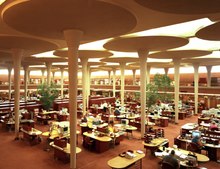
Interior, "Great Workroom", of the Johnson Wax Headquarters building
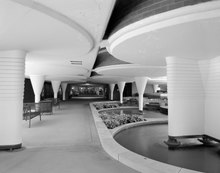
"Lily pad" columns
The construction of the Johnson Wax building created controversies for the architect. In the Great Workroom, the dendriform columns are 9 inches (23 cm) indiameter at the bottom and 18 feet (550 cm) in diameter at the top, on a wide, round platform that Wright termed the "lily pad." This difference in diameter between the bottom and top of the column did not accord with building codes at the time; they deemed the pillar's dimensions too slender at the base to support the weight. Building inspectors required that a test column be built and loaded with twelve tons of material. The test column, once it was built, was not only tough enough to support the requested weight but Wright insisted that it be loaded with fivefold the weight. It took sixty tons of materials before the "calyx," the part of the column that meets the lily pad, cracked (and even then, only collapsing when the wooden beams supporting the "lily-pad" were removed; crashing the 60 tons of materials to the ground, even damaging a water main 30 feet underground). After this demonstration, a vindicated Wright was given his building permit.
Additionally, it was very difficult to properly seal the glass tubing of the clerestories and roof, thus causing leaks. This problem was not solved until the company replaced the top layers of tubes with skylights of angled sheets of fiberglass and specially molded sheets of Plexiglas with painted dark lines to resemble in a 'trompe l'oeil' the original joints when viewed from the ground. And finally, Wright's chair design for Johnson Wax originally had only three legs, supposedly to encourage better posture (because one would have to keep both feet on the ground at all times to sit in it). However, the chair design proved too unstable, tipping very easily. Herbert Johnson, needing a new chair design, purportedly asked Wright to sit in one of the three-legged chairs and, after Wright fell from the chair, the architect agreed to design new chairs for Johnson Wax with four legs; these chairs, and the other office furniture designed by Wright, are still in use to this day.

Research tower
Despite these problems, Johnson was pleased with the building design and later commissioned the Research Tower and a house from Wright known as Wingspread.
Research Tower
The Research Tower was a later addition to the building, and provides a vertical counterpoint to the horizontal administration building. It is one of only 2 existing high rise buildings by Frank Lloyd Wright. Cantilevered from a giant stack, the tower's floor slabs spread out like tree branches, providing for the segmentation of departments vertically. Elevator and stairway channels run up the core of the building. The single reinforced central core, termed by Wright as a tap root, was based on an idea proposed by Wright for the St. Mark's Tower in 1929. Wright recycled the tap root foundation in the Price Tower in Bartlesville, Oklahoma in 1952. Freed from peripheral supporting elements, the tower rises gracefully from a garden and three fountain pools that surround its base while a spacious court on three sides provides ample parking for employees.[5]
The Research Tower is no longer in use because of the change in fire safety codes (it has one 29-inch wide twisting staircase), although the company is committed to preserving the tower as a symbol of its history.[3] In 2013, an extensive 12-month restoration was completed. The tower was relit on December 21, 2013 to mark the winter solstice, and SCJ announced that it would be opened for public tours for the first time in its history.[6] The research labs shown on the tour have been set up to appear frozen in time, including beakers, scales, centrifuges, archival photographs and letters about the building.[7]
Legacy
The Johnson Wax buildings are on the National Register of Historic Places, and the Administration Building and the Research Tower were each chosen by the American Institute of Architects as two of seventeen buildings by the architect to be retained as examples of his contribution to American culture. In addition, the Administration Building and Research Tower were both designated National Historic Landmarks in 1976.[2][8]
In 2008, the U.S. National Park Service submitted the Johnson Wax Headquarters and the Research Tower, along with nine other Frank Lloyd Wright properties, to a tentative list for World Heritage Status. The 10 sites have been submitted as one total site. The January 22, 2008, press release from the National Park Service website announcing the nominations states that, "The preparation of a Tentative List is a necessary first step in the process of nominating a site to the World Heritage List."[9] However, a revised nomination in 2011 removed the Johnson Wax Headquarters and the Research Tower from the list.[10]