Frank Gehry
Frank Gehry
.jpg)
Gehry in 2010
Born
Frank Owen Goldberg
February 28, 1929
NationalityCanadian, AmericanAlma materUniversity of Southern CaliforniaOccupationArchitectSpouse(s)Berta Isabel Aguilera (m. 1975)Children4AwardsListPracticeGehry Partners LLPBuildingsListWebsitefoga.com
Frank Owen Gehry, CC, FAIA (/ˈɡɛəri/; born Frank Owen Goldberg; February 28, 1929)[1] is a Canadian-born American architect, residing in Los Angeles.
A number of his buildings, including his private residence, have become world-renowned attractions. His works are cited as being among the most important works of contemporary architecture in the 2010 World Architecture Survey, which led Vanity Fair to label him as "the most important architect of our age".[2]
Gehry's best-known works include the titanium-clad Guggenheim Museum in Bilbao, Spain; Walt Disney Concert Hall in downtown Los Angeles; Louis Vuitton Foundation in Paris, France; MIT Ray and Maria Stata Center in Cambridge, Massachusetts; The Vontz Center for Molecular Studies on the University of Cincinnati campus; Museum of Pop Culture in Seattle; New World Center in Miami Beach; Weisman Art Museum at the University of Minnesota in Minneapolis; Dancing House in Prague; the Vitra Design Museum and the MARTa Herford museum in Germany; the Art Gallery of Ontario in Toronto; the Cinémathèque Française in Paris; and 8 Spruce Streetin New York City.
It was his private residence in Santa Monica, California, that jump-started his career. Gehry is also the designer of the future National Dwight D. Eisenhower Memoriial
Early life

Gehry Residence in Santa Monica, California (1978)
Gehry was born Frank Owen Goldberg[1] on February 28, 1929, in Toronto, Ontario, to parents Sadie Thelma (née Kaplanski/Caplan) and Irving Goldberg.[4] His father was born in Brooklyn, New York, to Russian Jewish parents, and his mother was a Polish Jewish immigrant born in Łódź.[5][6][7] A creative child, he was encouraged by his grandmother, Leah Caplan,[8] with whom he would build little cities out of scraps of wood.[9] With these scraps from her husband's hardware store, she entertained him for hours, building imaginary houses and futuristic cities on the living room floor.[4]
His use of corrugated steel, chain-link fencing, unpainted plywood and other utilitarian or "everyday" materials was partly inspired by spending Saturday mornings at his grandfather's hardware store. He would spend time drawing with his father, while his mother introduced him to the world of art. "So the creative genes were there", Gehry says. "But my father thought I was a dreamer, I wasn't gonna amount to anything. It was my mother who thought I was just reticent to do things. She would push me."[10]
He was given the Hebrew name "Ephraim" by his grandfather, but only used it at his bar mitzvah.[1]
Education
In 1947, his family immigrated to the United States settling in California. Gehry got a job driving a delivery truck, and studied at Los Angeles City College, eventually to graduate from the University of Southern California's School of Architecture. During that time, he became a member of Alpha Epsilon Pi.[11]
According to Gehry, "I was a truck driver in L.A., going to City College, and I tried radio announcing, which I wasn't very good at. I tried chemical engineering, which I wasn't very good at and didn't like, and then I remembered. You know, somehow I just started wracking my brain about, 'What do I like?' Where was I? What made me excited? And I remembered art, that I loved going to museums and I loved looking at paintings, loved listening to music. Those things came from my mother, who took me to concerts and museums. I remembered Grandma and the blocks, and just on a hunch, I tried some architecture classes."[12] Gehry graduated with a Bachelor of Architecture degree from the University of Southern California (USC) in 1954.[13]
After graduating from college, he spent time away from the field of architecture in numerous other jobs, including service in the United States Army.[9] In the fall of 1956, he moved his family to Cambridge, where he studied city planning at the Harvard Graduate School of Design. He left before completing the program, disheartened and underwhelmed.[14]Gehry's left-wing ideas about socially responsible architecture were under-realized,[clarification needed] and the final straw occurred when he sat in on a discussion of one professor's "secret project in progress"—a palace that he was designing for right-wing Cuban dictator Fulgencio Batista (1901–1973).[4]
Career

Chiat/Day Building in Venice, California (1991)
.jpg)
Part of the roof of the Fondation Louis Vuitton building as seen from the Bois de Boulogne in Paris, France (2016)

New World Center in Miami Beach, Florida (2011)

The tower at 8 Spruce Street in Lower Manhattan, completed in February 2011, has a stainless steel and glass exterior and is 76 stories high (2011)
Gehry returned to Los Angeles to work for Victor Gruen Associates, to whom he had been apprenticed while at the USC School of Architecture. In 1957 he was given the chance to design his first private residence at the age of 28, with friend and old classmate Greg Walsh. Construction was done by another neighbor across the street from his wife's family, Charlie Sockler. Built in Idyllwild, California, for his wife Anita's family neighbor Melvin David, "The David Cabin",[15]shows features that were to become synonymous with later work. The over 2,000 sq ft (190 m2) mountain retreat has unique design features with strong Asian influences, stemming from his earliest inspirations at the time like Shosoin Treasure House in Nara, Japan, among others. Beams protrude from the exterior sides, vertical grain douglas fir detail, and exposed, unfinished ceiling beams are prominent features.
In 1961, he moved to Paris where he worked for architect Andre Remondet.[16] In 1962, Gehry established a practice in Los Angeles which became Frank Gehry and Associates in 1967[9] and then Gehry Partners in 2001.[17] Gehry's earliest commissions were all in Southern California, where he designed a number of innovative commercial structures such as Santa Monica Place (1980) and residential buildings such as the eccentric Norton House (1984) in Venice, California.[18]
Among these works, however, Gehry's most notable design may be the renovation of his own Santa Monica residence.[19] Originally built in 1920 and purchased by Gehry in 1977, the house features a metallic exterior wrapped around the original building that leaves many of the original details visible.[20] Gehry still resides there.
Other completed buildings designed by Gehry during the 1980s include the Cabrillo Marine Aquarium (1981) in San Pedro and the California Aerospace Museum (1984) at the California Museum of Science and Industry in Los Angeles.
In 1989, Gehry was awarded the Pritzker Architecture Prize. The jury cited Gehry as "Always open to experimentation, he has as well a sureness and maturity that resists, in the same way that Picasso did, being bound either by critical acceptance or his successes. His buildings are juxtaposed collages of spaces and materials that make users appreciative of both the theatre and the back-stage, simultaneously revealed."[21]
Though Gehry continued to design other notable buildings in California such as the Chiat/Day Building (1991) in Venice in collaboration with Claes Oldenburg, which is well known for its massive sculpture of binoculars, he also began to receive larger national and international commissions. These include Gehry's first European commission, the Vitra International Furniture Manufacturing Facility and Design Museum in Germany completed in 1989. This was soon followed by other major commissions including the Frederick Weisman Museum of Art[22] (1993) in Minneapolis, Minnesota, the Cinémathèque Française[23] (1994) in Paris, and the Dancing House[24] (1996) in Prague.
In 1997, Gehry vaulted to a new level of international acclaim[2] when the Guggenheim Museum Bilbao opened in Bilbao, Spain. Hailed by The New Yorker as a "masterpiece of the twentieth century" and legendary architect Philip Johnson as "the greatest building of our time",[25]the museum became famous for its striking yet aesthetically pleasing design and the economic effect that it had on the city.
Since then, Gehry has regularly won major commissions and has further established himself as one of the world's most notable architects. His best received works include several concert halls for classical music, such as the boisterous and curvaceous Walt Disney Concert Hall(2003) in Downtown Los Angeles, which has been the centerpiece of the neighborhood's revitalization and has been labeled by the Los Angeles Times as "the most effective answer to doubters, naysayers, and grumbling critics an American architect has ever produced",[26] the open-air Jay Pritzker Pavilion (2004) adjacent to Millennium Park in Chicago,[27] and the understated New World Center (2011) in Miami Beach, which the LA Times called "a piece of architecture that dares you to underestimate it or write it off at first glance."[28]
Other notable works include academic buildings such as the Stata Center (2004)[29] at MIT and the Peter B. Lewis Library (2008) at Princeton University,[30] museums such as the Museum of Pop Culture (2000) in Seattle, Washington,[31] commercial buildings such as the IAC Building (2007) in New York City,[32] and residential buildings such as Gehry's first skyscraper, the Beekman Tower at 8 Spruce Street (2011)[33] in New York City.
Several recent and ongoing major works by Gehry around the world include the Dr Chau Chak Wing Building in the University of Technology Sydney, completed in 2014.[34] The Chau Chak Wing, with its 320,000 bricks in "sweeping lines" is described as "10 out of 10" on a scale of difficulty.[35] An ongoing project is the Guggenheim Abu Dhabi on Saadiyat Island in the United Arab Emirates.[36] Other significant projects such as the Mirvish Towers in Toronto,[37] and a multi-decade renovation of the Philadelphia Museum of Art are currently in the design stage. In October 2013, Gehry was appointed joint architect with Foster + Partners to design the "High Street" phase of the development of Battersea Power Station in London, Gehry's first project there.[38]
However, in recent years, some of Gehry's more prominent designs have failed to go forward. In addition to unrealized designs such as a major Corcoran Art Gallery expansion in Washington, D.C., and a new Guggenheim museum near the South Street Seaport in New York City, Gehry was notoriously dropped by developer Bruce Ratner from the Pacific Park (Brooklyn) redevelopment project and was also dropped in 2014 as the designer of the World Trade Center Performing Arts Center; both of these projects were in New York City.[39] That said, some stalled projects have recently shown progress: after many years and a dismissal, Gehry was recently reinstated as architect for the Grand Avenue Project in Los Angeles and, though Gehry's controversial[40][41] [42] design of the National Dwight D. Eisenhower Memorialin Washington, D.C., has been subject to numerous delays during the approval process with the United States Congress, the project was finally approved in 2014 with a modified design.
In 2014, two significant, long-awaited museums designed by Gehry opened: the Biomuseo,[43] a biodiversity museum in Panama City, Panama, and the Fondation Louis Vuitton,[44][45][46] a modern art museum in the Bois de Boulogne park in Paris, France, which opened to some rave reviews.[47]
Also in 2014, Gehry was commissioned by River LA, formerly known as the Los Angeles River Revitalization Corporation, a nonprofit group founded by the city of Los Angeles in 2009 to coordinate river policy, to devise a wide-ranging new plan for the river.[48][49]
In February 2015 the new building for the University of Technology Sydney was officially opened, with a façade constructed from more than 320,000 hand-placed bricks and glass slabs, and costing AU$180 million. Gehry said he would not design a building like the "crumpled paper bag" again.[50]
Gehry told the French newspaper La Croix in November 2016 that President of France François Hollande had assured the architect that he could relocate to France if Donald Trump was elected President of the United States.[51][52] The following month Gehry said that he had no plans to move.[53] He and Trump exchanged words in 2010 when Gehry's 8 Spruce Street, originally known as Beekman Tower, was built 1 foot (0.30 m) taller than the nearby Trump Building, which until then had been New York City's tallest residential building.[52][54]
Architectural style
Said to "defy categorisation", Gehry's work reflects a spirit of experimentation coupled with a respect for the demands of professional practice and has remained largely unaligned with broader stylistic tendencies or movements.[55] With his earliest educational influences rooted in modernism, Gehry's work has sought to escape modernist stylistic tropes while still remaining interested in some of its underlying transformative agendas. Continually working between given circumstances and unanticipated materializations, he has been assessed as someone who "made us produce buildings that are fun, sculpturally exciting, good experiences" although his approach may become "less relevant as pressure mounts to do more with less".[55]
Gehry is sometimes associated with what is known as the "Los Angeles School" or the "Santa Monica School" of architecture. The appropriateness of this designation and the existence of such a school, however, remains controversial due to the lack of a unifying philosophy or theory. This designation stems from the Los Angeles area's producing a group of the most influential postmodern architects, including such notable Gehry contemporaries as Eric Owen Moss and Pritzker Prize-winner Thom Mayne of Morphosis, as well as the famous schools of architecture at the Southern California Institute of Architecture (co‑founded by Mayne), UCLA, and USC where Gehry is a member of the board of directors.[citation needed]
Gehry's style at times seems unfinished or even crude, but his work is consistent with the California "funk" art movement in the 1960s and early 1970s, which featured the use of inexpensive found objects and non-traditional media such as clay to make serious art.[56] His works always have at least some element of deconstructivism.[57] Gehry has been called "the apostle of chain-link fencing and corrugated metal siding".[58] However, a retrospective exhibit at New York's Whitney Museum in 1988 revealed that he is also a sophisticated classical artist, who knows European art history and contemporary sculpture and painting.[56]
Gallery
-

"El Peix", fish sculpture located in front of the Port Olímpic, in Barcelona, Catalonia, Spain (1992)

-
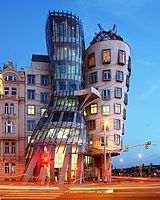
Dancing House in Prague (1996)

-
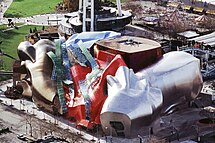
The Museum of Pop Culture in Seattle(2000)


-
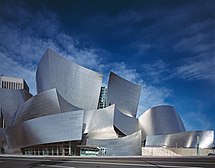
Walt Disney Concert Hall in Los Angeles(2003)


-
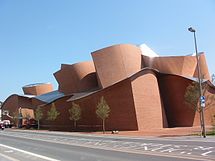
MARTa Herford, Herford, Germany(2005)

-
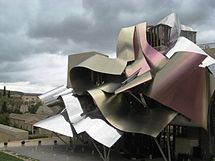
Hotel Marqués de Riscal in Elciego, Spain (2006)

-
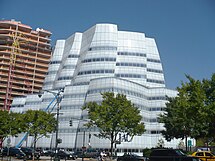
The headquarters of IAC in Manhattan, New York City (2007)
-

Art Gallery of Ontario in Toronto, Ontario, Canada (2008)


-

Gallery of African American Art, Ohr-O'Keefe Museum Of Art campus in Biloxi, Mississippi (2010)

-

Dr Chau Chak Wing Building in Sydney, Australia (2014)
.jpg)
-
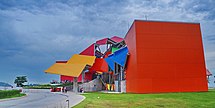
Biomuseo in Panama City (2014)
-

David Cabin - Idyllwild CA (1957)


Bilbao effect

The Guggenheim Museum in Bilbao, Spain
After the phenomenal success of Gehry's design for the Guggenheim Museum in Bilbao, Spain, critics began referring to the economic and cultural revitalization of cities through iconic, innovative architecture as the "Bilbao effect".[59] In the first 12 months after the museum was opened, an estimated US$160 million were added to the Basque economy. Indeed, over $3.5 billion has been added to the Basque economy since the building opened.[60] In subsequent years there have been many attempts to replicate this effect through large-scale eye-catching architectural commissions that have been both successful and unsuccessful, such as Daniel Libeskind's expansion of the Denver Art Museum and buildings by Gehry himself such as the almost universally well-received Walt Disney Concert Hall in Los Angeles and the more controversial Museum of Pop Culture in Seattle.[61] Though some link the concept of the Bilbao Effect to the notion of starchitecture, Gehry has consistently rejected the label of a starchitect.[62]
Criticism
Though much of Gehry's work has been well-received, reception of Gehry's work is not always positive. Art historian Hal Foster reads Gehry's architecture as, primarily, in the service of corporate branding.[63] Criticism of his work includes complaints over design flaws that the buildings waste structural resources by creating functionless forms, do not seem to belong in their surroundings or enhance the public context of their locations, and are apparently designed without accounting for the local climate.[64][65][66]
Moreover, the socialist magazine Jacobin pointed out that Gehry's work can be summed up as architecture for the super-wealthy, in the sense that it is expensive, not resourceful, and does not serve the interests of the overwhelming majority. The article criticized Gehry's statement that, "In the world we live in, 98 percent of what gets built and designed today is pure shit."[67]
Other aspects of career
Academia
In January 2011, Gehry joined the University of Southern California (USC) faculty, as the Judge Widney Professor of Architecture.[68] He has since continued in this role at his alma mater. In addition to his position at USC, Gehry has held teaching positions at Harvard University, the University of California at Los Angeles, the University of Toronto, Columbia University, the Federal Institute of Technology in Zurich, and at Yale University where he is still teaching as of 2017.[69]
Though Gehry is often referred to as a "starchitect", Gehry has repeatedly expressed his disdain for the term, insisting instead that he is only an architect.[62][70] Steve Sample, President of the University of Southern California, told Gehry that "...After George Lucas, you are our most prominent graduate".
As of December 2013, Gehry has received over a dozen honorary degrees from various universities (see #Honorary doctorates).
In February 2017, MasterClass announced an online architecture course taught by Gehry that was then released in July.[71]
Exhibition design
Gehry has been involved in exhibition designs at the Los Angeles County Museum of Art dating back to the 1960s. In 1965 Gehry designed the exhibition display for the "Art Treasures of Japan" exhibition at the LACMA. This was followed soon after by the exhibition design for the "Assyrian Reliefs" show in 1966 and the "Billy Al Bengston Retrospective" in 1968. The LACMA then had Gehry design the installation for the "Treasures of Tutankhamen" exhibition in 1978 followed by the "Avant-Garde in Russia 1910–1930" exhibition in 1980. The subsequent year Gehry designed the exhibition for "Seventeen Artists in the 60's" at the LACMA followed soon after by the "German Expressionist Sculpture Exhibition" in 1983. In 1991/92, Gehry designed the installation of the landmark exhibition "Degenerate Art: The Fate of the Avant-Garde in Nazi Germany", which opened at the Los Angeles County Museum of Art and traveled to the Art Institute of Chicago, the Smithsonian Institution in Washington and the Altes Museum in Berlin.[72][73] In 2014, Gehry was asked to design an exhibition on the work of Alexander Calder at the Los Angeles County Museum of Art's Resnick Pavilion, again invited by the museum's curator Stephanie Barron.[74] The exhibition began on November 24, 2013, and ran through July 27, 2014.
In addition to his long-standing involvement with exhibition design at the LACMA, Gehry has also designed numerous exhibition installations with other institutions. In 1998, "The Art of the Motorcycle" exhibition opened at the Solomon R. Guggenheim Museum with its installation designed by Gehry. This exhibition subsequently traveled to the Field Museum of Natural History in Chicago, the Guggenheim Museum in Bilbao and the Guggenheim Las Vegas.
In 2014, he curated an exhibition of photography by his close friend and businessman Peter Arnell that ran from March 5 through April 1 at Milk Studios Gallery in Los Angeles.[75]
Stage design
In 1983, Gehry created the stage design for Lucinda Childs' dance Available Light, set to music by John Adams. It premiered at the Museum of Contemporary Art, Los Angeles at the "Temporary Contemporary", and was subsequently seen at the Brooklyn Academy of Music Opera House in New York City, and the Theatre de la Ville in Paris. The set consisted of two levels angled in relation to each other, with a chain-link backdrop.[76] The pieces was revived in 2015,[77] and was performed, among other places, in Los Angeles and Philadelphia, where it was presented by FringeArts, which commissioned the revival.[78]
In 2012 Gehry designed the set for the Los Angeles Philharmonic's opera production of Don Giovanni, performed at the Walt Disney Concert Hall.
In April 2014 Gehry designed a set for an "exploration of the life and career of Pierre Boulez" by the Chicago Symphony Orchestra, which was performed in November of that year.[79]
Other designs

Wiggle side chair
In addition to architecture, Gehry has made a line of furniture, jewelry for Tiffany & Co., various household items, sculptures, and even a glass bottle for Wyborowa Vodka. His first line of furniture, produced from 1969 to 1973, was called "Easy Edges", constructed out of cardboard. Another line of furniture released in the spring of 1992 is "Bentwood Furniture". Each piece is named after a different hockey term. He was first introduced to making furniture in 1954 while serving in the U.S. Army, where he designed furniture for the enlisted soldiers.
In many of his designs, Gehry is inspired by fish. "It was by accident I got into the fish image", claimed Gehry. One thing that sparked his interest in fish was the fact that his colleagues were recreating Greek temples. He said, "Three hundred million years before man was fish....if you gotta go back, and you're insecure about going forward...go back three hundred million years ago. Why are you stopping at the Greeks? So I started drawing fish in my sketchbook, and then I started to realize that there was something in it."[80]
As a result of his fascination, the first Fish Lamps were fabricated between 1984 and 1986. They employed wire armatures molded into fish shapes, onto which shards of plastic laminate ColorCore are individually glued. Since the creation of the first lamp in 1984, the fish has become a recurrent motif in Gehry's work, most notably in the Fish Sculpture at La Vila Olímpica del Poblenou in Barcelona (1989–92) and Standing Glass Fish for the Minneapolis Sculpture Garden (1986).[81]
Gehry has previously collaborated with luxury jewelry company Tiffany & Co creating six distinct jewelry collections: the Orchid collection, Fish collection, Torque collection, Equus collection, Axis collection and Fold collection. In addition to jewelry, Gehry designed other items including a distinctive collector's chess set as well as a series of tableware items including vases, cups and bowls for the company.[82]
In 2004, Gehry designed the official trophy for the World Cup of Hockey.[83] He redesigned the trophy for the next tournament in 2016.[84]
In 2014, Gehry was one of the 6 "iconoclasts" selected by French fashion house Louis Vuitton to design a piece using their iconic monogram pattern as part of their "Celebrating Monogram" campaign.[85]
In 2015, Gehry designed his first yacht.[86]
Software development
Gehry's firm was responsible for innovation in architectural software.[87] His firm spun off another firm called Gehry Technologies that was established in 2002. In 2005, Gehry Technologies began a partnership with Dassault Systèmes to bring innovations from the aerospace and manufacturing world to AEC and developed Digital Project software as well as GTeam software. In 2014, Gehry Technologies was acquired by software company Trimble Navigation.[88] Its client list includes Diller Scofidio + Renfro, Herzog & de Meuron, Jean Nouvel, Coop Himmelb(l)au and Zaha Hadid.
Personal life
In 1952, Gehry (then Goldberg) married Anita Snyder. According to an interview with Gehry on the genealogy program Finding Your Roots, he changed his name in 1956 to Frank O. Gehry in part because of the antisemitism he had experienced as a child and as an undergraduate at USC. Gehry and Snyder divorced in 1966.
He married his current wife, Panamanian Berta Isabel Aguilera, in 1975. He has two daughters from his first marriage and two sons from his second marriage.
Having grown up in Canada, Gehry is an avid fan of ice hockey. He began a hockey league in his office, FOG (which stands for Frank Owen Gehry), though he no longer plays with them.[89] In 2004, he designed the trophy for the World Cup of Hockey.[90] Gehry holds dual citizenship in Canada and the United States. He lives in Santa Monica, California, and continues to practice out of Los Angeles.
Gehry is known for his sometimes cantankerous personality. During a trip to Oviedo, Spain, to accept the prestigious Prince of Asturias Award in October 2014, he received a significant amount of attention, both positive and negative, for publicly flipping off a reporter at a press conference who accused him of being a "showy" architect.[91][92]
Gehry is a member of the California Yacht Club in Marina Del Rey, California, and enjoys sailing with his fiberglass-hulled yacht, "Foggy".[93] Gehry also serves on the Leadership council of The New York Stem Cell Foundation.[94]
In popular culture
In 2004, he voiced himself on the children's TV show Arthur, where he helped Arthur and his friends design a new treehouse.[95] Gehry also voiced himself in the 2005 episode of The Simpsons called "The Seven-Beer Snitch", in which he designs a concert hall for the fictional city of Springfield. Gehry has since voiced that he regrets his appearance since a joke about his design technique has led people to misunderstand his architectural process.[96]
In 2006, filmmaker Sydney Pollack made a documentary about Gehry's work called Sketches of Frank Gehry. The film, which followed Gehry over the course of five years and painted a positive portrait of his character, was well-received critically.[97]
In 2009, architecturally-inspired ice cream sandwich company Coolhaus named a cookie and ice cream combination after Gehry. Dubbed the "Frank Behry", it features Strawberries & Cream gelato and snickerdoodle cookies.[98][99]
Works
Exhibitions of Gehry's work
In October 2014, the first major European exhibition of Gehry's work debuted at the Centre Pompidou in Paris, France.[100] Other museums or major galleries that have done exhibitions on Gehry's architecture or design include the Leo Castelli Gallery in 1983 and the Walker Art Center in 1986 whose exhibition then traveled to the Toronto Harbourfront Museum, the Contemporary Arts Museum Houston, the High Museum of Art in Atlanta, the LACMA and the Whitney Museum. Subsequently, further museums that have done major exhibitions on Gehry's work include the Philadelphia Museum of Art, the Museum of Modern Art in 1992, the Gagosian Gallery in 1984, 1992 and 1993, the Solomon R. Guggenheim Museum in 2001, the Guggenheim Bilbao in 2002, the Jewish Museum in Manhattan in 2010 and the Milan Triennale, first in 1988 and then in 2010, with an exhibition entitled "Frank Gehry from 1997." In 2015, LACMA held a major retrospective of Gehry's work.[101]
Gehry participated in the 1980 Venice Biennale's La Strada Novissima installation. He also contributed to the 1985 Venice Biennale with an installation and performance named Il Corso del Coltello done in collaboration with Claes Oldenburg. His projects were featured in the 1996 Venice Biennale. He subsequently contributed to the 2008 Venice Biennale with the installation Ungapatchket.
In October 2015, 21 21 Design Sight in Tokyo held the exhibition Frank Gehry. I Have An Idea, curated by Japanese architect Tsuyoshi Tane.[102]
Awards and honors

The Lou Ruvo Center for Brain Health of the Cleveland Clinic in Las Vegas, Nevada (2010)
- 1987: Fellow of American Academy of Arts and Letters
- 1988: Elected into the National Academy of Design
- 1989: Pritzker Architecture Prize
- 1992: Praemium Imperiale
- 1994: The Dorothy and Lillian Gish Prize
- 1995: American Academy of Achievement's Golden Plate Award[103]
- 1998: National Medal of Arts[104]
- 1998: Gold Medal Award, Royal Architectural Institute of Canada
- 1999: AIA Gold Medal, American Institute of Architects
- 2000: Cooper–Hewitt National Design Award Lifetime Achievement[105]
- 2002: Companion of the Order of Canada[106]
- 2004: Woodrow Wilson Award for Public Service
- 2006: Inductee, California Hall of Fame
- 2007: Henry C. Turner Prize for Innovation in Construction Technology from the National Building Museum (on behalf of Gehry Partners and Gehry Technologies)
- 2009: Order of Charlemagne
- 2012: Twenty-five Year Award, American Institute of Architects
- 2014: Prince of Asturias Award
- 2014: Commandeur of the Ordre National de la Légion d'honneur, France
- 2015: J. Paul Getty Medal
- 2016: Harvard Arts Medal
- 2016: Leonore and Walter Annenberg Award for Diplomacy through the Arts, Foundation for Arts and Preservation in Embassies
- 2016: Presidential Medal of Freedom
- 2018: Neutra Medal[107]
Gehry was elected to the College of Fellows of the American Institute of Architects (AIA) in 1974, and he has received many national, regional and local AIA awards. He is a Senior Fellow of the Design Futures Council and serves on the steering committee of the Aga Khan Award for Architecture.
External video
 Frank Gehry: My days as a young rebel, 44:28, TED Talks[108] Frank Gehry: A master architect asks, Now what?, 21:56, TED Talks[109]
Honorary doctorates
- 1987: California Institute of the Arts
- 1987: Rhode Island School of Design
- 1989: Otis College of Art and Design
- 1989: Technical University of Nova Scotia
- 1993: Occidental College
- 1995: Whittier College
- 1996: Southern California Institute of Architecture
- 1998: University of Toronto
- 2000: Harvard University
- 2000: University of Edinburgh
- 2000: University of Southern California
- 2000: Yale University
- 2002: City College of New York
- 2004: School of the Art Institute of Chicago
- 2013: Case Western Reserve University
- 2013: Princeton University
- 2014: Juilliard School
- 2015: University of Technology Sydney
- 2017: University of Oxford
- Bletter, Rosemarie Haag; Walker Art Center (1986). The Architecture of Frank Gehry. New York: Rizzoli. ISBN 0-8478-0763-0. ISBN 978-0-8478-0763-5.
- Friedman, Mildred (ed.); Sorkin, Michael (December 17, 1999). Gehry Talks: Architecture + Process (Hardcover) (1st ed.). New York: Rizzoli. ISBN 978-0-8478-2165-5.
- Gehry, Frank O. (2004). Gehry Draws. Violette Editions. ISBN 978-1-900828-10-9.
- Richardson, Sara S. (1987). Frank O. Gehry: A Bibliography. Monticello, Ill.: Vance Bibliographies. ISBN 1-55590-145-X.
- van Bruggen, Coosje (December 30, 1999) [1997]. Frank O. Gehry: Guggenheim Museum Bilbao (Hardcover) (1st ed.). New York: Guggenheim Museum Pubns. ISBN 978-0-8109-6907-0.
Tadao Ando
Jump to navigationJump to search
Tadao Ando

Tadao Ando (2004)
Born13 September 1941
NationalityJapaneseOccupationArchitectAwards
- Alvar Aalto Medal, 1985
- Carlsberg Architectural Prize, 1992
- Pritzker Prize, 1995
- RIBA Royal Gold Medal, 1997
- AIA Gold Medal, 2002
- Neutra Medal for Professional Excellence, 2012
PracticeTadao Ando Architects & AssociatesBuildings
- Row House, Sumiyoshi, 1979
- Church of the Light, Osaka, 1989
- Water Temple, Awaji, 1991
ProjectsRokko Housing I, II, III, Kobe, 1983–1999
Tadao Ando (安藤 忠雄 Andō Tadao, born 13 September 1941) is a Japanese self-taught architect[1][2] whose approach to architectureand landscape was categorized by architectural historian Francesco Dal Co as "critical regionalism". He is the winner of the 1995 Pritzker Prize.
Early life
Ando was born a few minutes before his twin brother in 1941 in Osaka, Japan.[3] At the age of two, his family chose to separate them, and have Tadao live with his grandmother.[3] He worked as a boxer before settling on the profession of architect, despite never having formal training in the field. Struck by the Frank Lloyd Wright-designed Imperial Hotel on a trip to Tokyo as a second-year high school student, he eventually decided to end his boxing career less than two years after graduating from high school to pursue architecture.[4]He attended night classes to learn drawing and took correspondence courses on interior design.[5] He visited buildings designed by renowned architects like Le Corbusier, Ludwig Mies van der Rohe, Frank Lloyd Wright, and Louis Kahn before returning to Osaka in 1968 to establish his own design studio, Tadao Ando Architects and Associates.[citation needed]
Career
Style

Modern Art Museum of Fort Worth, Fort Worth, Texas

Modern Art Museum of Fort Worth, showing the restaurant

Galleria Akka, Osaka, 1988
Ando was raised in Japan where the religion and style of life strongly influenced his architecture and design. Ando's architectural style is said to create a "haiku" effect, emphasizing nothingness and empty space to represent the beauty of simplicity. He favors designing complex spatial circulation while maintaining the appearance of simplicity. A self-taught architect, he keeps his Japanese culture and language in mind while he travels around Europe for research. As an architect, he believes that architecture can change society, that "to change the dwelling is to change the city and to reform society".[6] "Reform society" could be a promotion of a place or a change of the identity of that place. Werner Blaser has said, "Good buildings by Tadao Ando create memorable identity and therefore publicity, which in turn attracts the public and promotes market penetration".[7]
The simplicity of his architecture emphasizes the concept of sensation and physical experiences, mainly influenced by Japanese culture. The religious term Zen, focuses on the concept of simplicity and concentrates on inner feeling rather than outward appearance. Zen influences vividly show in Ando's work and became its distinguishing mark. In order to practice the idea of simplicity, Ando's architecture is mostly constructed with concrete, providing a sense of cleanliness and weightlessness (even though concrete is a heavy material) at the same time. Due to the simplicity of the exterior, construction, and organization of the space are relatively potential in order to represent the aesthetic of sensation.
Besides Japanese religious architecture, Ando has also designed Christian churches, such as the Church of the Light (1989) and the Church in Tarumi (1993). Although Japanese and Christian churches display distinct characteristics, Ando treats them in a similar way. He believes there should be no difference in designing religious architecture and houses. As he explains,
We do not need to differentiate one from the other. Dwelling in a house is not only a functional issue, but also a spiritual one. The house is the locus of heart (kokoro), and the heart is the locus of god. Dwelling in a house is a search for the heart (kokoro) as the locus of god, just as one goes to church to search for god. An important role of the church is to enhance this sense of the spiritual. In a spiritual place, people find peace in their heart (kokoro), as in their homeland.[8]
Besides speaking of the spirit of architecture, Ando also emphasises the association between nature and architecture. He intends for people to easily experience the spirit and beauty of nature through architecture. He believes architecture is responsible for performing the attitude of the site and makes it visible. This not only represents his theory of the role of architecture in society but also shows why he spends so much time studying architecture from physical experience.
In 1995, Ando won the Pritzker Prize for architecture, considered the highest distinction in the field.[2] He donated the $100,000 prize money to the orphans of the 1995 Kobe earthquake.[9]
Buildings and works

Hyogo Prefectural Museum of Art, Kobe
Tadao Ando's body of work is known for the creative use of natural light and for structures that follow natural forms of the landscape, rather than disturbing the landscape by making it conform to the constructed space of a building. Ando's buildings are often characterized by complex three-dimensional circulation paths. These paths weave in between interior and exterior spaces formed both inside large-scale geometric shapes and in the spaces between them.
His "Row House in Sumiyoshi" (Azuma House, 住吉の長屋), a small two-story, cast-in-place concrete house completed in 1976, is an early work which began to show elements of his characteristic style. It consists of three equal rectangular volumes: two enclosed volumes of interior spaces separated by an open courtyard. The courtyard's position between the two interior volumes becomes an integral part of the house's circulation system. The house is famous for the contrast between appearance and spatial organization which allow people to experience the richness of the space within the geometry.
Ando's housing complex at Rokko, just outside Kobe, is a complex warren of terraces and balconies, atriums and shafts. The designs for Rokko Housing One (1983) and for Rokko Housing Two (1993) illustrate a range of issues in traditional architectural vocabulary—the interplay of solid and void, the alternatives of open and closed, the contrasts of light and darkness. More significantly, Ando's noteworthy engineering achievement in these clustered buildings is site specific—the structures survived undamaged after the Great Hanshin earthquake of 1995.[10] New York Times architectural critic Paul Goldberger argues that:
Ando is right in the Japanese tradition: spareness has always been a part of Japanese architecture, at least since the 16th century; [and] it is not without reason that Frank Lloyd Wright more freely admitted to the influences of Japanese architecture than of anything American."[10]
Like Wright's Imperial Hotel in Tokyo Second Imperial Hotel 1923-1968, which did survive the Great Kantō earthquake of 1923, site specific decision-making, anticipates seismic activity in several of Ando's Hyōgo-Awaji buildings.[11]
Projects

Langen Foundation

Langen Foundation

Langen Foundation


The Church of the Light in Ibaraki, Osaka

Honpuku Temple (Water Temple)

Suntory Museum in Osaka

Akita Museum of Art, stairs

Lee Ufan museum

Westin Awaji Island Hotel

Hyogo prefectural museum of art

Hyogo prefectural museum of art

The Shikokumura gallery
Building/projectLocationCountryDateTomishima HouseOsakaJapan1973Uchida HouseJapan1974Uno HouseKyotoJapan1974Hiraoka HouseHyōgo PrefectureJapan1974Shibata HouseAshiya, Hyogo PrefectureJapan1974Tatsumi HouseOsakaJapan1975Soseikan-Yamaguchi HouseHyōgo PrefectureJapan1975Takahashi HouseAshiya, Hyōgo PrefectureJapan1975Matsumura HouseKobeJapan1975Row House in Sumiyoshi (Azuma House)Sumiyoshi, OsakaJapan1976Hirabayashi HouseOsaka PrefectureJapan1976Bansho HouseAichi PrefectureJapan1976Tezukayama Tower PlazaSumiyoshi, OsakaJapan1976Tezukayama House-Manabe HouseOsakaJapan1977Wall House (Matsumoto House)Ashiya, Hyōgo PrefectureJapan1977Glass Block House (Ishihara House)OsakaJapan1978Okusu HouseSetagaya, TokyoJapan1978Glass Block Wall (Horiuchi House)Sumiyoshi, OsakaJapan1979Katayama BuildingNishinomiya, Hyōgo PrefectureJapan1979Onishi HouseSumiyoshi, OsakaJapan1979Matsutani HouseKyotoJapan1979Ueda HouseOkayama PrefectureJapan1979StepTakamatsu, KagawaJapan1980Matsumoto HouseWakayama, WakayamaPrefectureJapan1980Fuku HouseWakayama, Wakayama PrefectureJapan1980Bansho House AdditionAichi PrefectureJapan1981Koshino HouseAshiya, Hyōgo PrefectureJapan1981Kojima Housing (Sato House)Okayama PrefectureJapan1981Atelier in OyodoOsakaJapan1981Tea House for Soseikan-Yamaguchi HouseHyōgo PrefectureJapan1982Ishii HouseShizuoka PrefectureJapan1982Akabane HouseSetagaya, TokyoJapan1982Kujo Townhouse (Izutsu House)OsakaJapan1982Rokko Housing One (34.725613°N 135.227564°E)Rokko, Hyōgo PrefectureJapan1983Bigi AtelierShibuya, TokyoJapan1983Umemiya HouseKobeJapan1983Kaneko HouseShibuya, TokyoJapan1983FestivalNaha, Okinawa prefectureJapan1984Time'sKyotoJapan1984Koshino House AdditionAshiya, Hyōgo PrefectureJapan1984Melrose, MeguroTokyoJapan1984Uejo HouseOsaka PrefectureJapan1984Ota HouseOkayama PrefectureJapan1984Moteki HouseKobeJapan1984Shinsaibashi TO BuildingOsaka PrefectureJapan1984[12]Iwasa HouseAshiya, Hyōgo PrefectureJapan1984Hata House (34.76805°N 135.32397°E)Nishinomiya, Hyōgo PrefectureJapan1984Atelier Yoshie InabaShibuya, TokyoJapan1985Jun Port Island BuildingKobeJapan1985Mon-petit-chouKyotoJapan1985Guest House for Hattori HouseOsakaJapan1985Taiyō Cement Headquarters BuildingOsakaJapan1986TS BuildingOsakaJapan1986Chapel on Mount RokkoKobeJapan1986Old/New RokkovKobeJapan1986Kidosaki HouseSetagaya, TokyoJapan1986Fukuhara ClinicSetagaya, TokyoJapan1986Sasaki HouseMinato, TokyoJapan1986Main Pavilion for Tennoji FairOsakaJapan1987Karaza TheaterTokyoJapan1987Ueda House AdditionOkayama PrefectureJapan1987Church on the WaterTomamu, HokkaidoJapan1988Galleria AkkaOsakaJapan1988Children's MuseumHimeji, HyōgoJapan1989Church of the Light (34.818763°N 135.37201°E)Ibaraki Osaka PrefectureJapan1989[13][14]CollezioneMinato, TokyoJapan1989Morozoff P&P StudioKobeJapan1989Raika HeadquartersOsakaJapan1989Natsukawa Memorial HallHikone, ShigaJapan1989Yao Clinic, NeyagawaOsaka PrefectureJapan1989Matsutani House AdditionKyotoJapan1990Ito House, SetagayaTokyoJapan1990Iwasa House AdditionAshiya, Hyōgo PrefectureJapan1990Garden of Fine ArtsOsakaJapan1990S BuildingOsakaJapan1990Water Temple (34.546406°N 134.98813°E)Awaji Island, Hyōgo PrefectureJapan1991[15]Atelier in Oyodo IIOsakaJapan1991Time's IIKyotoJapan1991Museum of LiteratureHimeji, HyōgoJapan1991Sayoh HousingHyōgo PrefectureJapan1991Minolta Seminar HouseKobeJapan1991Benesse HouseNaoshima, KagawaJapan1992[16]Japanese Pavilion for Expo 92SevilleSpain1992Otemae Art CenterNishinomiya, Hyōgo PrefectureJapan1992Forest of Tombs MuseumKumamoto PrefectureJapan1992Rokko Housing TwoRokko, KobeJapan1993Vitra Seminar HouseWeil am RheinGermany1993Gallery NodaKobeJapan1993YKK Seminar HouseChiba PrefectureJapan1993Suntory MuseumOsakaJapan1994Maxray Headquarters BuildingOsakaJapan1994Chikatsu Asuka MuseumOsaka PrefectureJapan1994Kiyo Bank, Sakai BuildingSakai, OsakaJapan1994Garden of Fine ArtKyotoJapan1994Museum of wood cultureKami, Hyōgo PrefectureJapan1994Inamori AuditoriumKagoshimaJapan1994Nariwa MuseumOkayama PrefectureJapan1994Naoshima Contemporary Art MuseumNaoshima, KagawaJapan1995[17]Atelier in Oyodo AnnexOsakaJapan1995Nagaragawa Convention CenterGifuJapan1995Naoshima Contemporary Art Museum AnnexNaoshima, Kagawa PrefectureJapan1995Meditation Space, UNESCOParisFrance1995Asahi Beer Oyamazaki Villa Museum of ArtKyoto PrefectureJapan1995[18]Shanghai Pusan Ferry TerminalOsakaJapan1996Museum of Literature II, HimejiHyōgo PrefectureJapan1996Gallery Chiisaime (Sawada House)Nishinomiya, Hyōgo PrefectureJapan1996Museum of Gojo Culture & AnnexGojo, Nara PrefectureJapan1997Toto Seminar HouseHyōgo PrefectureJapan1997Yokogurayama Natural Forest MuseumKōchi PrefectureJapan1997Harima Kogen Higashi Primary School & Junior High SchoolHyōgo PrefectureJapan1997Koumi Kogen MuseumNagano PrefectureJapan1997Eychaner/Lee HouseChicago, IllinoisUnited States1997Daikoku Denki Headquarters BuildingAichi PrefectureJapan1998Daylight MuseumShiga PrefectureJapan1998Junichi Watanabe Memorial HallSapporoJapan1998Asahi Shimbun Okayama BureauOkayamaJapan1998Siddhartha Children and Women HospitalButwalNepal1998Church of the Light Sunday SchoolIbaraki, Osaka PrefectureJapan1999Rokko Housing III'KobeJapan1999Shell Museum, NishinomiyaHyōgo PrefectureJapan1999Fabrica (Benetton Communication Research Center)VillorbaItaly2000Awaji-Yumebutai (34.560983°N 135.008144°E[19])Hyōgo PrefectureJapan2000Rockfield Shizuoka FactoryShizuokaJapan2000Pulitzer Arts FoundationSt. Louis, MissouriUnited States2001Komyo-ji (shrine)Saijō, EhimeJapan2001Ryotaro Shiba Memorial MuseumHigashiosaka, Osaka prefectureJapan2001Teatro Armani-Armani World HeadquartersMilanItaly2001Hyōgo Prefectural Museum of ArtKobe, Hyōgo PrefectureJapan2002[20]Modern Art Museum of Fort WorthFort Worth, TexasUnited States2002[21]Piccadilly GardensManchesterUnited Kingdom20034x4 houseKobeJapan2003Invisible HousePonzano VenetoItaly2004Chichu Art MuseumNaoshima, KagawaJapan2004[22]Langen FoundationNeussGermany2004[23]Gunma Insect World Insect Observation HallKiryū, GunmaJapan2005Picture Book MuseumIwaki, Fukushima PrefectureJapan2005[24]Saka no Ue no Kumo MuseumMatsuyama, EhimeJapan2006Morimoto (restaurant)Chelsea Market, ManhattanUnited States2005Sakura GardenOsakaJapan2006Omotesando Hills, Jingumae 4-ChomeTokyoJapan2006House in ShigaŌtsu, ShigaJapan200621 21 Design SightMinato, TokyoJapan2007Stone Hill Center expansion for the Clark Art InstituteWilliamstown, MassachusettsUnited States2008[25]Glass HouseSeopjikojiSouth Korea2008[26]Genius LociSeopjikojiSouth Korea2008[26]Punta della Dogana (restoration)VeniceItaly2009[27]Tokyo Skytree[28][29][30]TokyoJapan2009House, stable, and mausoleum for fashion designer and film director Tom Ford's Cerro Pelon Ranchnear Santa Fe, New MexicoUnited States2009Rebuilding the Kobe Kaisei HospitalNada Ward, KobeJapan2009Gate of Creation, Universidad de MonterreyMonterreyMexico2009NIWAKA BuildingKyotoJapan2009[31]Capella Niseko Resort and ResidencesNiseko, Abuta District, Shiribeshi, Hokkaido PrefectureJapan2010Interior design of Miklós Ybl VillaBudapestHungary2010Kaminoge Station, Tokyu CorporationTokyoJapan2011Centro Roberto Garza Sada of Art Architecture and DesignMonterreyMexico2012Akita Museum of ArtAkita, AkitaJapan2012Bonte MuseumSeogwipoSouth Korea2012[26]Asia Museum of Modern ArtWufeng, TaichungTaiwan2013Hansol Museum [32] (Museum SAN)WonjuSouth Korea2013Aurora MuseumShanghaiChina2013Visitor, Exhibition and Conference Center, Clark Art InstituteWilliamstown, MassachusettsUnited States2014Casa WabiPuerto Escondido, OaxMexico2014[33]JCC (Jaeneung Culture Center)SeoulSouth Korea2015[34]Hill of the BuddhaSapporoJapan2015Pearl Art MuseumShanghaiChina2017152 Elizabeth Street CondominiumsNew York, New YorkUnited States2018Wrightwood 659ChicagoUnited States2018[35]

- Works and details of different works by Tadao Ando
-

Asahi Beer Oyamazaki Villa Museum of Art, Kyoto

-

Lincoln park house, Chicago

-
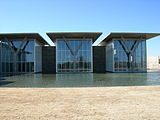
Modern Art Museum of Fort Worth, showing the reflecting pool

-

Himeji City Museum of Literature

-
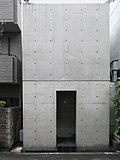
Azuma House
-

View from Akita Museum of Art


-

Mount Rokko Chapel

-
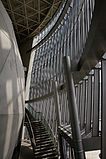
Suntory Museum, showing the staircase and the inside structure

-

City Museum of Literature

-

Chikatsu Asuka museum
-
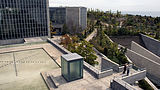
Awaji Yumebutai in Awaji, Hyogo prefecture, Japan


-
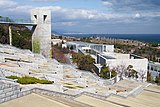
Awaji Yumebutai, showing the view and the stairs down

-

Suntory Museum, the parallelepiped intersecting the spherical body of the IMAX theatre, shown in profile

-

Rokko Housing I and II, Kobe

-
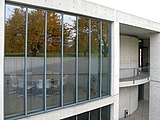
Vitra Conference Pavillon
-

Langen Foundation at night


Awards

Kaminoge Station in Tokyo

The interior of the Omotesando Hills shopping complex in Tokyo

This section of a biography of a living person needs additional citations for verification. (June 2013) (Learn how and when to remove this template message)
AwardOrganization/locationCountryDateAnnual Prize (Row House, Sumiyoshi)Architectural Institute of JapanJapan1979Cultural Design Prize (Rokko Housing One and Two)TokyoJapan1983Alvar Aalto MedalFinnish Association of ArchitectsFinland1985Gold Medal of ArchitectureFrench Academy of ArchitectureFrance1989Carlsberg Architectural Prize (International)New Carlsberg Foundation, CopenhagenDenmark1992Japan Art Academy PrizeJapan Art AcademyJapan1993Asahi PrizeTokyoJapan1994Pritzker Architecture Prize (International)ChicagoUnited States1995Chevalier de l'Ordre des Arts et des LettresParisFrance1995Praemium Imperiale First “FRATE SOLE” Award in ArchitectureJapan Art AssociationJapan1996Officier de l'Ordre des Arts et des LettresParisFrance1997Royal Gold MedalRIBAGreat Britain1997AIA Gold MedalAmerican Institute of ArchitectsUnited States2002Kyoto PrizeInamori FoundationJapan2002Person of Cultural MeritMinistry of Education, Culture, Sports, Science and TechnologyJapan2003UIA Gold MedalInternational Union of ArchitectsFrance2005Order of CultureThe EmperorJapan2010Neutra Medal for Professional ExcellenceCal Poly Pomona College of Environmental DesignUnited States2012[36]Grand Officer of the Order of the Star of Italy[37]RomeItaly2013